

Three major Korean battery companies—LG Energy Solution, Samsung SDI, and SK On—are set to compete fiercely once again in the government's third central contract market for energy storage systems (ESS). Each company is refining its lineup by addressing weaknesses exposed during the first and second bidding rounds.
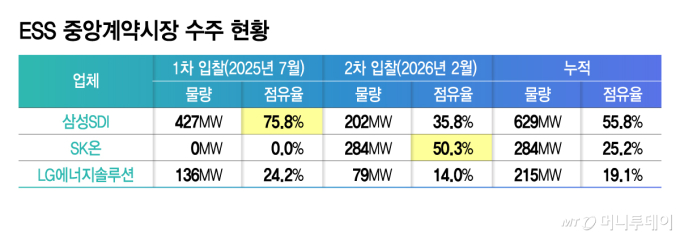
In previous competitions, outcomes varied depending on each company's products and supply chain strategies. In the first bid held last July, Samsung SDI essentially dominated the field. Out of a total 563 MW (megawatts), Samsung SDI secured 427 MW, capturing a 75.8% market share. LG Energy Solution obtained the remaining 24.2% (136 MW), while SK On failed to secure any portion.
In the second bid held in February this year, the landscape flipped. SK On secured 284 MW out of a total 565 MW, rising to become the largest supplier with a 50.3% market share. Samsung SDI captured 35.8% (202 MW), and LG Energy Solution obtained 14.0% (79 MW).
According to industry sources, the three battery companies are focusing on strengthening price competitiveness, domestic production and supply chains, and fire safety ahead of the third bid, which is expected to begin soon. They believe that how well each company addresses its weaknesses in the remaining time will determine the outcome of future orders.
Each company's strategy is becoming clearer. LG Energy Solution is concentrating on bolstering domestic production and supply chains. It is considering a plan to initially produce 1 GWh (gigawatt-hour) of ESS-grade lithium iron phosphate (LFP) batteries at its Cheongju Ochang Energy Plant in North Chungcheong Province starting in 2027, with plans to gradually expand production capacity according to demand. The company is also strengthening domestic supply chains for key secondary battery materials, notably by establishing a cooperative framework with L&F for LFP cathode materials used in ESS.
Samsung SDI is focusing on enhancing price competitiveness while maintaining its strengths in domestic production and supply chains. In the first and second bids, it highlighted prismatic batteries based on nickel-cobalt-aluminum (NCA) produced at its Ulsan plant, emphasizing advantages such as higher energy density compared to LFP. However, with competitors offering relatively lower-priced LFP-based product lines, Samsung SDI is reportedly considering shifting toward LFP batteries depending on the specific conditions of future bid announcements.
SK On is expected to further strengthen its LFP battery and domestic supply chain strategies that proved effective in the second bid. It currently has a total production capacity of 7 GWh across two plants in Seosan, South Chungcheong Province (Plant 1: 1 GWh; Plant 2: 6 GWh). By early next year, it plans to convert half of Plant 2—3 GWh—to an ESS-grade LFP production line targeting Yangsan. Additionally, the company is considering expanding its ESS-grade LFP production capacity in Seosan up to a maximum of 6 GWh.
An industry official stated, "If the third bid exceeds 1 GW, it would translate to a battery order battle equivalent to 6–7 GWh through simple calculation. Even securing just 30% of the volume would amount to 2 GWh, making it an opportunity that battery companies cannot afford to miss."
The expansion of the ESS market is not a trend unique to Korea. With the spread of AI (artificial intelligence) data centers driving a surge in power demand and increasing grid instability, ESS linked with renewable energy has emerged as a key alternative solution.
The region where the ESS market is growing fastest is undoubtedly the United States. As industries related to AI, including data centers, continue to expand, power demand is skyrocketing. Consequently, ESS connected with renewable energy sources such as solar and wind power is becoming a core pillar of power infrastructure. This context aligns with Wood Mackenzie's forecast that the U.S. ESS market will grow to approximately four times its current size by 2031.
Domestic battery companies are also responding swiftly. In a situation where slowing demand for EV batteries is straining utilization rates and profitability, ESS is helping offset declining revenues. Indeed, as of the second quarter this year, ESS accounted for 28% of LG Energy Solution's revenue and 20% of Samsung SDI's, marking significant growth.
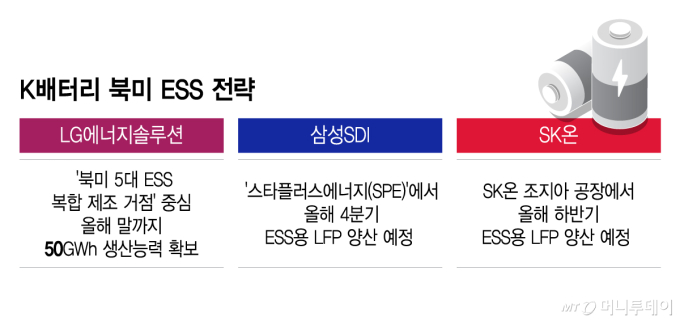
Investment in ESS by Korean battery companies, centered on North America, is accelerating. LG Energy Solution plans to establish five major ESS manufacturing hubs in North America—Holland, Michigan; L-H Battery Company, Ohio; Ultium Cells, Tennessee; Lansing, Michigan; and NextStar Energy, Ontario—and secure production capacity exceeding 50 GWh by the end of this year. All facilities have already begun operations targeting Yangsan. The company aims to ensure profitability for its ESS business itself, excluding the Advanced Manufacturing Production Credit (AMPC) under the U.S. Inflation Reduction Act (IRA), starting from year-end.
Samsung SDI is also converting existing production facilities for ESS use. It will convert part of its electric vehicle production line at Starplus Energy (SPE), a joint venture with global automaker Stellantis, in Indiana, to begin producing ESS-grade LFP batteries from the fourth quarter this year. The plant has been producing ESS batteries based on ternary (NCA) chemistry since the fourth quarter of last year.
SK On is focusing its efforts on penetrating the North American ESS market. It is converting part of its electric vehicle battery production line at its Georgia plant into an ESS-grade LFP (lithium iron phosphate) battery production line, with operations set to begin in the second half of this year targeting Yangsan. Additionally, it has secured sole operating rights for Blue Oval SK (now SK On Tennessee), a joint venture previously operated with Ford. Industry observers believe this facility can also serve as a key production hub to support future expansion of its ESS business.

 in INDUSTRY

