

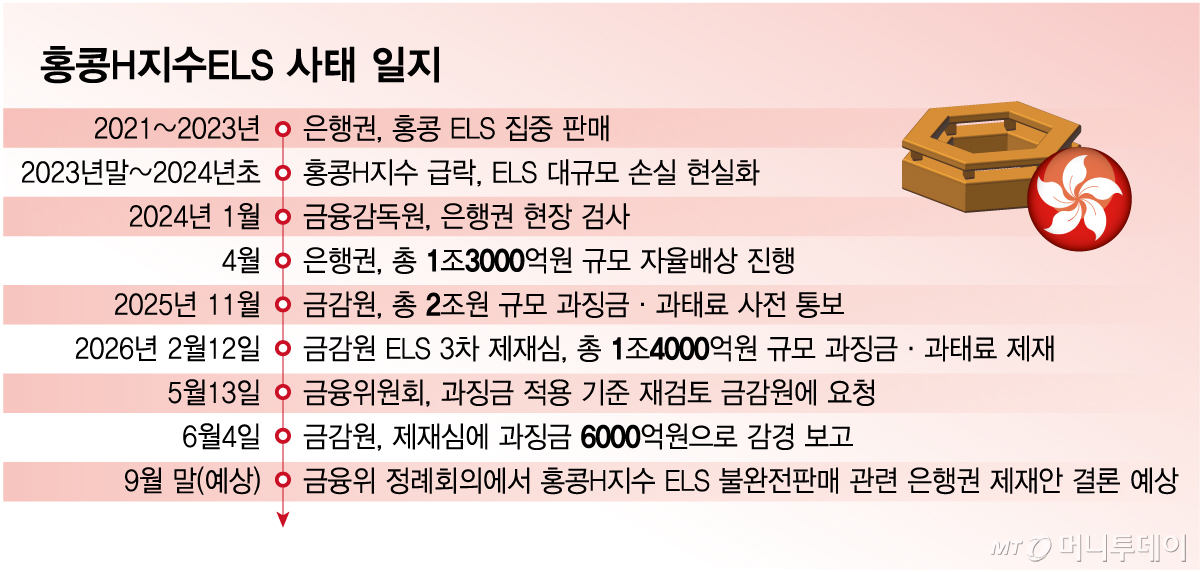
In the legal dispute over the incomplete sale of Hong Kong H-Index equity-linked securities (ELS), NH NongHyup Bank secured a victory in both the first and second instances against investors. With courts consistently ruling in favor of banks, attention is focused on whether the bank sector’s fine, already reduced to approximately 600 billion won, will be further mitigated during deliberations by the Financial Services Commission.
According to legal and financial industry sources on the 7th, the Second Civil Division of Changwon District Court (Presiding Judge Kim Ju-mi) dismissed the appeal filed by investor A, who had sued NongHyup Bank for damages over Hong Kong H-Index ELS products, in a second-instance trial held last month on the 13th. This marks another victory for the bank following the first-instance ruling on October 30 of last year.
The fact that the bank won not only in the first instance but also in the second could become a variable for the Financial Services Commission, which is reviewing the level of sanctions against Hong Kong ELS. While civil liability for damages and administrative penalties are separate matters, there is significant overlap in the underlying factual circumstances—such as whether the duty to explain was fulfilled and the investor’s understanding of the product—as well as legal application. It appears that within the Financial Services Commission itself, some view it as difficult to completely separate the second-instance ruling from the sanction decision.
The Financial Supervisory Service submitted a draft sanction plan imposing approximately 1.4 trillion won in fines on banks to the Financial Services Commission last February. After the Commission requested supplementary information on factual circumstances and applicable laws and legal principles, the Financial Supervisory Service adjusted factors such as the motive for violations and reduced the fine to about 600 billion won in June. The Commission plans to finalize the sanction level by considering additional factors, including the grace period during the early implementation of the Financial Investment Services and Capital Markets Act, voluntary compensation by banks, and post-incident remedial efforts.
Investor A invested a total of 123 million won in two specific monetary trust ELS products containing the Hong Kong H-Index at NongHyup Bank in February and March 2021. The first product was based on KOSPI 200, S&P 500, and the Hong Kong H-Index; the second used S&P 500, Hong Kong H-Index, and Euro Stoxx 50 as underlying assets. The structure stipulated that if any of the underlying assets fell below 65% of their initial reference price at maturity, investors would lose between 35% and 100% of their principal.
As the Hong Kong H-Index plummeted, Investor A lost approximately 66.4 million won out of the 123rd million won invested. He filed a lawsuit claiming that NongHyup Bank failed to properly explain the product details and risks and did not directly prepare or provide the relevant subscription documents. In the second-instance trial, he argued that the bank’s liability ratio should be set at 70% by applying the criteria for voluntary compensation to his case.
The first-instance court ruled that it was difficult to conclude that NongHyup Bank sufficiently explained the product details and investment risks to Investor A. However, the court noted that Investor A had worked in financial institutions for over 20 years, held relevant financial qualifications, and had repeatedly invested in similar ELS products, indicating he fully understood the product structure and associated risks.
NongHyup Bank was not the only bank to receive a victory ruling. The Twenty-Second Civil Division of Seoul Central District Court dismissed a claim for damages worth over 1.4 trillion won filed by a Hong Kong ELS investor against KB Kookmin Bank in January. Several other trials are still ongoing. In the Seventeenth Civil Division of Seoul Central District Court, lawsuits involving approximately 3.6 billion won filed by 15 investors against Kookmin, Shinhan, Hana, and NongHyup banks, as well as another case worth about 1.9 billion won filed by 19 investors against Kookmin, Shinhan, and NongHyup banks, are currently in progress.
Beyond civil rulings, the Financial Services Commission is also examining the balance between voluntary compensation and sanctions. Key considerations include how much of the approximately 1.4 trillion won already voluntarily compensated by the banking sector should be reflected in the fine, and what level of combination should be applied between monetary penalties worth tens of billions of won and institutional investor sanctions. If these factors are comprehensively reflected during the regular meeting expected as early as the end of this month, there is a possibility that the fine could be lowered further below 600 billion won.

 in FINANCE
