

More diverse corporate information about the startups mentioned in this article can be viewed at Unicorn Factory's Big Data Platform 'Data Lab'.
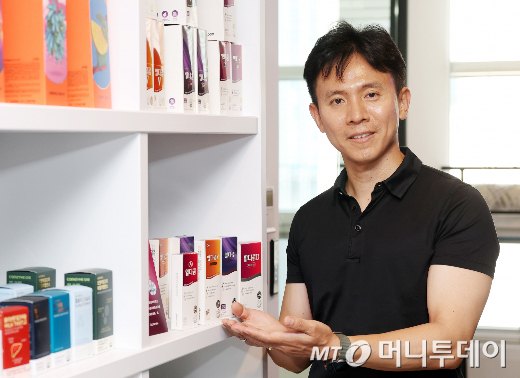
The latest buzzword in the global wellness market is "healthy pleasure." Consumer psychology seeking to enjoy both fun and health simultaneously is emerging across various markets. At the center of this trend are South Korea's hangover relief products. The "healthy pleasure" pattern, which aims to care for both the drinking session and the body condition the next day, first appeared in the Korean market. This experience is now serving as a stepping stone for overseas expansion.
APK, established in January last year, has taken note of this trend. Kwon Young-min, CEO of APK, stated, "In the past, hangover relief products were sought only after excessive drinking, but they have now become companions to everyday drinking." He added, "Even for those who drink moderately, these products are becoming essential items for those who do not want their next-day condition to be affected."
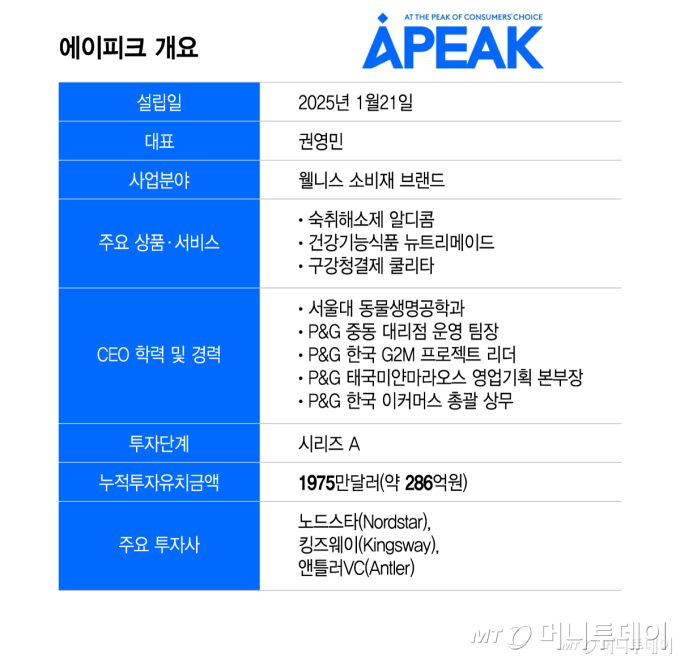
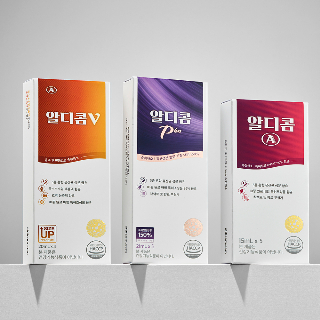
The ELee Pi-keu-ui (CEO) product is the 'Aldicom' LINE, which accounted for more than 90% of last year's sales. Established strong players such as Condishon, Sangkwae-hwan, and Yeomyeong are asserting their presence in the established hangover relief market, securing shelf space at major convenience stores, Olive Young, duty-free shops, and pharmacies.
Kwon Yeong-min (CEO) stated, "Starting with Aldicom as a single product, we later launched Aldicom Plus and Aldicom V, and recently expanded our LINE to include energy gel." He added, "While existing hangover relief products focused on aspects like 'various flavors' or forms such as 'jelly or pills,' Aldicom concentrated solely on the 'hangover relief power' itself, generously incorporating patented hangover-relief ingredients at high concentrations."
Product competitiveness, packaging design that captures consumers' attention, marketing that drives purchases, and swift, strategic entry into key distribution channels all came together perfectly. This is the result of Kwon (CEO) applying know-how accumulated over 15 years at P&G (Procter & Gamble), where they experienced a wide range of brands, distribution channels, and countries.
Thanks to the growth of Aldicom, Apex turned profitable in terms of EBITDA (earnings before interest, taxes, depreciation, and amortization) in the fourth quarter of last year. In the first half of this year, both operating profit and net income have continued on a profitable trend. Already in the first half of this year alone, sales have surpassed last year's total of 8 billion won.
Aldicom has begun targeting Olive Young first, rather than convenience stores, which have long been the primary battleground for hangover relief products. This strategy is based on the assessment that hangover remedies, once sought only after heavy drinking, have now become essential items even for light drinking, driven by a trend led by women in their 20s and 30s.
Kwon (CEO) remarked, "Most consumers who want to maintain their physical condition the next day even after having one or two beers or highballs are young women." They added, "With dozens of brands competing fiercely and convenience stores having the highest entry costs, we decided to target Olive Young, where women actually shop."
The results came in numbers. Just two months after its exclusive products were listed, it became the number one real-time sales product in the health food category. Within five months of listing the exclusive products, the number of stores increased tenfold. Assuming that customers would stock up on hangover relief products as essential items for drinking, ON-LINE also focused its efforts, bolstering its own online mall, Coupang, and Naver Store. The customer loyalty that grew through word-of-mouth later became a stepping stone for Aldicom to easily enter more than 20,000 convenience stores.
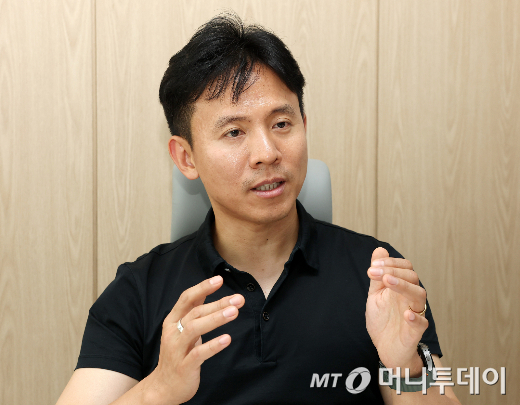
APK focused on another key stage: duty-free shops. From the early days, it secured locations for Aldicom in the downtown and airport duty-free stores of the Big 4 (Lotte, Shilla, Shinsegae, Hyundai), raising awareness among foreign tourists and domestic business and leisure travelers. Building on this foundation, APK is accelerating its expansion into overseas markets such as Japan and the United States.
Kwon (CEO) stated, "As of 2022, the Japanese hangover relief market was valued at 570 billion won, approximately twice the size of Korea's market and 1.8 times larger than Korea's. It is projected to grow to 1.6 trillion won by 2030." He added, "While established players like Ukonnochi KARA and Heparije still dominate the market, their brand image remains fixed around middle-aged men and after-work drinking culture, leaving a clear space for sensory K-lifestyle care products targeting women in their 20s and 30s to enter." He further noted that Aldicom ranked third in real-time sales within the food category on the direct-to-consumer platform Quten Japan at the end of last year.
The United States, where a hangover relief product category has not yet been established, is also a target market. Following entry into Amazon, the company is targeting Asian American consumers and breaking through platforms like Weee and Yamibuy, which are frequently visited by this demographic.
APK has established Aldicom as its undisputed cash cow and is planning to increase investment in health supplement Nutrimade and oral rinse Coolita. The company aims to achieve annual sales of 100 billion won by 2030 through efforts to penetrate both domestic and international markets.
Kwon (CEO) emphasized that as the global wellness market continues to achieve high single-digit annual growth, the trust and preference of global consumers demonstrated in K-content and K-beauty are now spreading to K-wellness consumer goods. He added, "Given that this is the right time for K-wellness to enter the global market, Apic will actively target the market based on its superior product and marketing capabilities."
[Money Today startup media platform 'Unicorn Factory']

 in FUTURE


