

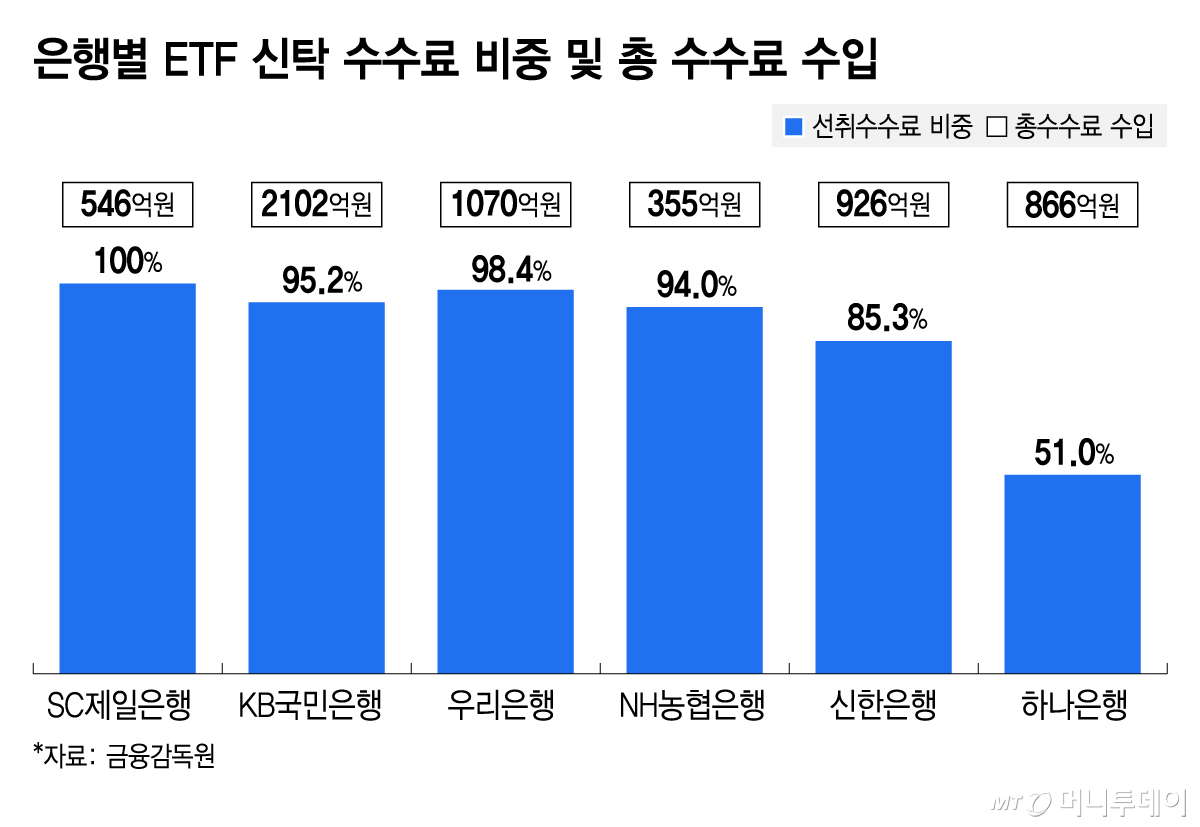
Critics point out that the decisive reason why over 90% of bank ETF (exchange-traded fund) trust subscribers chose front-load fees, which are disadvantageous for short-term investing, lies in the product explanation script. Most banks either explained the fee structure loosely or focused primarily on front-load fees in the scripts they read while selling products. In contrast, Hana Bank, which sold a mixed front-and-back-load fee product, saw its front-load share at just 51%, half that of other banks.
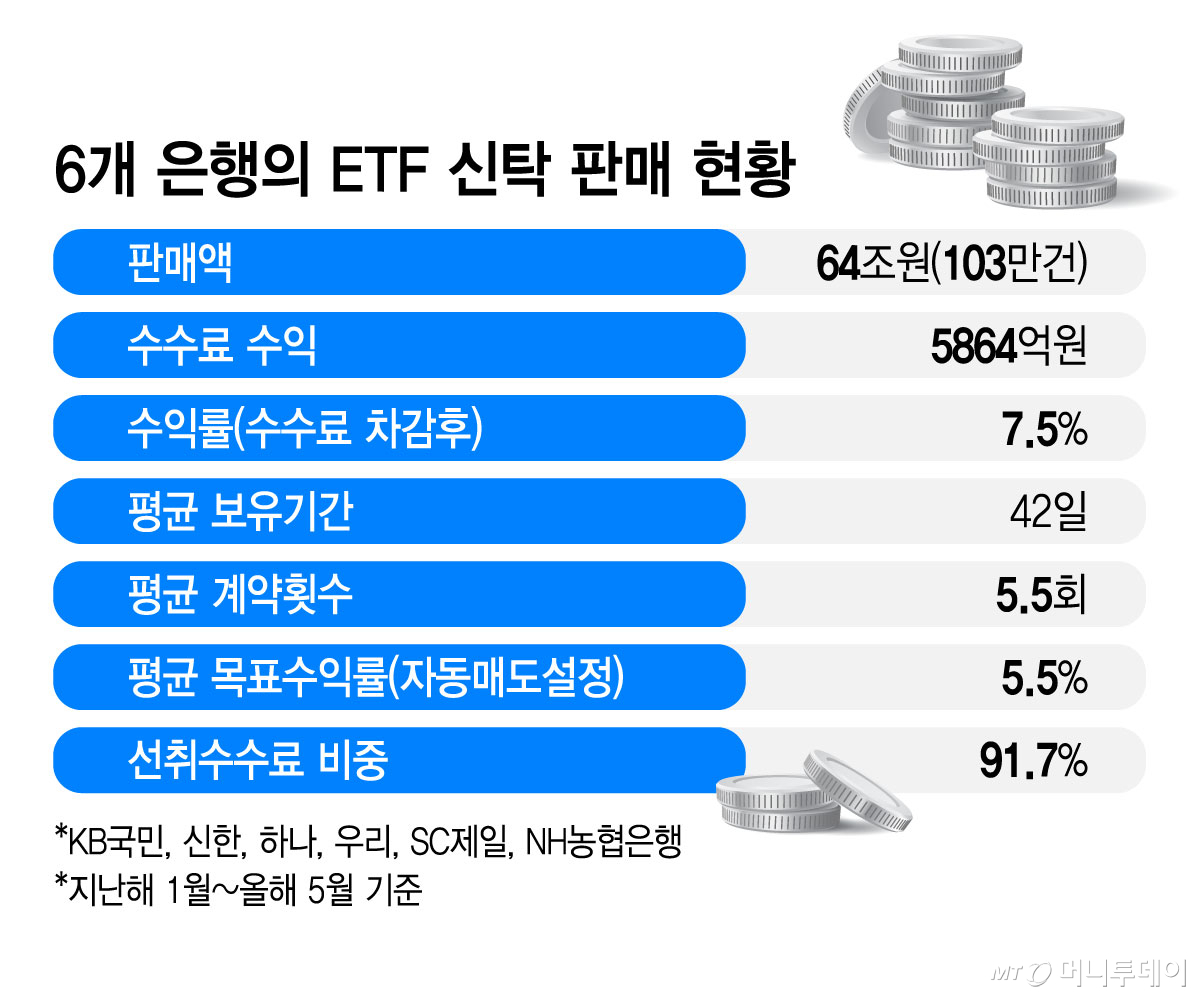
According to financial industry sources on the 10th, from January last year through May this year—a period of sharp stock market gains—6 major banks sold 64 trillion won worth of ETF trusts across 1.03 million transactions. Although the average investment period was only 42 days due to early achievement of target returns, 9 out of 10 subscribers (91.7%) chose front-load fees, which are disadvantageous for short-term investing. For short-term investors, back-load fees, which apply fees differently based on the investment period, are more advantageous than front-load fees, which deduct a 1% fee upfront at the time of subscription.
The proportion of front-load sales varied significantly by bank. Standard Chartered Bank Korea sold 100% front-load products, and Woori Bank sold 98.4%, making front-load fees virtually the norm. KB Kookmin Bank and NH NongHyup Bank also recorded 95.2% and 94%, respectively. However, Hana Bank stood out with just 51%. Standard Chartered Bank Korea did not sell any back-load products at all, leaving subscribers with no choice. While product brochures containing overall information on the products showed little difference across banks, subscribers signed a section stating they "understood" the contents of the brochure. In contrast, scripts varied in content depending on each bank's sales strategy.
Hana Bank informed subscribers about fees including the mixed front-and-back-load type. This bank charges fees in three ways: front-load, mixed, and back-load. For the mixed type, a 0.5% front-load fee and a 0.5% back-load fee are deducted. At the time of subscription, a 0.5% fee is charged upfront, followed by an annual charge of 0.5% based on the investment period. For example, if the investment period is one month, a fee equivalent to 1/12th of 0.5% (0.041%) is applied.
Since around 2023, Hana Bank has primarily sold installment purchase-type ETF trust products rather than lump-sum purchase types. For instance, if an investor puts in 100 million won, they first purchase 25 million won worth of the product and then add more purchases later when prices drop. This installment purchase structure is well-suited for a mixed fee type that combines front-load and back-load fees.
In contrast, other banks told subscribers in their scripts to "refer to the product brochure for detailed explanations" or primarily recommended front-load subscriptions. Some banks even added guidance stating, "Front-load fees are advantageous if the investment period exceeds one year." Ultimately, this shows that subscribers' fee choices depended on where each bank focused its explanation efforts.
There is no legal requirement for recording when selling ETFs. According to court precedents, if a subscriber signs the product brochure, the investor's responsibility takes precedence. Even if a bank explained primarily certain fees in its script, the fact that the product brochure holds legal priority could become a future point of contention. A financial industry official pointed out, "Merely fulfilling the duty of explanation in form does not provide substantive consumer protection." On the other hand, counterarguments have been raised stating, "Since investors signed the product brochure themselves, they should bear responsibility."
Critics also argue that the fee level itself must be examined for appropriateness. Is it appropriate to charge 1% of the investment amount? In the case of fund sales fees, the statutory maximum front-load fee rate is 1%. A banking industry official stated, "ETF trusts are not more complex or require more explanation than other products, so there is room for debate over whether a 1% fee is appropriate."
Commercial banks significantly expanded their trust fee proportion by about 20% compared to the previous year when setting KPI (branch performance evaluation scores) this year. They set a high target for trust fees anticipating a boom in the stock market. This led to intense sales competition among banks in the first half of the year, with particularly notable shifts such as Shinhan Bank falling to third place in fee income and Woori Bank rising to second place.

 in FINANCE

