

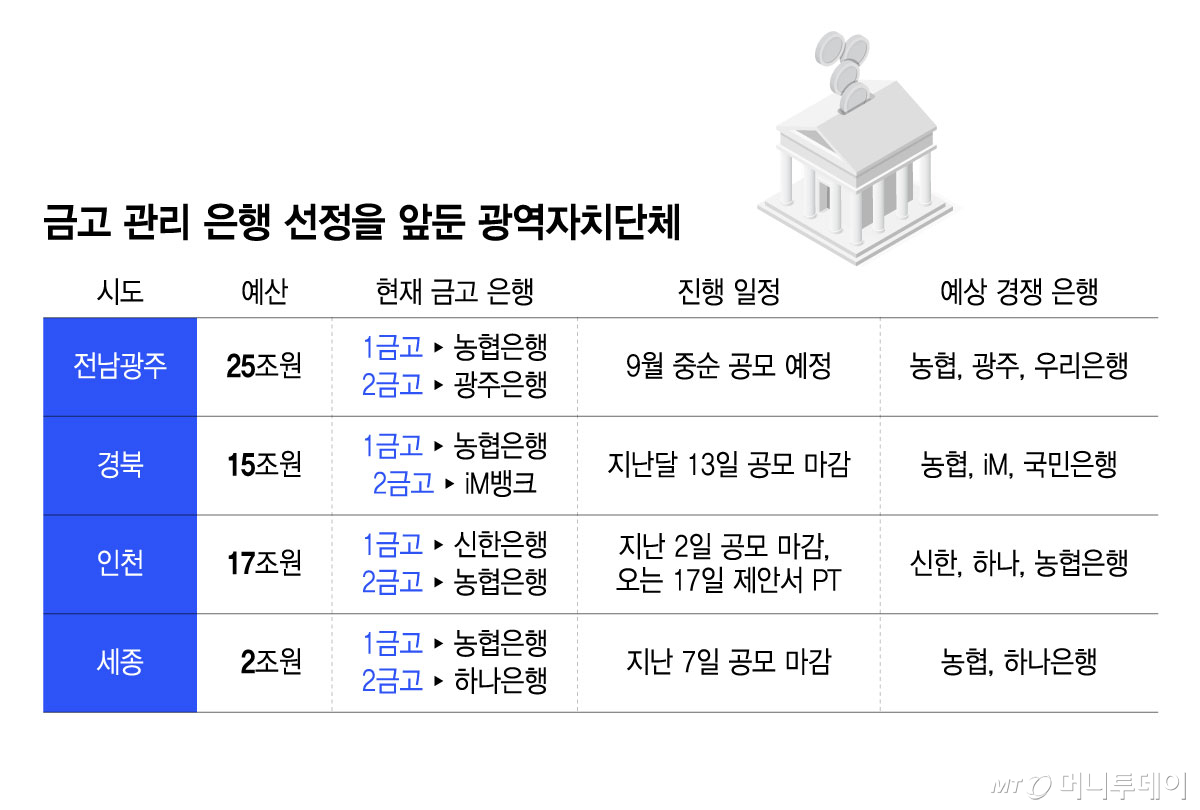
Competition among banks is heating up ahead of the selection of a 25 trillion won consolidated depository for Jeollanam-do Gwangju Metropolitan Special City. A rematch between NH NongHyup Bank, which currently holds the temporary first depository, and Gwangju Bank, which has guarded the former Gwangju City first depository for 57 years, is expected, while Woori Bank is also actively considering participation. In the Gyeongbuk Provincial depository, KB Kookmin Bank is challenging existing participants NH NongHyup Bank and iM Bank, signaling an expanding territorial competition among banks over local government depositories.
According to financial industry sources on the 13th, Jeollanam-do Gwangju Metropolitan Special City plans to issue a public notice as early as this week to select its next depository bank. Unlike the temporary depository selected last May and valid until the end of this year, the newly selected depository bank will manage the special city's finances for four years through 2030. The special city's fiscal scale this year amounts to approximately 25 trillion won.
There is a high possibility that NH NongHyup Bank, currently holding the temporary first depository, and Gwangju Bank, which has guarded the former Gwangju City first depository for 57 years, will face off again. As the depository selection approaches, controversies over evaluation criteria are also intensifying.
In particular, Park Jin-han, a Democratic Party of Korea lawmaker representing Jeollanam-do Gwangju Metropolitan Special City, recently proposed an amendment to local ordinances requiring that when evaluating financial institutions' regional sales networks, assessments should consider the distribution across cities, counties, and districts rather than simply counting the number of branches. Observers suggest this could create relatively favorable criteria for NH NongHyup Bank, which has a broad sales network extending throughout Jeollanam-do's cities and counties, compared to Gwangju Bank, whose outlets are concentrated in downtown Gwangju.
The Metropolitan Special City Council reviewed the ordinance at its regular meeting on the 8th. Since this is the first time the council has been formally constituted after consolidation, there is a possibility that revised criteria could be reflected in this depository selection evaluation if related administrative procedures are expedited.
Controversies over evaluation criteria are not new for this issue. During the process of selecting the temporary depository, fairness concerns arose when NH NongHyup Bank's sales network was evaluated including branch offices of regional agricultural cooperatives, which are separate legal entities. Conversely, when evaluating financial institutions' creditworthiness, only NH NongHyup Bank's credit rating was reflected without including lower-rated regional agricultural cooperatives, prompting Gwangju Bank to raise equity concerns.
With other major banks also showing signs of joining the competition, the competitive landscape is becoming increasingly complex. In particular, Woori Bank is actively considering participation in the public solicitation. Hana Bank, KB Kookmin Bank, and IBK Industrial Bank of Korea are also monitoring the solicitation details and evaluation criteria while considering whether to participate.
The offensive by commercial banks toward local depositories has already materialized in other regions. The approximately 15 trillion won Gyeongbuk Provincial depository is a prime example. Following the submission of applications for the next depository bank by Gyeongbuk Province on the 12th–13 last month, not only NH NongHyup Bank (the existing first depository) and iM Bank (the second depository), but also KB Kookmin Bank submitted proposals. In response, iM Bank has publicly demanded that KB Kookmin Bank withdraw its proposal, citing "mutual prosperity."
However, not all commercial banks are actively expanding into local depositories. Shinhan Bank faced strong backlash from the local community after taking over the primary banking business for Chosun University, a private institution in Gwangju Ji Yeok (CEO), from Gwangju Bank in 2023. Subsequently, Shinhan Bank signed a "Growth Together" agreement with Gwangju Bank and has refrained from entering the local depository market.
A banking industry official stated, "As acquiring new customers has become the top priority for banks, it is inevitable that major banks are showing interest in local depositories." The official added, "For regional banks as well, with their deposit base weakening, the importance of securing depositories has grown even greater."

 in FINANCE
