

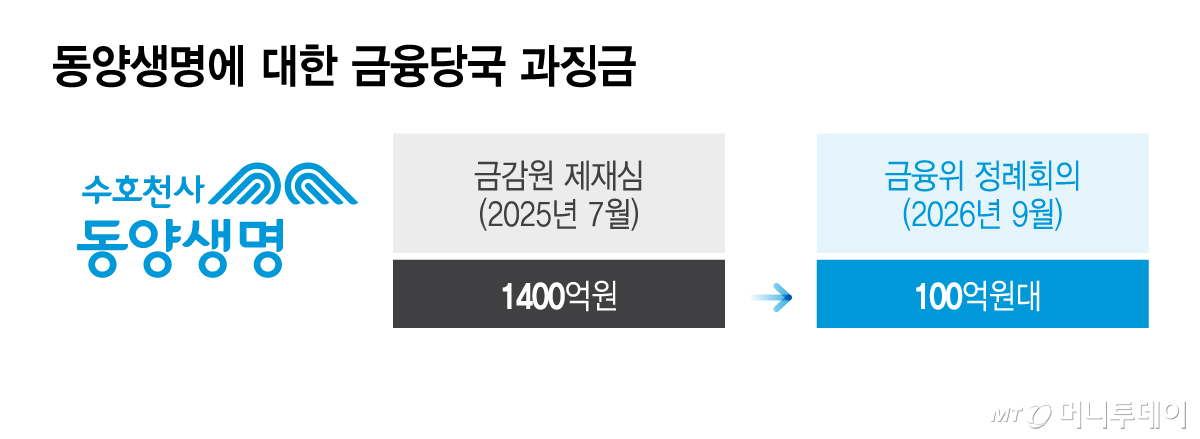
The Financial Services Commission is reported to have significantly reduced the penalty against Dongyang Life for violating the Credit Information Act (hereinafter referred to as the New Credit Information Act) from an initial 140 billion won to around 10 billion won. This move allows Dongyang Life to avoid a penalty exceeding its annual net profit last year. The financial authorities are also considering improvements to the excessive penalty system under the New Credit Information Act.
According to the financial sector on the 8th, the Financial Services Commission is scheduled to deliberate on the sanction against Dongyang Life for violating the New Credit Information Act at its regular meeting on the 9th. Prior to the regular meeting, the subcommittee reviewing agenda items decided to significantly reduce the penalty against Dongyang Life to around 10 billion won.
The Financial Supervisory Service imposed a penalty of 140 billion won over a year ago, which exceeds Dongyang Life's net profit of 120 billion won last year. This amount reaches about 10% of Woori Financial Group's acquisition price for Dongyang Life, leading to criticism that Woori Financial may have effectively lost the acquisition deposit. The Financial Supervisory Service discovered during a 2022 inspection of Dongyang Life that personal credit information was transferred to its subsidiary GA (insurance agency) without customer consent and held a sanction deliberation committee last year, determining it violated the New Credit Information Act.
The Financial Services Commission received the results of the Financial Supervisory Service's sanction deliberation and proceeded with discussions in the agenda subcommittee after going through a separate legal interpretation deliberation committee. It is reported that during this process, personal credit information transferred to the GA subsidiary was deemed to fall under business entrustment, differing from situations where personal information is illegally transferred to third parties. This is the decisive reason why the penalty of 140 billion won imposed by the Financial Supervisory Service was significantly reduced to around 10 billion won.
Members of the Financial Supervisory Service's sanction deliberation committee also considered that a penalty of 140 billion won was excessive from the outset, taking into account the degree of Dongyang Life's violation, its motives, and the extent of harm suffered by individuals. However, according to the Financial Supervisory Service's inspection and sanction regulations, the maximum reduction rate it can apply is only 50%. This is because the basic penalty must be selected from 50%, 75%, or 100% of the base amount depending on the severity of the violation. While separate reduction standards in individual laws may apply, the New Credit Information Act does not provide for differentiated rates. Under the New Credit Information Act, the basic penalty is set at "3% of sales." Even applying the maximum reduction rate of 50% allowed by the Financial Supervisory Service results in a structure where a 140 billion won penalty is imposed.
The financial sector criticizes this penalty standard under the New Credit Information Act as excessive, labeling it a representative case of "punitive administration." In fact, laws such as the Financial Consumer Protection Act (FCPA) and the Personal Information Protection Act (PIPA) allow for differentiated reduction rates ranging from 1% to 100%, enabling penalties to be adjusted based on violation motives and the extent of harm.
The issue is that Shinhan Life and Lina Life also transferred personal information without customer consent, similar to Dongyang Life, and were subsequently detected by the Financial Supervisory Service. These insurance companies are also facing sanctions from the Financial Supervisory Service. In the case of Shinhan Life, applying the Financial Supervisory Service's maximum reduction rate of 50% based on last year's sales could result in a penalty exceeding 200 billion won. Currently, under existing regulations, the Financial Supervisory Service is forced to impose record-breaking penalties similar to those against Dongyang Life, while the Financial Services Commission must reconsider significant reductions or other measures.
Consequently, there are calls for more granular penalty standards through amendments to the New Credit Information Act. It is reported that financial authorities are considering improving the penalty system under the New Credit Information Act, similar to the PIPA and FCPA. However, with a series of personal information leakage incidents occurring recently in society, concerns have also been raised that improvements to the penalty system could be perceived as "favoritism."

 in FINANCE
