

Cooperation among financial institutions, telecommunications companies, and the government is key to preventing voice phishing victims. This is because voice phishing is a crime that spans from deception via telecommunications networks to fund misappropriation in bank accounts and tracking of criminals.
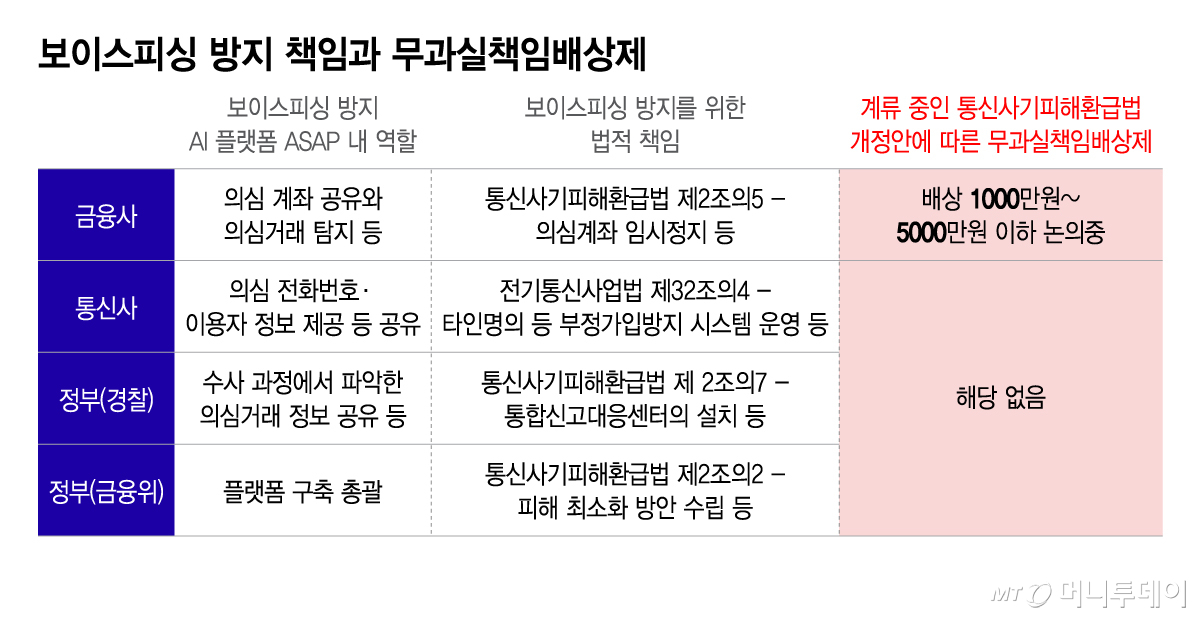
Accordingly, last year the government established an information-sharing platform among financial institutions, telecommunications companies, and law enforcement authorities. However, when damage occurs, only financial firms bear compensation liability. This is the situation that would arise if the no-fault liability system for voice phishing currently being promoted by the government were implemented.
According to the financial sector on the 15th, financial authorities are pushing for the National Assembly's passage of a revision to the Act on Refund of Victims of Telecommunications Fraud, which stipulates the no-fault compensation liability of financial institutions for voice phishing damages.
The revision would require financial firms to compensate up to 50 million won for voice phishing victims even if they were not at fault. The Political Affairs Committee is expected to begin deliberations on the bill after this year's national audit.
The no-fault compensation liability system is controversial because it concentrates responsibility solely on financial institutions, differing from the government's previous policy direction aimed at eradicating voice phishing. Until now, the government has emphasized joint responses among financial institutions, telecommunications companies, and law enforcement authorities.
This stance stems from the judgment that crimes begin via telecommunications networks, cause damage in financial accounts, and extend to money laundering and escape, making them difficult to stop by any single institutional investor alone.
The 'ASAP' artificial intelligence (AI) platform for sharing and analyzing voice phishing information, established by the Financial Services Commission (FSC) last October, is a prime example. ASAP is a platform where financial institutions, telecommunications companies, and law enforcement authorities share voice phishing information they have each secured and use AI to prevent crimes. F
inancial institutions, telecommunications companies, and law enforcement authorities utilize account payment suspensions, phone number blocking, investigations, and other measures based on information provided by other institutional investors and analysis data from ASAP.
Since its launch, ASAP has shared 463,000 suspicious reports through the end of July last year, achieving results in preemptively blocking voice phishing totaling 66.36 billion won. In addition, starting this August, the FSC is revising the Act on Refund of Victims of Telecommunications Fraud to encourage more proactive sharing of suspicious voice phishing information via ASAP, thereby emphasizing cooperation among financial institutions, telecommunications companies, and law enforcement authorities.
In contrast to the government's emphasis on voice phishing cooperation, concerns are being raised that introducing a no-fault compensation system placing burdens solely on financial firms could foster moral hazard among telecommunications companies and law enforcement authorities.
Financial institutions have already operated a voluntary compensation system for voice phishing since 2024, providing compensation measures when preventive efforts against voice phishing were insufficient. However, there has been no case where telecommunications companies compensated victims in connection with voice phishing.
Although the current Telecommunications Business Act does not stipulate liability for damages, it does prescribe various obligations for telecommunications companies to block voice phishing.
Article 32-4 of the Act requires telecommunications companies to verify subscriber identity using systems such as the fraudulent registration prevention system, thereby preventing the use of "podo" phones (prepaid mobile phones registered under false identities). Additionally, Article 84-2 of the same Act stipulates that telecommunications companies must block or correct calls from phone numbers displayed falsely and suspend communication services.
Nevertheless, according to the National Police Agency, 97,399 "podo" phones were identified in 2024, more than ten times the 8,923 identified in 2020. This highlights the need to expand regulations on telecommunications, which serve as a primary tool for voice phishing crimes.
The roles of the government and law enforcement authorities are also defined by law. Article 2-2 of the Act on Refund of Victims of Telecommunications Fraud stipulates that the Financial Services Commission (FSC) shall take response measures to prevent and minimize damage, such as collecting and disseminating information related to voice phishing and issuing forecasts and alerts.
The Integrated Reporting and Response Center for Telecommunications and Financial Fraud established within the National Police Agency is responsible, under Article 2-7 of the same Act, not only for receiving reports and tips but also for requesting payment suspensions on fraud-utilized accounts, requesting suspension of communication services for phone numbers used in crimes, and analyzing and disseminating related information.
A financial sector official stated, "Responsibilities and roles have been divided through ASAP, yet under the no-fault compensation liability system, only financial institutions bear the burden." The official added, "Rather than patching up the issue by amending the Act on Refund of Victims of Telecommunications Fraud, which falls under the FSC's jurisdiction, it is necessary to present a fundamental solution through a special law that includes telecommunications companies and the government."

 in FINANCE

