

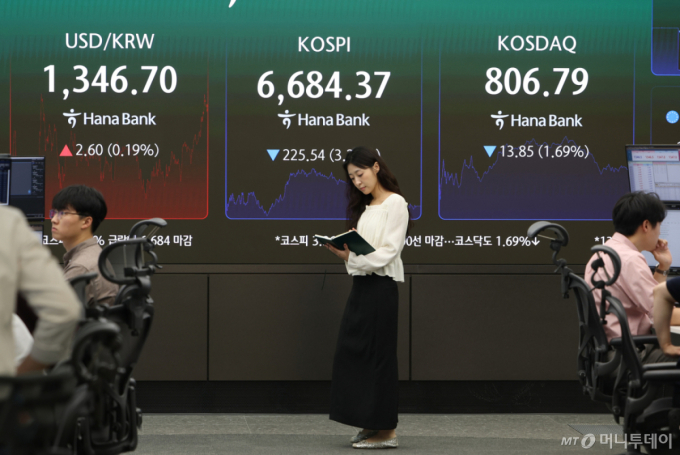
The won-dollar exchange rate, which fell by more than 200 won in just over two months, has reached an inflection point ahead of the Federal Reserve System (Fed) resuming tightening. With international oil prices and U.S. Treasury yields surging, there are expectations that if the Fed raises its base rate, the widening U.S.-Korea interest rate gap could partially reverse the steep won appreciation that had been underway. The simultaneous rise in exchange rates and inflation is also expected to increase pressure on the Bank of Korea for further rate hikes as it has already turned toward tightening.
On the 14th, the won-dollar exchange rate in Seoul's foreign exchange market closed weekly trading at 1,347.3 won, up 1.4 won from the previous trading day. This marks three consecutive days of gains.
Compared to July 1 when it stood at 1,551.2 won, the rate has fallen by more than 200 won in just over two months, but the downward trend has recently slowed. The exchange rate had dipped to the 1,330 won range earlier this month before rising back to the 1,340 won range amid a sharp surge in international oil prices and a rise in U.S. Treasury yields.
One of the factors that had driven won appreciation was the narrowing of the U.S.-Korea interest rate gap. With concerns about U.S. tightening easing in July and August, the Bank of Korea repeatedly raised its base rate, narrowing the interest rate differential between the two countries. This coincided with dollar selling by export companies due to strong semiconductor exports and a strengthening yen, accelerating the decline in exchange rates.
However, if the Federal Reserve raises interest rates this week, the trend could change. If the Fed raises its base rate by 0.25 percentage points at its Federal Open Market Committee (FOMC) meeting on the 15th-16th (local time), the U.S.-Korea interest rate gap would widen again from a high of 0.75 percentage points to 1.00 percentage point.
What pushed the Fed toward raising rates was stronger-than-expected employment and inflation pressures. U.S. non-farm payrolls in August increased by 162,000, significantly exceeding market forecasts. Core consumer prices also rose 0.3% from the previous month, surpassing the expected 0.2%. With international oil prices exceeding $100 per barrel, concerns about a resurgence in inflation have grown.
As a result, the market is treating a September rate hike as a foregone conclusion. However, since the market has already priced in much of the September increase, assessments suggest that the direction of exchange rates depends more on the future interest rate path than on the hike itself. If the hike is limited to one round, it could be seen as resolving uncertainty; but if the dot plot and Fed Chair Kevin Warsh strongly signal further tightening possibilities, pressure for a stronger dollar and weaker won could intensify.
Kim Ho-jeong, an economist at Yuanta Securities, presented a baseline path of 0.25 percentage point hikes in both September and December but evaluated that "the market's anticipated path of three to four consecutive rate hikes is excessive." This means that more than the September hike itself, the dot plot and the future tightening intensity projected by the Fed will become key variables for the market.
The Fed's resumption of tightening has also complicated the Bank of Korea's calculations. The Bank of Korea raised its base rate consecutively in July and August, bringing it to an annual 3.00%, before signaling a need to adjust the pace of hikes. In the dot plot showing the six-month outlook for the base rate, five dots were placed at the current level of 3.00%, ten at 3.25%, and six at 3.50%.
Bank of Korea Governor Shin Hyun-song said after last month's Monetary Policy Board meeting that regarding the median value of 3.25% in the dot plot, "it implies raising rates one more time out of four future meetings, so we expect a gradual pace of increases." This indicates an intention to observe the effects of two consecutive rate hikes before deciding on further increases.
If the U.S.-Korea interest rate gap widens again due to Fed rate hikes and the won-dollar exchange rate rebounds, pressure from rising import prices due to a weaker won could intensify. With high oil prices stemming from the Middle East also weighing in, domestic consumer price inflation rebounded to 3.1% last month.
The market is placing weight on the possibility that the Bank of Korea will implement one additional rate hike in November or next year's first quarter, raising the final rate to 3.25%. However, if Fed tightening lasts longer than expected and upward pressure on exchange rates and inflation grows, the magnitude of further rate hikes by the Bank of Korea is also expected to change.

 in FINANCE
