

Although the interest rate hike cycle has officially begun, banks are pursuing diverse Yeosu strategies. In the early stages of an interest rate hike, lending rates typically rise first, widening the deposit-lending margin; however, this time, variables such as easing total volume management and responding to stock market money movements have created a trend different from the past.
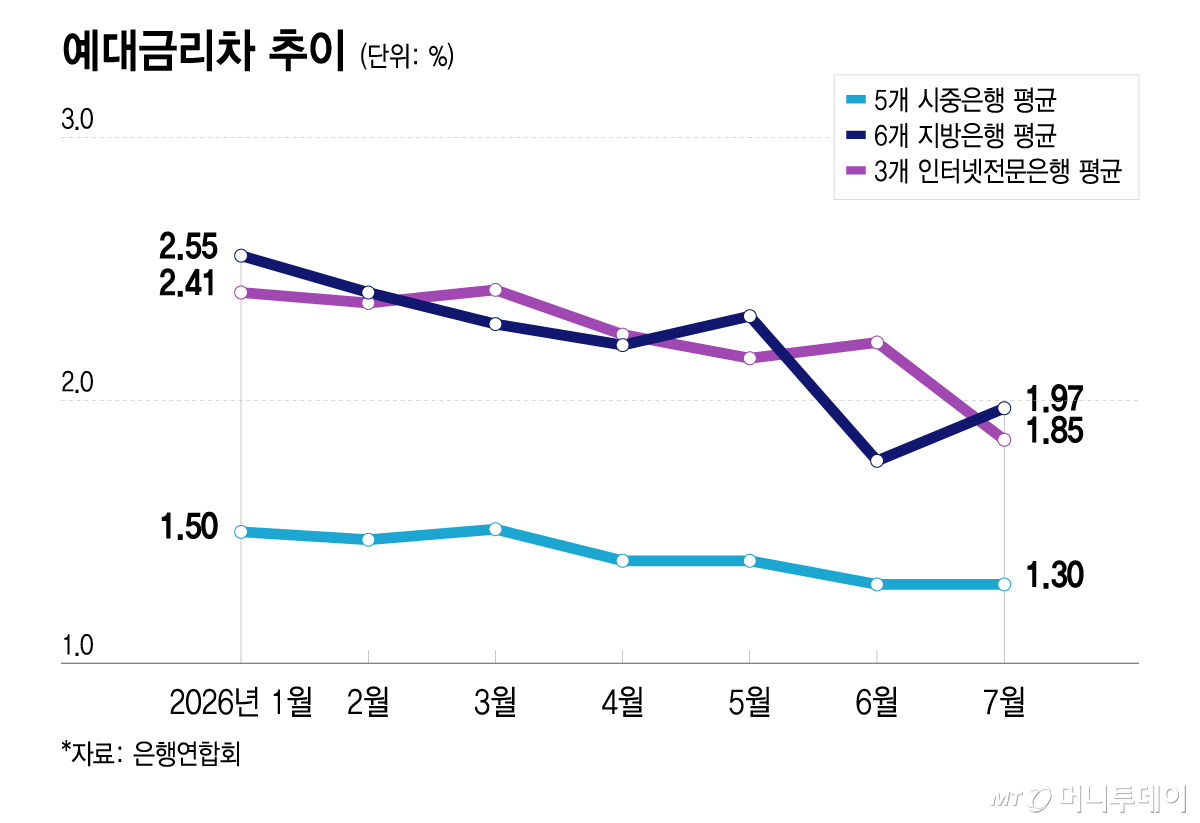
According to the Korea Banks Association on the 27th, based on July's new transaction amounts, the average household deposit-lending interest rate gap (excluding policy finance) for the five major commercial banks—KB Kookmin, Shinhan, Hana, Woori, and NH NongHyup—stood at 1.30%, unchanged from the previous month. During the same period, the average for six regional banks—BNK Busan, Gyeongnam, iM Bank, Gwangju, Jeonbuk, and Jeju—rose by 0.20 percentage points (P) to 1.97%. Meanwhile, the average for three internet-only banks—Kakao, KEB Hana (referred to as "K" in source), and Toss Bank—fell by 0.37 P to 1.85%.
Trends also vary by bank. Among 14 banks, six saw their deposit-lending interest rate gaps widen: NH NongHyup, Hana, Jeju, Jeonbuk Bank, iM Bank, and K Bank; the remaining eight experienced declines. The gap between banks has also widened significantly compared to before. The difference in deposit-lending margins between Jeonbuk Bank (highest) and iM Bank (lowest) expanded from 2.85 P in June to 3.73 P in July.
Typically, at the beginning of an interest rate hike cycle, lending rates linked to bank bonds rise first, widening the deposit-lending interest rate gap. Since mortgage loans—which account for a large portion of household loans handled by banks—are tied to bank bond rates, lending rates tend to increase first. Although the Bank of Korea raised its base rate in July, officially launching loan rate hikes, no unified trend is visible this time. Due to differing Yeosu strategies among banks, deposit-lending interest rate gaps vary widely. This trend is expected to become more pronounced when August data are released next month.
A key variable is the change in household loan total volume regulations. As financial authorities eased loan total volume restrictions to supply loans to genuine borrowers, some banks began adjusting the pace of their lending rate hikes. With the financial authorities raising the target for net growth in household loans from 1.5% to around 3%, banks now have greater lending capacity. Those with ample room lowered lending rates to compete in business operations.
IBK Industrial Bank of Korea will expand the application of special interest reduction clauses for housing-related loans starting from the 22nd. For what is commonly called fixed-rate mortgage loans (5-year and 10-year maturity types), an additional reduction of 0.5 P will be applied; for variable-rate mortgages, an additional reduction of 0.2 P will be granted. For rental deposit loans, regardless of whether they are fixed or variable rate, the reduction margin will be expanded by 0.3 P. Previously, NongHyup Bank had lowered the upper limits for in-person mortgage loans and credit loans by 0.45 P and 0.20 P, respectively.
Moreover, amid a stock market boom in the first half of the year, signs have emerged of banks proactively raising deposit rates to attract funds that moved into the stock market back into their institutions. NH NongHyup Bank raised the interest rate on its non-face-to-face deposit product "NH All-in-e Deposit" by 0.30 P and increased rates for face-to-face time deposit products by 0.2–0.3 P. Kookmin Bank first raised the rate on its "KB Star Time Deposit" by 0.6 P on the 14th, then added another 0.1 P increase just five business days later on the 21st. Previously, Woori Bank also raised the interest rate on its WON Plus deposit twice, each time by 0.30 P. Shinhan Bank and Hana Bank also increased the rates on their representative deposit products by 0.20 P and 0.10 P, respectively.
Banks that lower lending rates while raising deposit rates are expected to maintain or narrow their deposit-lending margins. A financial industry official stated, "While there was pressure from total volume management in July, banks have begun raising deposit rates from August onward, so this will be reflected sequentially in the indicators."
Conversely, among commercial banks, those with a high need for loan total volume management or those primarily handling medium-interest-rate loans—such as regional and internet banks—are expected to see their deposit-lending margins widen, as they find it difficult to immediately adjust lending rates.
A regional bank official said, "Institutions that handle many medium-interest-rate loans generally have higher base rates, making it difficult to easily adjust the deposit-lending margin." He added, "Even among regional banks, institutions with governance structures such as re-election of the chairman may face different situations since they must demonstrate performance indicators."

 in FINANCE
