

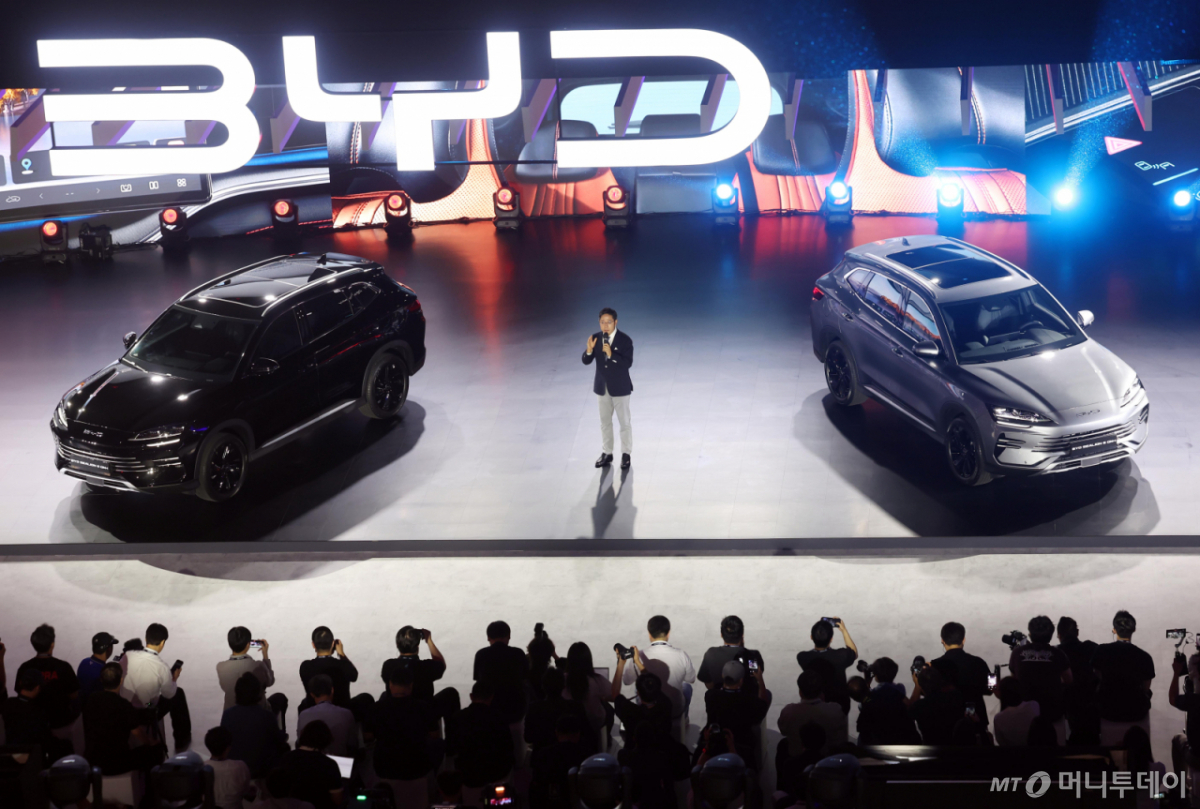
Chinese automakers are rapidly gaining prominence in the European market. Analysts warn that if local production ramps up fully, their market share could surge to a higher level as seen in Brazil, increasing pressure on domestic automakers.
According to industry sources and the European Automobile Manufacturers Association (ACEA) on the 28th, combined sales of three Chinese companies—BYD, Chery Automobile, and Shanghai Automotive Industry Corporation (SAIC)—in the European market (EU·EFTA·UK) reached 69,889 units in August, a 102.1% increase compared to the same month last year. During the same period, Hyundai Motor Group (Hyundai and Kia) sold 62,620 units, down 9.2%. Just one year ago, the three Chinese companies held a combined market share of 4.4%, half of Hyundai Motor Group's 8.7%. However, last month their share rose to 8.4%, surpassing Hyundai Motor Group's 7.5% by 0.9 percentage points.
On a monthly basis, Hyundai Motor Group led through April, but since May when the three Chinese companies' combined sales reached 93,119 units, overtaking Hyundai Motor Group's 86,444 units, they have maintained their lead. By brand, BYD's sales rose 127.9% to 26,007 units last month, narrowing the gap with Hyundai's brand (which fell 30% to 26,228 units) to just 221 units. Kia sold 36,392 units, up 15.5%. Year-to-date from January to August, Hyundai Motor Group led with 686,252 units, 13,992 more than the three Chinese companies' combined 672,260 units. However, during this period, while Hyundai Motor Group's sales declined by 1.9%, the three Chinese companies surged by 95.9%.
Chinese automakers are offsetting weak domestic demand with exports. According to Hana Securities, China's domestic car sales fell 21% year-on-year from January to August this year, while exports jumped 71% to 6.099 million units. Electric vehicles (new energy vehicles) accounted for 54% of export volumes.
Industry observers worry that the Brazilian case could be repeated in Europe. China's combined market share in Brazil rose from 6.9% in June 2024 to 17.8% from January to August this year. After BYD and Great Wall Motor (GWM) acquired Ford and Mercedes-Benz plants respectively to begin local production, their share jumped from 10% in the third quarter of last year to 23% last month. BYD alone increased its market share from 3.1% in 2024 to 7.8% from January to August this year. Although the Brazilian government raised import tariffs on finished electric vehicles to 35% in July, Chinese companies with established local production systems continue to expand.
Domestic automakers have already been pushed out of Brazil's electric vehicle market. According to KOTRA (Korea Trade-Investment Promotion Agency), South Korea's electric vehicle exports to Brazil amounted to $840,000 last year, a 78.1% decline from the previous year. In contrast, Chinese exports reached $851.48 million during the same period. BYD and Geely accounted for 82.3% of Brazil's electric vehicle sales in the first half of this year.
Local production by Chinese automakers is also ramping up in Europe. BYD delayed its Hungary plant, Yangsan, to the fourth quarter of this year. Chery has begun joint production with Nissan using a factory in Spain. Chinese EV maker Leapmotor, which formed a European sales joint venture with Stellantis, plans to produce at Stellantis' Spanish factory in the second half of this year, while SAIC aims to start production at a new Spanish plant in 2028. Currently, the EU applies tariffs and minimum price mechanisms to Chinese-made electric vehicles, but locally produced vehicles are exempt.
Song Seon-jae, a researcher at Hana Securities, stated, "As local production increases in Europe during 2027–2028, we must worry that the protective barriers will weaken and the jump seen in Brazil could be repeated." He added, "Intensified competition will first manifest in selling prices and incentives rather than sales volumes."

 in INDUSTRY
