

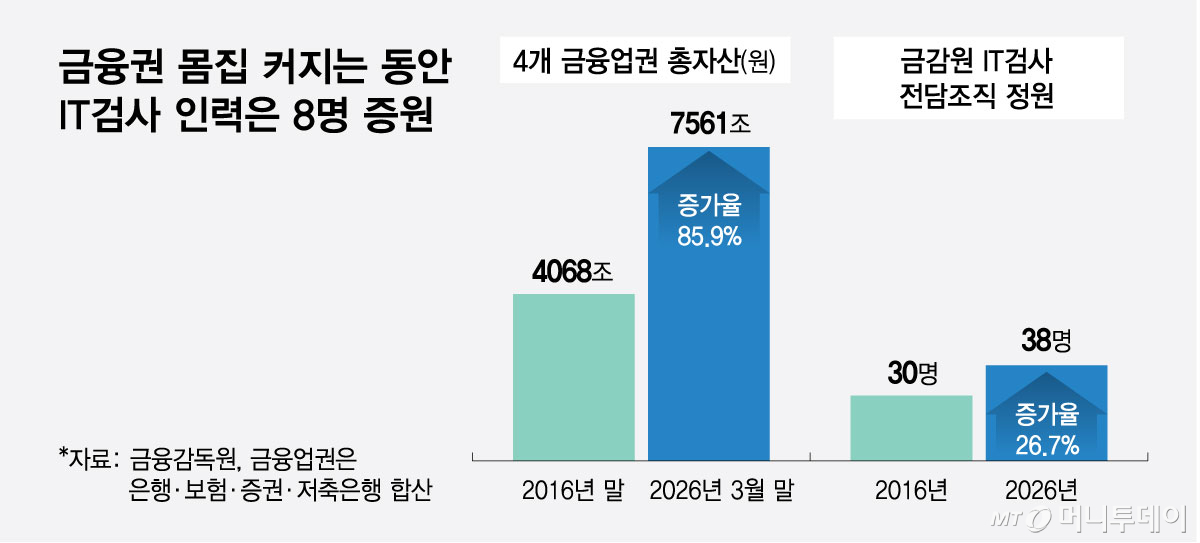
The number of dedicated IT inspection personnel at the Financial Supervisory Service has increased by only 8 over the past decade. While the total assets of the financial sector have grown nearly 1.9 times and non-face-to-face financial transactions and hacking threats have expanded, the pace of growth in FSS inspection staff responsible for checking the IT security status of financial companies has been slow. Voices are emerging that the supervisory authority's dedicated personnel must be further expanded to respond to security threats in the financial industry.
According to financial authorities on the 15th, the staffing quota for the Financial Supervisory Service's dedicated IT inspection organization increased by 8 (26.7%) over 10 years, from 30 in 2016 to 38 this year. In 2016, the IT Inspection Division had five teams: the Planning Team, Bank Inspection Team, Small and Medium-sized/Salaries Inspection Team, Insurance Inspection Team, and Financial Investment Inspection Team. Currently, the IT Inspection Bureau operates with six teams, including the addition of a Continuous Monitoring Team. Over the past 10 years, the number of teams has increased by one, and the staffing quota by eight.
Recent organizational restructuring was also closer to the reallocation of existing personnel rather than the expansion of new staff. The Financial Supervisory Service transferred its bank and financial investment inspection teams under the IT Inspection Bureau to sector-specific inspection bureaus last year, only to integrate them back into the IT Inspection Bureau this year. Although they were separated to improve collaboration efficiency with sector-specific inspection bureaus, it was determined that consolidating IT inspection personnel in one place was more effective in actual operations, leading to a return to the original structure.
Only 2 FSC breach response practitioners… Numerous follow-up tasks remain
During the same period, the size of the financial industry grew much faster. The total assets of four financial sectors—banks, insurance, securities, and savings banks—increased by 349.3 trillion won (85.9%), from 406.8 trillion won at the end of 2016 to 756.1 trillion won at the end of March this year. As the scale of the financial industry expanded and digital financial services spread, the importance of IT inspections also increased. The total workforce of the Financial Supervisory Service has also steadily expanded. The total staff quota increased by 267, from 2,026 in 2021 to 2,293 at the end of June this year.
Behind the slow expansion of IT inspection personnel compared to the growth rate of the financial industry are constraints on staffing quotas and budgets. In a structure where staffing quotas and budgets are determined through resolutions by the Financial Services Commission, the judgment was made to prioritize allocating personnel to new supervisory duties. As new supervisory targets such as virtual assets emerged, or as work related to financial consumer protection and national tasks expanded, personnel were first deployed to those departments.
The Financial Supervisory Service is moving to expand its IT specialized workforce. The number of Grade 5 new recruits in the IT field decreased from 13 in 2024 to 11 in 2025, and to 7 this year, but plans are in place to select 17 among those scheduled to join next year. This is an increase of 10 compared to this year. However, since IT field recruits include personnel for system development and financial transaction information analysis in addition to IT inspection and supervision, it remains uncertain how much the actual dedicated staff will increase.
The Financial Services Commission faces a similar situation. There are only two clerks responsible for breach incident response at the FSC's Financial Safety Division, who also concurrently handle work on relaxing network separation regulations for financial security policy. Amidst recent consecutive breach incidents where response capabilities have been concentrated, the selection of 15 financial companies as targets for the second phase of network separation regulation relaxation, which was scheduled for the 7th, has also been postponed. With follow-up tasks such as establishing an IT asset identification guideline and strengthening information protection responsibilities remaining, the workload on practitioners is increasing.

 in FINANCE
