

[For more diverse company information on startups mentioned in this article, please visit the Unicorn Factory Big Data Platform 'DataLab'.]

'Negawatt' is a concept proposed by American physicist Amory Lovins over 40 years ago. It posits that watts saved through improved efficiency (Negative) hold the same value as megawatts newly generated at power plants—not just new generation, but also reduced consumption. Also known as 'power plants not built,' this idea gained traction after being presented at the 1989 Montreal Green Energy Conference in Canada, leading some U.S. states to adopt policies treating energy conservation programs equally with power generation initiatives.
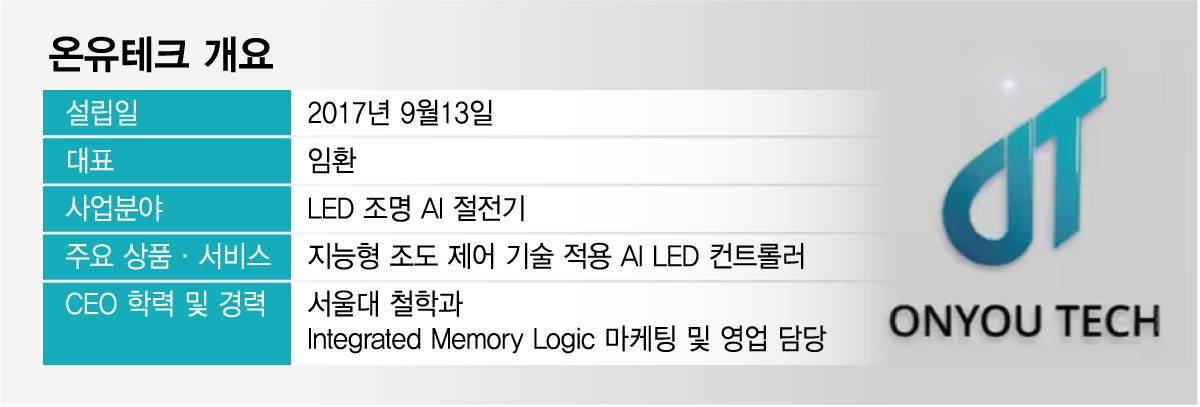
Onyutech is a startup that has turned this concept into a business through its 'AI-powered energy-saving device,' which minimizes electricity leakage in homes, buildings, and factories. Im Hwan, CEO of Onyutech, stated, "To address power supply-demand challenges in the AI era, we must focus not only on generation (supply) but also on conservation (demand)." He added, "If AI-powered energy-saving devices are installed on all LED flat-panel lights nationwide, they could save 5.7 GW—equivalent to five nuclear power plants."
Up to 50% energy savings without replacing existing LEDs... 'AI-powered energy-saving device' deployed across five Seoul National University buildings
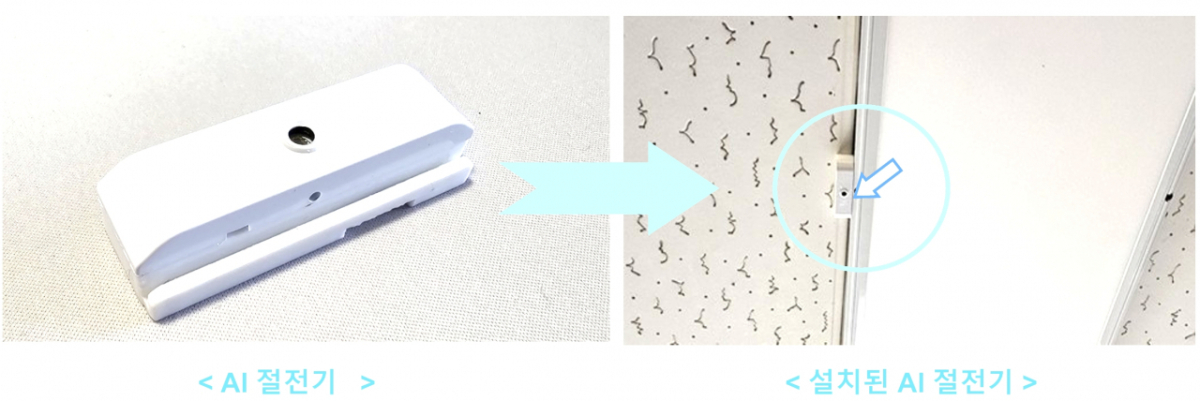
Onyutech's 'AI-powered energy-saving device' features a compact case the size of a fingertip containing a light sensor and controller. It attaches to the side of existing LED flat-panel lights, requiring only a one-time replacement of the standard converter inside the fixture with a dimming converter. No additional programming or setting input is needed; it simply 'adds on' to existing fixtures. Lim (CEO) explained, "The sensor autonomously learns ambient light changes directly beneath the fixture and identifies optimal settings," adding, "It reduces power consumption by up to 50% compared to conventional LEDs."
The AI-powered energy-saving device operates in two ways. First, when sunlight enters near windows, it automatically lowers output from 40W to 24W, 15W, or 5W to maintain uniform indoor lighting levels. Second, it detects movement from people or forklifts; during low-traffic periods, lights operate at only 40–50% of normal brightness, then instantly return to 100% upon detecting motion.
Unexpected side benefits also exist. Lim (CEO) noted, "When window-side lighting becomes too bright during the day, people experience 'excessive light stress.' However, with stabilized overall illumination, many users report their eyes feel more comfortable."
Although energy-saving devices have previously entered the market, many were rejected for failing to pass real-world validation. Onyutech launched its pilot program last year using a testbed at Seoul National University's Energy Management Center Research Laboratory, achieving an average savings rate of 40%. The system was subsequently expanded to five buildings across Seoul National University, including the Graduate School of Public Health and dormitory dining halls. Seoul National University is reported to spend approximately 250 billion won annually on electricity alone. Lim (CEO) shared, "Regardless of whether departments are science or arts-focused, AI deployment in each research lab caused a surge in electricity usage, creating significant pressure from the university administration to reduce consumption." Beyond Seoul National University, pilot tests are currently underway at over 30 locations nationwide, including schools and logistics centers.
"Energy crisis can be addressed through demand rather than supply"
Solutions to the energy crisis have traditionally focused on 'expanding supply': building more power plants, expanding transmission and distribution networks, and installing additional solar panels. Lim (CEO) observed, "Reducing demand yields identical results, yet this area has consistently been overlooked."
According to Lim (CEO), energy conservation from the demand side is also more cost-effective. He explained, "Even if 100 GW of solar capacity is installed, average daily operation hours are only 3.6–4 hours, resulting in actual generation of around 15 GW, while installation costs exceed 100 trillion won. In contrast, installing AI-powered energy-saving devices requires significantly less investment—approximately 30–40 trillion won—to secure equivalent capacity within a short timeframe."
For individual consumers, reducing electricity demand directly translates to financial gains. According to Onyutech's cost simulations, applying AI-powered energy-saving devices to 300 sets of 40W LED flat-panel lights would recover the initial investment within 2.5 years, with an estimated cumulative return rate of 300% over a decade.
"With a shift in perception, nationwide adoption could accelerate rapidly"
Lim (CEO) emphasized the need for central government ministries, local governments, and public institutions such as elementary, middle, and high schools across the country to lead the installation of AI-powered energy-saving devices. He stated, "According to Korea Energy Management Corporation's annual data on energy consumption in the public sector, electricity usage increases by 2–5% each year. If facilities and equipment cannot be replaced en masse, AI-powered energy-saving devices offer a reliable alternative."
Lim (CEO) added, "If society shifts its perception to recognize that power shortages can be resolved through demand reduction, widespread adoption of AI-powered energy-saving devices becomes feasible. As lighting engineers nationwide deploy these systems on-site, it could also stimulate domestic economic activity."
Onyutech expects its revenue growth trajectory to accelerate starting this year following successful real-world validation of its AI-powered energy-saving device. The company targets annual revenues of 20 billion won this year and over 50 billion won next year. Lim (CEO) remarked, "While Onyutech's own revenue growth is important, the more critical goal is changing public perception and conserving energy across the entire nation. With over 200 million LED flat-panel lights, fluorescent lamps, floodlights in manufacturing facilities, and outdoor landscape lighting nationwide combined, the potential power savings could exceed 10 GW in capacity—a truly massive impact."
[MoneyToday startup media platform Unicorn Factory]

 in FUTURE


