

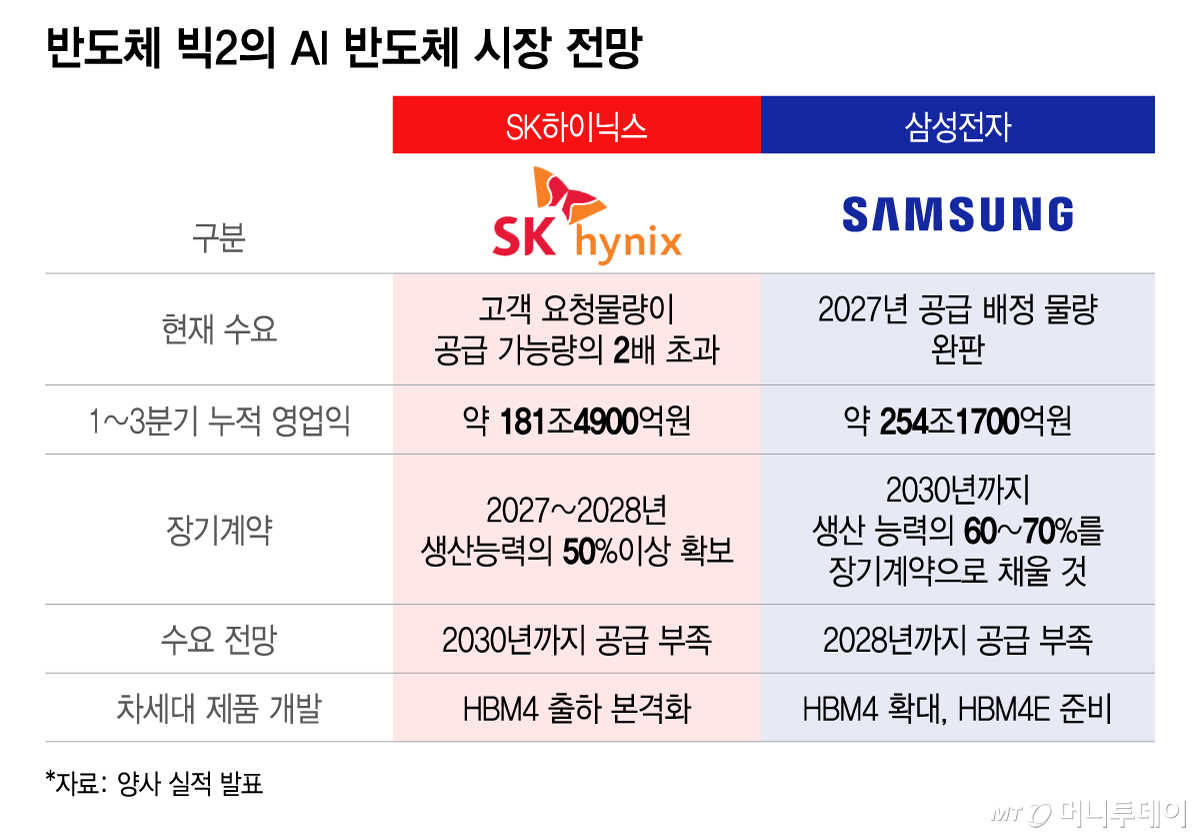
Global competition is fierce to secure HBM (High Bandwidth Memory) supply, in which Korea holds a strength, for the AI (Artificial Intelligence) era. In response, the government has a strategy to maintain global leadership in AI semiconductors by expanding the semiconductor hubs of Samsung Electronics and SK hynix nationwide through three mega-projects.
According to industry sources on the 2nd, Samsung Electronics opened the era of quarterly operating profit of 100 trillion won for the first time in the third quarter this year. SK hynix also recorded its highest-ever performance with sales of 105 trillion won and an operating profit of 83 trillion won. The cumulative operating profit of both companies for the third quarter was 435.7 trillion won, exceeding half of the government's 2027 budget proposal (821 trillion won).
The situation where AI memory demand from both companies exceeds supply is expected to continue for two to three years. HBM, which stacks multiple DRAMs vertically to enhance data processing speed and power efficiency, determines the performance of AI accelerators. As in-house AI chip development by big tech (large IT companies) and national-level AI infrastructure investment spread, HBM demand will increase, and expanding domestic production hubs is an opportunity for Korea to maintain dominance in the AI semiconductor supply chain. This is why the government is proceeding with a mega-project to expand the semiconductor industry's production base from the capital region to the entire country. The project is centered on Yongin, the southwest region, and the Chungcheong region.
First, Yongin aims to double memory production capacity within five years by advancing the completion date of fabs (fab·production lines). Construction began last month on the first zone of the Yongin Semiconductor National Industrial Complex.
The southwest region, where four memory fabs worth 800 trillion won will be built, is also accelerating the creation of a second production hub. The government is in final negotiations with the United States over the relocation of the Gwangju military airport near the fab site and is formulating support plans for a task force (TF) to compensate Muan County.
In the Chungcheong region, the investment scale increased by more than four times from the initial 81 trillion won to 392 trillion won as corporate investment was added to the government's semiconductor packaging investment. On the 15th of last month, Samsung Electronics broke ground on expansion works at its Onyang plant.
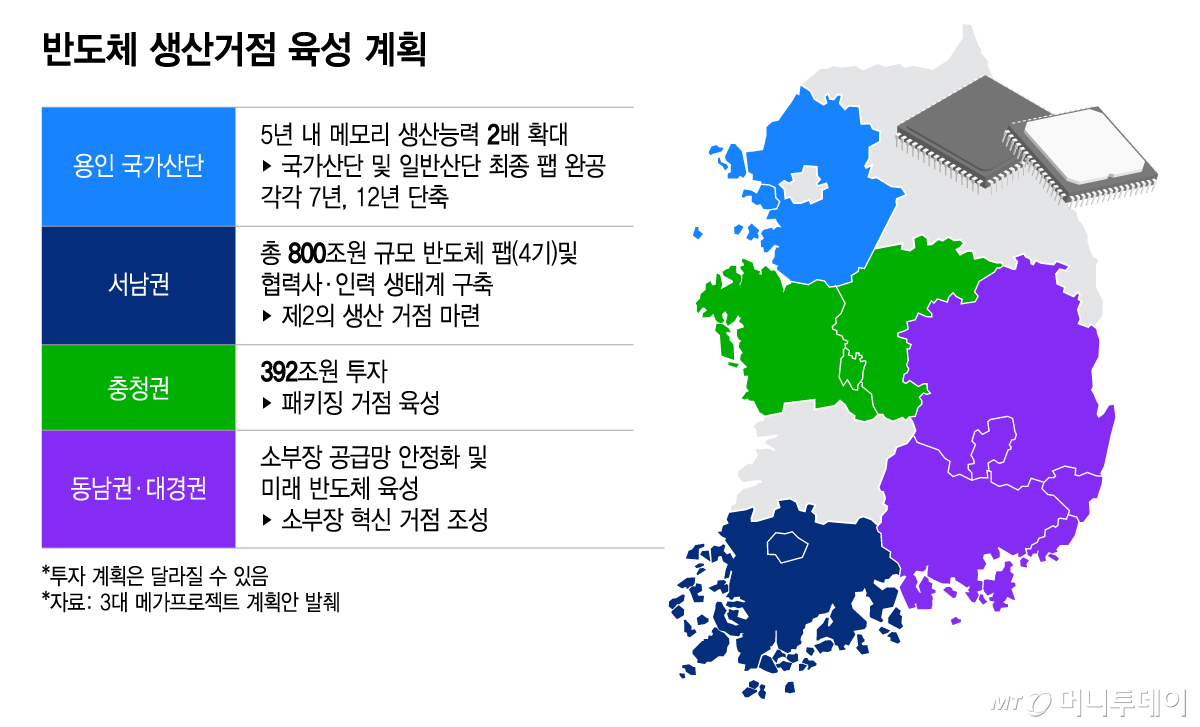
The expansion of the semiconductor production base is expected to grow regional industrial ecosystems and contribute to balanced national development. This is because large-scale investments are made during the construction phase of fabs, and after operation, they create demand for partner companies and specialized personnel.
The challenge is securing infrastructure. Semiconductor fabs must receive stable supplies of massive amounts of power and process water. If AIDCs (data centers) are also built together, power demand will increase further. For investment plans to lead to actual production capacity expansion, not only site acquisition but also the construction of transmission networks, generation facilities, and water supply systems must precede it. Challenges include cultivating personnel in connection with local universities and securing transportation networks so that the established results take root in the region.
Lee Jun, Senior Research Fellow at KIET (Korea Institute for Industrial Economics and Trade), said, "Individual large-scale investment projects must be transformed into a common demand, technology, and investment platform for national industries," adding, "It is necessary to link the demand and technological outcomes generated through mega-projects with the growth engines of seven regions to build a virtuous cycle structure of investment and growth."
[Production Support: Ministry of Culture, Sports and Tourism Public-Centered Communication Activation Project]

 in TECH

