

[For more diverse company information on startups, visit the Unicorn Factory big data platform 'Data Lab'.]
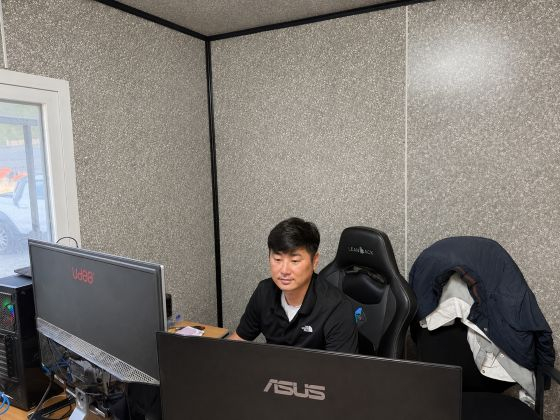
"A linden tree costs 100,000 won per unit, while a king cherry tree is priced at 400,000 won."
Even when starting from the same sapling and growing them for five to six years, profits can differ by up to four times. While most physical transaction markets—including automobiles, real estate, seafood, and agricultural products—have established official price benchmarks, South Korea's landscape tree market, valued at approximately 3.5 trillion won, is an exception. Since the Public Procurement Service abolished its official tree pricing system in 2020, objective price standards have vanished, turning the market into what is known as a 'dark market.'
Kim Hyeon-jae, CEO of Greennow Trader, identified business opportunities within this structural inefficiency. Before founding his company, he worked in the construction industry managing landscape tree procurement for project completion. He traveled directly to farms across the nation to secure trees of desired species and specifications. Kim stated, "Even after searching farms nationwide, it was difficult to find the trees we wanted, and with market prices not publicly disclosed, determining fair pricing proved challenging." He added, "I believed that a transparent trading platform was also needed for the landscape tree market."
Indeed, information asymmetry is confirmed by statistics. According to Greennow Trader, 73.8% of landscape tree farming households conduct transactions through middlemen. Even for trees of identical species and specifications, price differences can reach 30% to 50% depending on the transaction channel. Landscape construction managers spend over 60% of their working hours exchanging quotes via phone calls and text messages. Kim explained, "It is difficult to find reliable data even when searching for landscape tree market prices," noting that it is a market where actual transaction data itself remains undisclosed.
15,000 actual transaction records built through hands-on effort
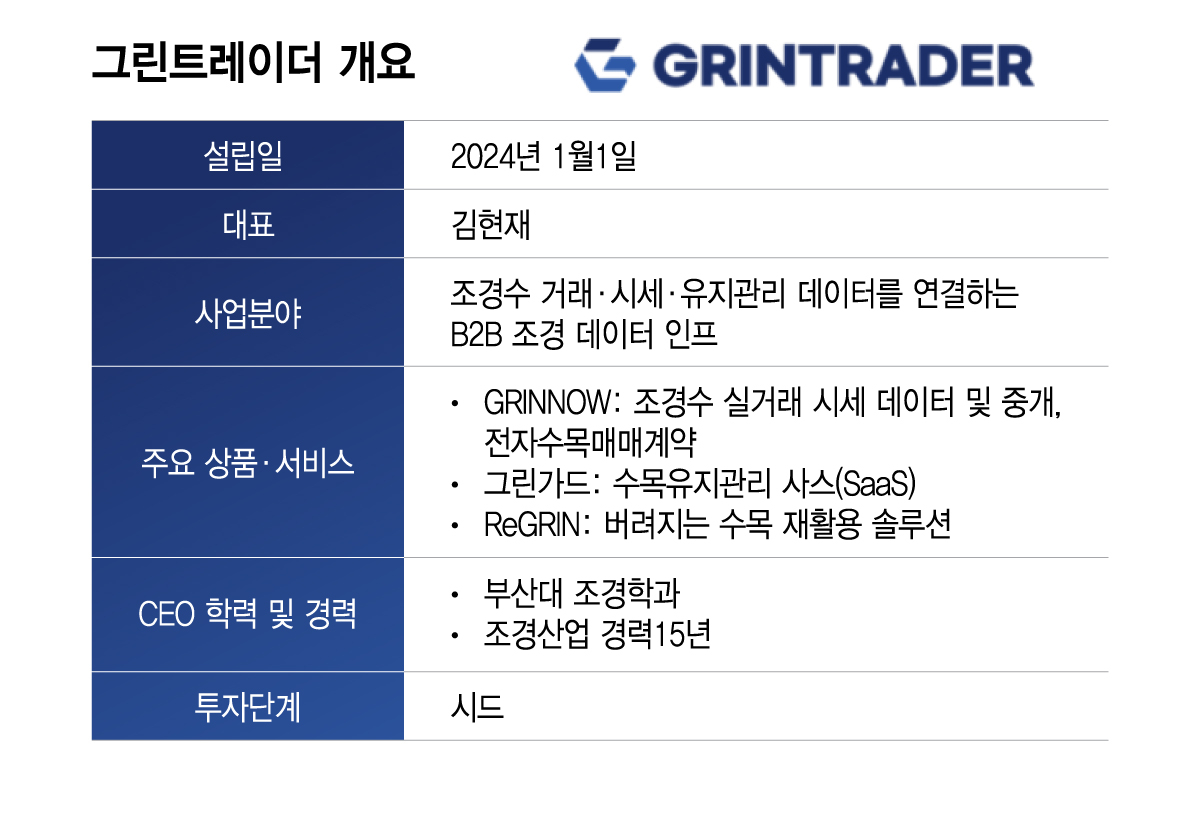
After being selected for the 2022 Pre-Startup Package program, Kim concretized his idea into a business. 'Greennow,' operated by Greennow Trader, is a B2B (business-to-business) landscape tree trading platform that connects farmers wishing to sell trees with landscaping companies and construction firms.
Its core competitive advantage lies in actual transaction price data for landscape trees. Initially, Kim personally visited farms nationwide to collect transaction prices. To date, the company has secured approximately 15,000 records. It has also established a structure where actual transaction prices are automatically reflected in market price data whenever transactions occur through the platform.
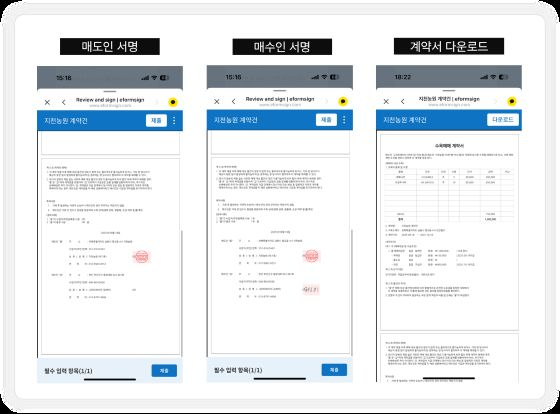
Market price data is made available free of charge to attract users, while electronic contract features accumulate transaction histories. As transaction records accumulate, a 'lock-in' effect occurs, making it difficult for users to leave the platform. In fact, based on the most recent six-month period, the repeat transaction rate reaches approximately 80%.
The revenue model consists of two pillars: landscape tree brokerage and direct sourcing sales. Alongside brokerage services that facilitate transactions, Greennow Trader also operates a business where it directly purchases landscape trees and supplies them to construction firms and landscaping companies.
A single incorrectly planted tree can result in losses of hundreds of millions of won
Based on its accumulated data, Greennow Trader also provides tree consulting services. This aims to solve the recurring problem of species selection failures that frequently occur on construction sites. Landscape design is often conducted in Seoul while construction takes place in regional areas; however, there are numerous cases where species selection fails to account for local climate and soil conditions, leading to large-scale defects.
A representative case involves a facility landscaping project in Gimhae, Gyeongsangnam-do. Birch trees were specified during the design phase, but birch is a species vulnerable to the hot and humid climate of southern regions. Although the construction company requested a change in species, the request was not accepted. Consequently, more than 40 out of the 60th planted trees died. Repair costs for these defects alone amounted to hundreds of millions of won. Kim remarked, "Landscape construction is structured such that profits are made upfront, but all gains are wiped out if defects occur." He added, "When trees die, they must be replanted within two years, causing significant damage."
Transplanting failures due to climate change are also increasing. When Kim was in his early twenties working on-site, the mortality rate was around 5%, but recently cases have emerged where rates have risen to at least 20%, and in some instances as high as 30% to 40%. He emphasized, "Cases of missing the optimal transplanting window are also increasing. This is an era where decisions on which trees to plant, when, and where must be based not on experience but on data."
Increasing survival rates with 'origin-destination-market price' data
The core of the data Greennow Trader builds lies in managing 'origin-destination-transaction price' as a single dataset. By accumulating information on which regional farm a tree was sourced from, where it was moved to, and at what price it was traded, the correlation between transportation distance and survival rates can be analyzed.
Kim stated, "Once an additional one to two years of data is accumulated, the platform will be able to automatically recommend region-specific species and optimal planting seasons by season." He added, "If combined with climate data, it could evolve into a decision-making platform usable even during the landscape design phase."
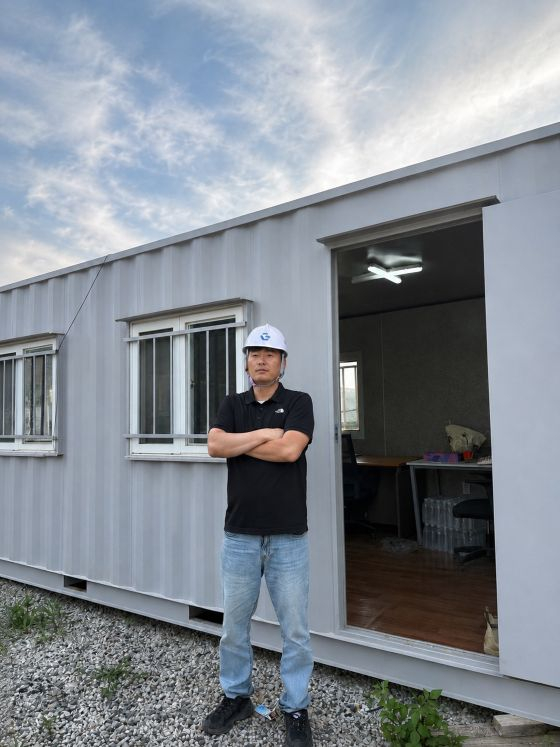
Beyond apartment landscaping to the era of 'garden economy'
Kim is also paying attention to changes in South Korea's landscaping market. While public landscaping such as apartment complexes and parks once dominated the market, private markets including large cafes and private gardens are now growing rapidly. In fact, commercial spaces investing 500 million to 10 thousand won in landscaping are also increasing.
A representative example is 'Momo Coffee,' a specialty coffee brand in Busan. This location, designated as South Korea's first private garden, currently has its landscaping maintenance managed by Greennow Trader. As so-called 'garden restaurants' have established themselves as a new consumption trend centered on social media platforms like Instagram, demand for landscaping services is expanding beyond businesses to include general consumers (B2C).
Long-term, Greennow Trader aims to build a 'total landscaping service' that provides not only landscape tree trading but also maintenance, contracts, and species consulting within a single platform. Kim stated, "Our goal is not merely buying and selling trees, but resolving all processes related to landscaping within one platform." He added, "Since the opacity of landscape tree information is not unique to Korea, we believe there is sufficient potential for expansion into overseas markets as well."
[MoneyToday startup media platform 'Unicorn Factory']

 in FUTURE


