

[For more diverse corporate information on startups mentioned in this article, please visit Unicorn Factory's big data platform 'Data Lab'.]
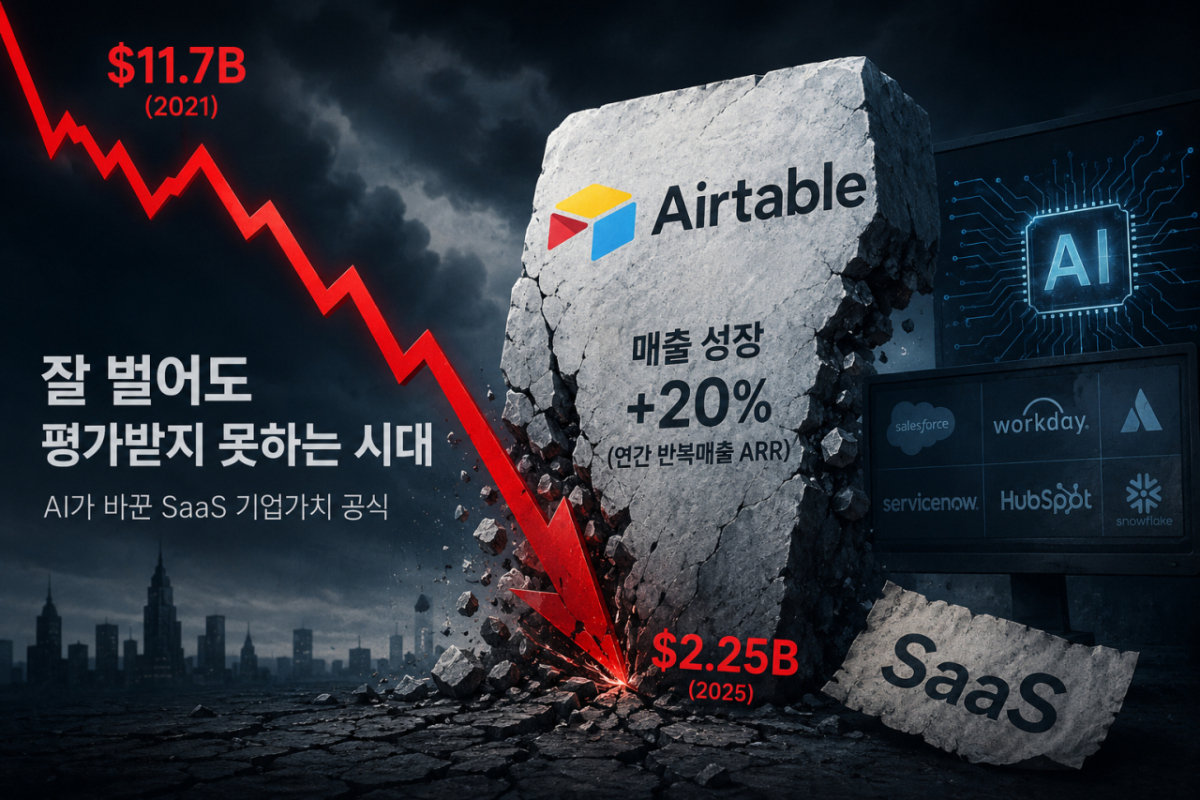
Airtable, a U.S. software startup once valued at $11.7 billion (approximately 16.6 trillion won), has found a new owner at a corporate valuation more than 80% below its peak. The shock is particularly significant given that the company's performance has been steadily improving. Industry analysts view this as a clear example showing how market evaluation criteria for traditional SaaS (Software-as-a-Service) companies have fundamentally shifted following the spread of generative AI (artificial intelligence).
According to major foreign media outlets including The Wall Street Journal (WSJ) and TechCrunch on the 7th, Italian tech company Vending Spoon has agreed to acquire Airtable for an enterprise value of $1.285 billion (approximately 1.84 trillion won). The total equity value, including net cash held by the company, was assessed at approximately $2.25 billion (about 3.22 trillion won). The transaction is expected to be finalized by year-end following regulatory approvals and other procedures.
Founded in 2013, Airtable is a U.S. SaaS company that provides a work collaboration platform combining spreadsheets and databases. Based on an interface familiar like Excel, it enables users to build databases and create various business applications for project management, sales management (CRM), marketing, and more without any coding.

This deal has drawn attention because Airtable's corporate valuation dropped significantly despite improving sales performance. As of June, Airtable's annual recurring revenue (ARR) reached approximately $480 million (about 686 billion won), an increase of more than 20% compared to a year ago. According to the company, over 500,000 organizations use its service, and 80% of Fortune magazine's list of America's 100 largest companies are also customers. The company has not lagged in AI adaptation; earlier this year, it unveiled "Super Agent," a platform that coordinates multiple AI agents to perform tasks.
However, the market did not grant the same premium as before. During the zero-interest-rate era and SaaS investment boom of 2021, Airtable received a corporate valuation of $11.7 billion during its Series F funding round. However, in this year's over-the-counter market, it was valued at around $4 billion (approximately 5.67 trillion won), and the price recognized in this sale was even lower.
The industry interprets this deal as a structural shift in the SaaS sector. Tomasz Tunguz, General Partner of Theory Ventures, a U.S. VC that primarily invests in AI companies, stated, "This is a clear example showing how significantly market valuation criteria for traditional SaaS companies have been readjusted." He added, "Strategic M&A at discounted prices has become a realistic exit scenario for SaaS unicorns that received funding at their 2021 peak."
Dave Samuel, co-founder of Freestyle Capital, Airtable's early investor, said, "This deal is a very painful event for B2B SaaS startups and investors," adding, "We are currently advising our portfolio (SaaS) companies to consider strategic sale possibilities as well."
Meanwhile, Vending Spoon, which acquired Airtable, is one of the most aggressive software acquirers in Silicon Valley recently. Founded in 2013 as a mobile app developer, Vending Spoon has recently gained attention for its strategy of acquiring digitally struggling companies with poor profitability, improving their business structures, and enhancing profitability.
This year, it acquired internet brand AOL and event platform Eventbrite, and also holds file-sharing service WeTransfer and video platform Vimeo. It has completed more than 50 M&A deals so far. After listing on NASDAQ last July, it chose Airtable as its first acquisition target.
A path has opened for general individual investors to indirectly 'bet' on startups invested in by Y Combinator (YC), Silicon Valley's leading accelerator (AC·entrepreneurship planner).
According to reports from Reuters and TechCrunch, U.S. fintech company Robinhood plans to list its "Robinhood Venture Fund II (RVII)" on the New York Stock Exchange on the 13th at a price of $25 per share (approximately 35,500 won). Through this offering, it aims to raise up to $200 million (about 280 billion won). The main investment targets are equity stakes in startups that have currently or previously gone through YC.
Investors will not directly hold startup equity. Instead, they can buy and sell shares of a fund containing stakes in multiple private companies. This allows indirect investment in early-stage Silicon Valley companies through the stock market, which was previously only possible by participating in VC funds or special purpose vehicles (SPVs).
This fund applies the industry-standard "2% management fee and 20% performance fee" (2·20 structure) common in the VC sector. Additionally, if YC-originated startups achieve successful exits through IPOs or M&A, generating profits for the fund, Robinhood Ventures, a management affiliate of Robinhood, will take 20% of the profits as a performance fee (Carried Interest).
However, there are also concerns that the profit realization structure for individual investors is somewhat opaque. Unlike typical VC funds, RVII has not specified a maturity or liquidation date, nor has it disclosed plans to regularly distribute investment returns in cash. TechCrunch pointed out that as a result, individual investors will likely have to rely mostly on capital gains from fund share price increases.
The previously launched Robinhood Venture Fund I (RVI) was a fund investing in private companies such as Databricks, OpenAI, and Mercuri, listed at its offering price of $21. On the 6th (local time), it completed trading at approximately $28, exceeding the offering price. However, considering that the stock price once exceeded $56 in May, there is significant volatility and a high risk of losses.
Robinhood has previously faced controversy over its private company investment products. Last year, it introduced "Tokenized Shares" linked to stocks of OpenAI and SpaceX to European investors, but OpenAI publicly refuted the claim, stating that the product had no relation to the company and that the tokens were unrelated to company equity.
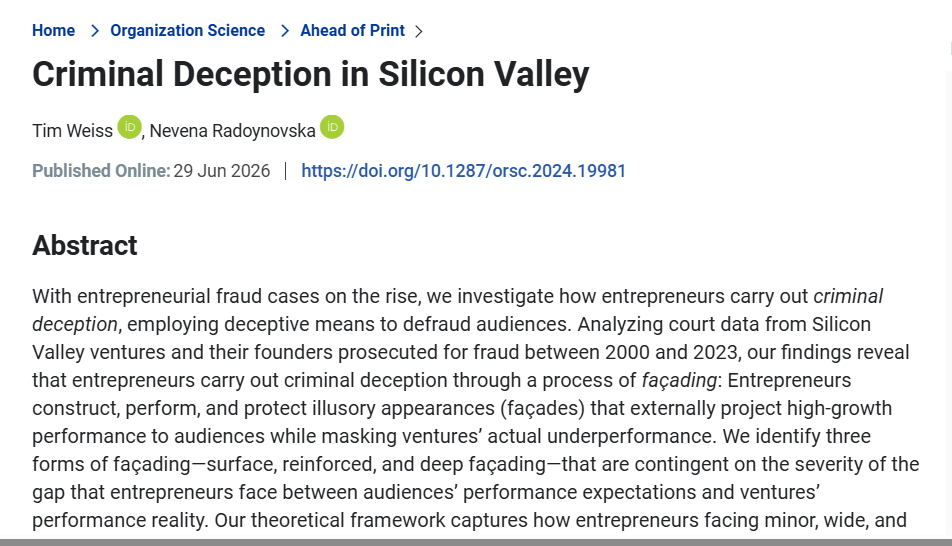
A study has found that startup fraud in Silicon Valley may not be merely the result of individual founder misconduct, but rather a product created jointly by investors and the venture investment ecosystem.
Researchers from Imperial College London in the UK and EM Lyon Business School in France recently released a report analyzing how founders of startups invested in by Silicon Valley VCs commit fraud and what role investors play in the process.
Published last June in the European international academic journal Organization Science, the report analyzed a database of technology company founders and startup cases prosecuted by the U.S. Securities and Exchange Commission (SEC) and the Department of Justice (DOJ) for civil and criminal securities fraud charges from 2000 to 2023.
Tim Weiss, co-author of the report, told TechCrunch in a recent interview, "Fraud in the startup industry is far more common than we realize and is accepted as somewhat normal."
He added, "The problem is not just the founders," noting that "investors who demand unrealistic high growth from founders also contribute to creating the problem." He further diagnosed that the current investment boom in AI startups has created an environment that easily tempts founders into fraud.
The researchers defined the process where founders gradually escalate lies to bridge the gap between investor expectations and actual business performance as "facading." They explained that it starts with exaggerating results, then progresses to creating fake contracts and fabricated revenue data, and eventually evolves into false demonstrations claiming superior technology than actually exists.
The researchers particularly pointed out that investors are not merely victims. Not only do they demand unrealistic growth targets, but there are also numerous cases where they reinvest in founders who have been suspected of fraud.
Weiss described this as "investors co-create fraud."
He proposed that the SEC should conduct regular investigations and audits for startups that receive investments above a certain scale. Currently, the SEC mostly begins investigations only after whistleblowers or investor lawsuits occur. He also suggested that investors should bear greater responsibility for forcing unrealistic growth targets on founders.
[MoneyToday startup media platform Unicorn Factory]

 in FUTURE


