

[For more diverse corporate information on startups mentioned in this article, please visit Unicorn Factory's big data platform 'Data Lab'.]
>A total of 250 new unicorns (private startups with a corporate valuation of $1 billion or more) have been created in the global market this year. This surge is attributed to heavy investment inflows into AI and robotics sectors, causing valuations of numerous startups to skyrocket. The top venture capital firms that produced the most unicorns are Sequoia Capital, Cooley Ventures, and Y Combinator.
>According to Crunchbase, a global investment information platform, the number of new unicorn companies from January to August 15 this year reached 250. This figure already exceeds last year's total of 193 new unicorns by 29.5%.
>By country, startups headquartered in the United States accounted for 139 (56%), more than half, followed by China with 47 companies (19%). By sector, unicorns emerged consecutively in AI and robotics, healthcare and biotech, financial services, and other areas.
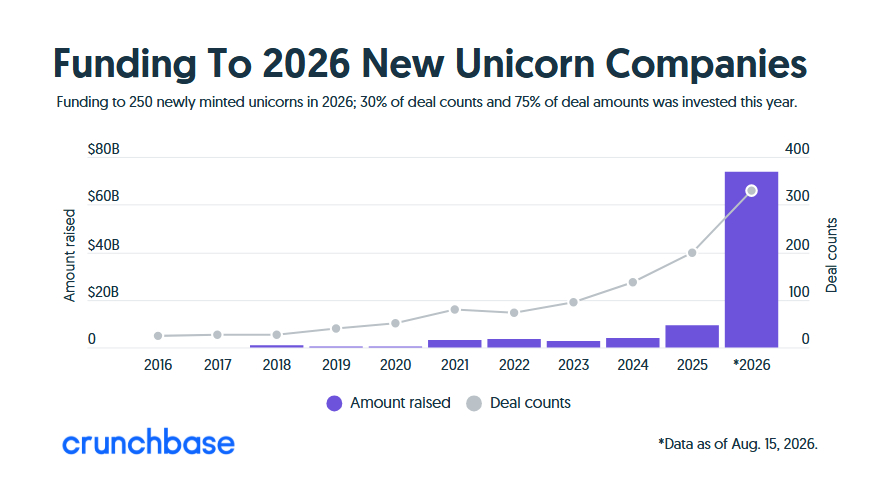
>The cumulative investment raised by new unicorn companies since their founding totals $98 billion (approximately 136 trillion won). Of this, $74 billion (approximately 102 trillion won), representing 75%, was concentrated in the current year.
>This indicates that startups in AI and robotics have secured large-scale funding within a short period, leading to rapid increases in corporate valuation. This marks a clear departure from the traditional startup growth formula, where investments were spread over several years and valuations rose gradually.
>Sequoia Capital holds the largest portfolio of companies that joined the unicorn ranks this year. Cooley Ventures and Y Combinator ranked second and third, respectively. Other top 10 investors include Lightspeed Venture Partners, Founders Fund, Andreessen Horowitz, Bessemer Venture Partners, Lux Capital, General Catalyst, and Box Group.
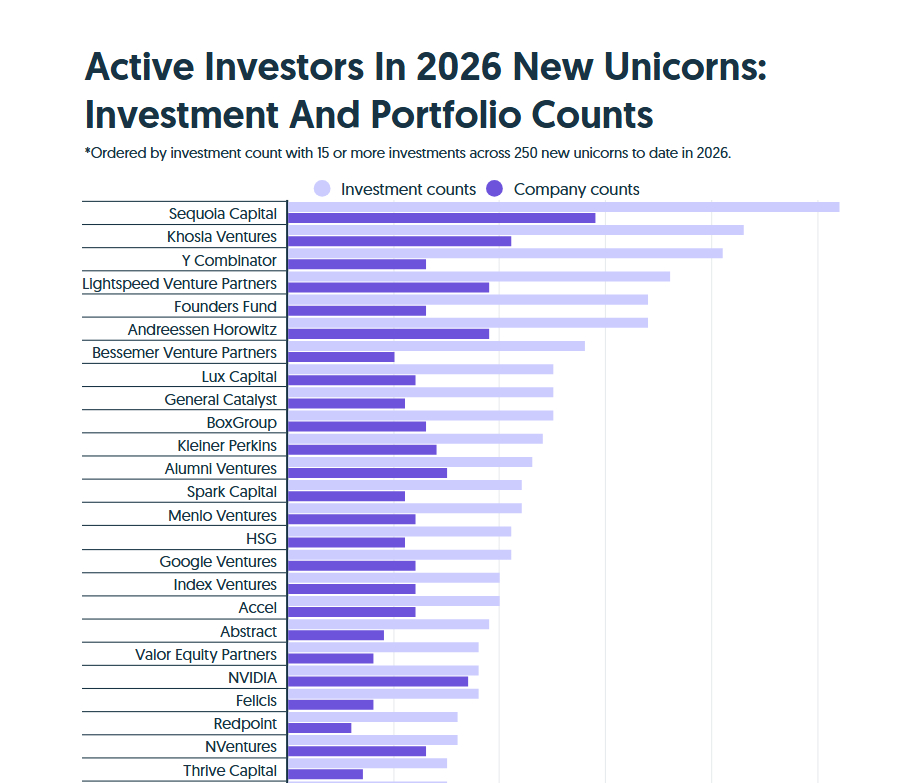
>In the earliest stages such as seed funding, global accelerators like Y Combinator and early-stage funds based in New York, such as Box Group, stood out. In Series A lead investment, Andreessen Horowitz took the most aggressive approach. Cooley Ventures, Spark Capital, and Sequoia Capital also formed a joint leading group.
>Beyond large venture capital firms (VCs), corporate venture capitalists (CVCs) such as private equity funds S3 Capital and Valor Equity Partners also made notable strides. Among big tech companies, NVIDIA and Google invested in unicorn startups to secure leadership in the AI and semiconductor ecosystems. Among Asian investors, HSG, a Hong Kong-based firm that spun off from former Sequoia Capital China, was the only one to enter the top investor list.
>Crunchbase analyzed that large VCs or funds capable of both early accessibility and massive scaling tend to dominate unicorn creation. It further diagnosed that proving whether newly funded unicorns can demonstrate performance and growth commensurate with their high corporate valuations will be a watershed moment for the future direction of the venture investment market this year.
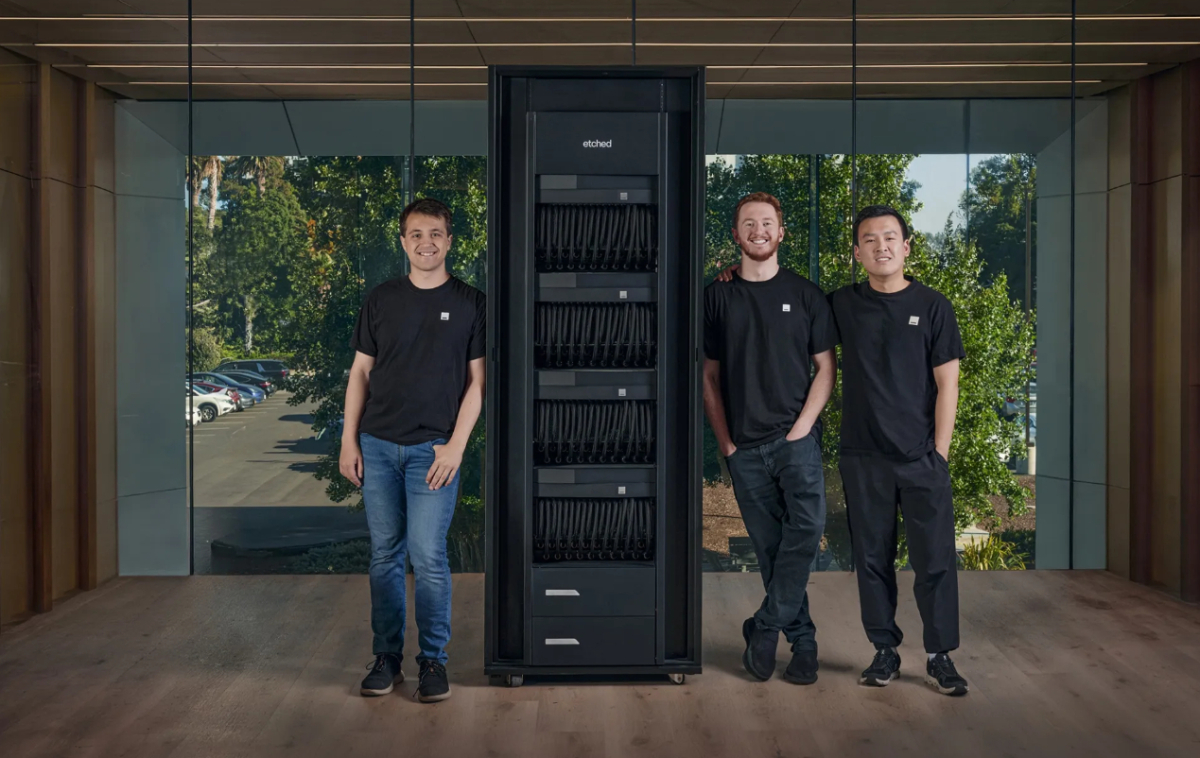
>AI inference semiconductor startup 'Etched', founded by three Harvard University dropouts, is capturing the attention of global capital markets and the semiconductor industry. Its corporate valuation has more than doubled within a month, and it has recruited numerous talents from NVIDIA, the world's leading AI semiconductor company.
>According to international media outlets including The Wall Street Journal (WSJ) and TechCrunch, Etched recently secured $700 million (approximately 97 billion won) in investment funding. This round was led by global quantitative investor Jane Street, with participation from Kleiner Perkins, Sequoia Capital, Andreessen Horowitz, Blackstone, and others. The total raised amount reaches $1.9 billion (approximately 2.6 trillion won). Etched's corporate valuation stands at $21 billion (approximately 29 trillion won), more than double the $10.3 billion recorded during its Series C round just one month ago.
>Etched was co-founded in 2022 by Gavin Uberti, Chris Zhu, and Robert Wachter, all Harvard alumni. The company attracted significant industry attention when Brian Royle, who led the development of AI server systems (HGX/DGX) at NVIDIA for over 20 years, and Septa Deep Pal, responsible for core GPU architecture, joined as key technical staff. According to WSJ, 15% of Etched's entire workforce consists of former NVIDIA employees, with some engineers declining NVIDIA's unprecedented retention offers to join Etched.
>Etched's AI chip 'Sohu' is an application-specific integrated circuit (ASIC) designed at the hardware level to exclusively handle computations for 'Transformer', the core algorithm of large language models (LLMs), unlike NVIDIA's general-purpose GPUs. By sacrificing versatility, Sohu maximizes inference speed and price competitiveness. Etched claims that a single server equipped with eight Sohu chips can replace 160 NVIDIA H100 GPUs.
>Lead investor Jane Street is reported to have directly introduced Etched's first test cluster into its own data center for validation. Etched has already secured orders exceeding $1 billion.
>Sonya Huang, General Partner at Sequoia Capital, stated, "There's an unwritten rule in the chip industry not to invest in startups or small, inexperienced companies, but Etched is changing that rule."
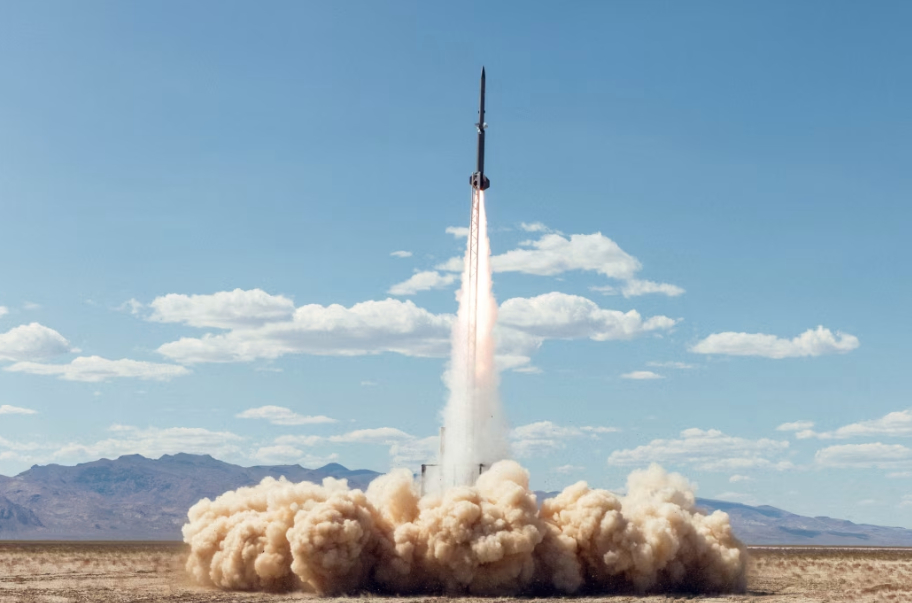
>US hypersonic missile startup 'Castelion' recently raised $1 billion (approximately 1.4 trillion won) in its Series C investment round. Its corporate valuation was assessed at $13 billion (approximately 18 trillion won). Cumulative funding has surpassed $1.5 billion (approximately 2 trillion won).
>According to The Wall Street Journal (WSJ), this investment round for Castelion was jointly led by JPMorgan, Andreessen Horowitz, and Carlyle Group. Lightspeed Venture Partners, Altimeter, and General Catalyst also participated. The structure combines new equity investment with a revolving credit facility. In the investment industry, it is considered highly unusual for Carlyle, a global private equity firm with massive assets under management, to participate in a single round of a defense startup.
>Castelion was co-founded in 2022 by three former SpaceX employees: Brian Higgs, Sean Pitt, and Andrew Kretz. Its core product is the hypersonic strike missile 'Blackbeard'.
>Hypersonic weapons traveling at Mach 5 (five times the speed of sound) or faster are virtually impossible to intercept with existing air defense systems. The problem was price. Existing US hypersonic missiles cost tens of millions of dollars (hundreds of billions of won) per unit, making mass deployment difficult.
>Castelion developed its product with the goal of revolutionizing the pricing of hypersonic weapons and recently secured multiple military contracts. According to a contract signed last month with the US Navy, the unit price of Blackbeard is under $300,000 (approximately 416 million won), which is one-hundredth the cost of existing missiles, as noted by WSJ.
>Castelion plans to use the raised funds for expanding production facilities, developing follow-up products with extended range for Blackbeard, and creating new defense systems. Brian Higgs, CEO of Castelion, stated, "Deterrence depends on American resilience. We must produce high-performance weapons that enemies fear at the lowest possible cost and in quantities unimaginable to them."
>[MoneyToday Startup Media Platform Unicorn Factory]

 in FUTURE


