

More diverse corporate information on startups can be viewed at Unicorn Factory's Big Data Platform 'Data Lab'.
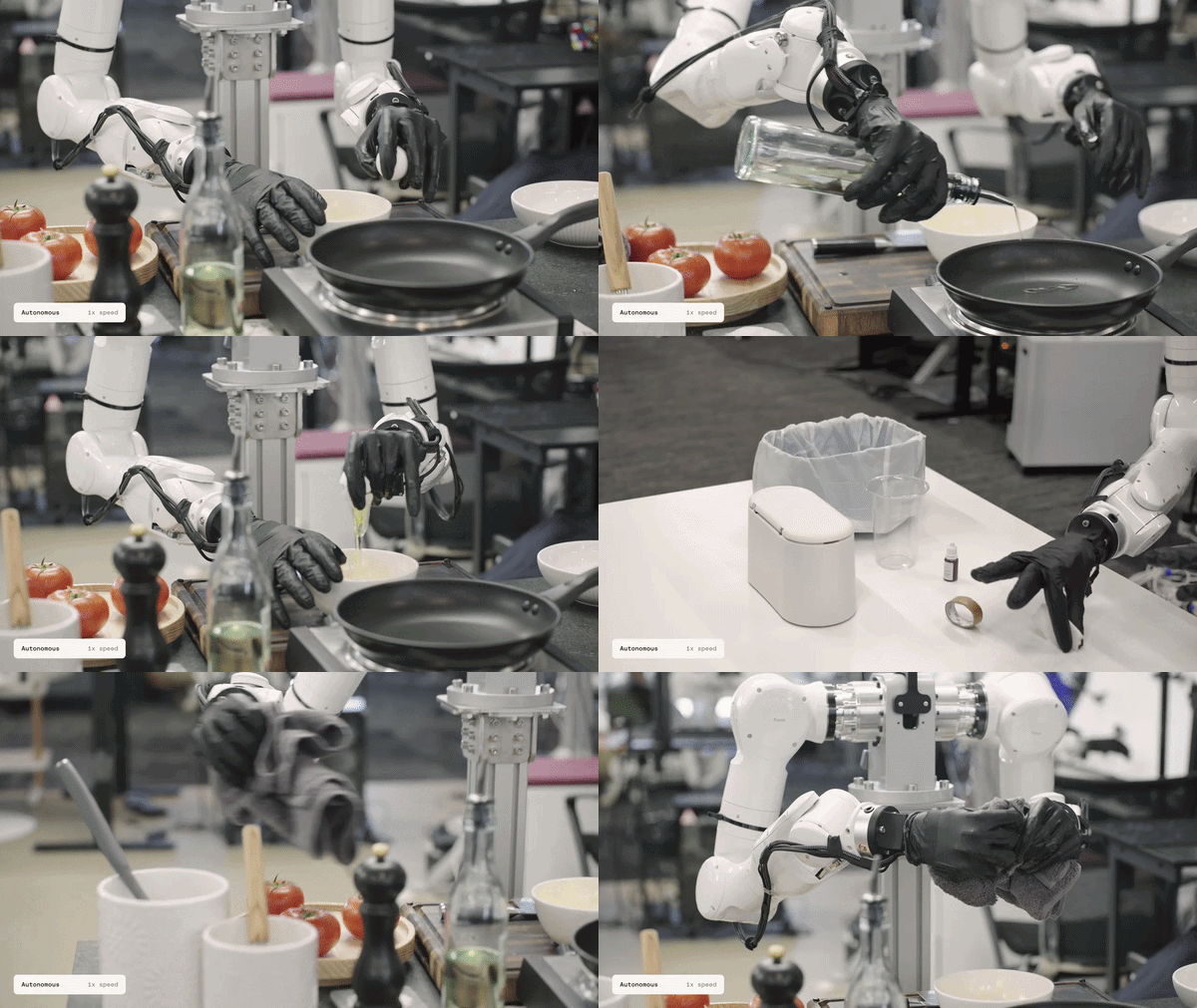
The reason robots cannot work like humans lies not in their "bodies" but in their "experience." While AI's LLMs (large language models) have become smart by using the entire internet as a textbook, robots absolutely lack physical experience data for picking up and handling objects.
A startup has emerged that aims to break through this data bottleneck with a "glove," drawing attention. The robotics company, Genesis AI, is based in San Carlos, California, and Paris, France.
Genesis AI, established last year, raised $105 million (approximately 147 billion won) in seed funding alone. Investors include Khosla Ventures, founded by Vinod Khosla, one of Silicon Valley's most renowned investors; Eric Schmidt, former CEO of Google; and Xavier Niel, founder of Iliad.
Theophile Gervet, co-founder and CEO of Genesis AI, is a former research scientist at Mistral AI, Europe's largest AI company. He previously worked at Meta AI and Skilled AI, and pursued a doctoral program in machine learning at Carnegie Mellon University (CMU), focusing on robotics and computer vision.
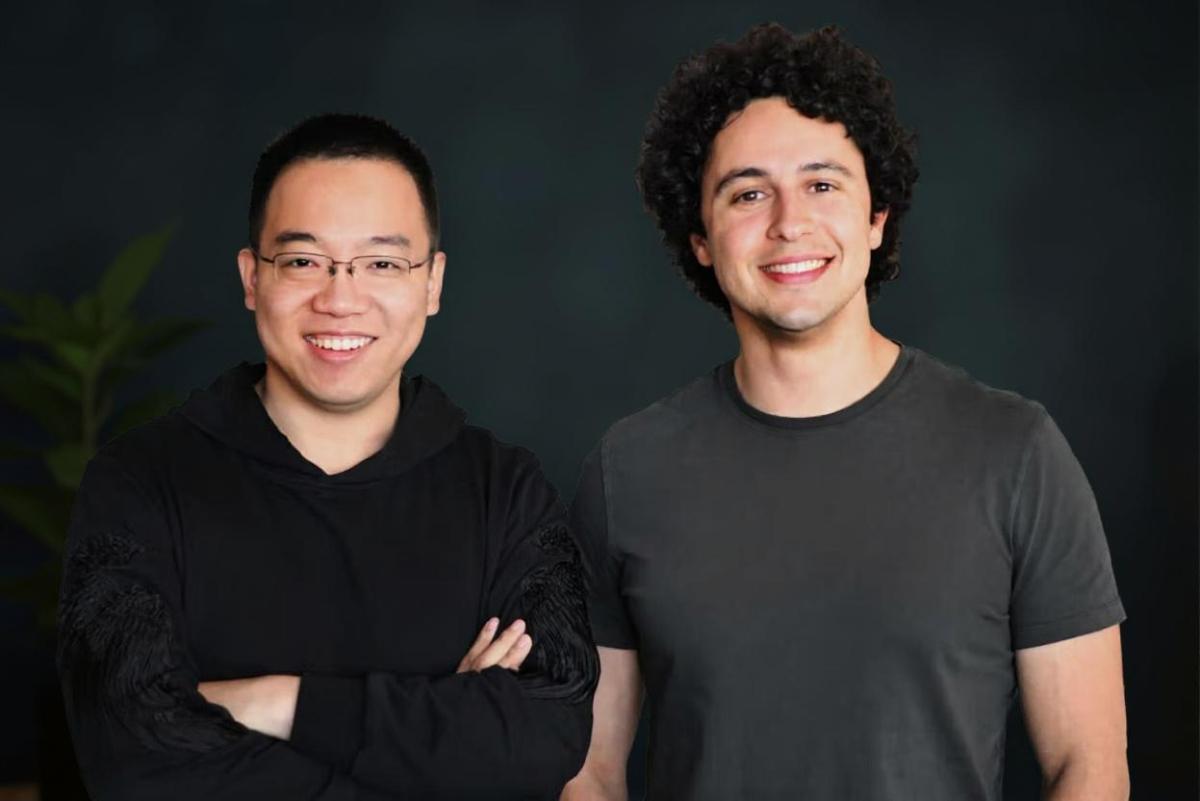
The connection between Je Reu-be (President) and Zhou Xian, CEO of Genesis AI, began during their doctoral studies at Carnegie Mellon University (CMU). The topic they worked on together was simulating the training of robots in virtual environments.
Je Reu-be (President) recalled, "We worked together with CEO Xi'an on a project to create better simulations," adding, "The early work from that time later became the technical foundation for founding Genesis AI."
As he delved deeper into the research, his ambition for technological advancement grew. He said, "The deeper I went, the more I realized that what the market wants is far beyond excellent simulation," adding, "To create a truly general-purpose robot, every layer of the system must be organically interconnected."
The chosen approach is "full stack." This involves developing AI models, robot hardware, data collection systems, and simulation platforms entirely in-house. It is a strategy opposite to that of most competitors, who focus on specific technologies at each layer.
Je Reu-be (President) emphasized that if AI, hardware, simulation, and data are developed separately, constant time is spent circumventing the limitations of other components, adding that they designed all layers together from the start instead of piecing together existing parts.
He added, "The robotic hand is designed to collect accurate data, while the data pipeline is designed to train AI models," noting that "all components work in harmony so that the overall system performance exceeds the sum of its parts."
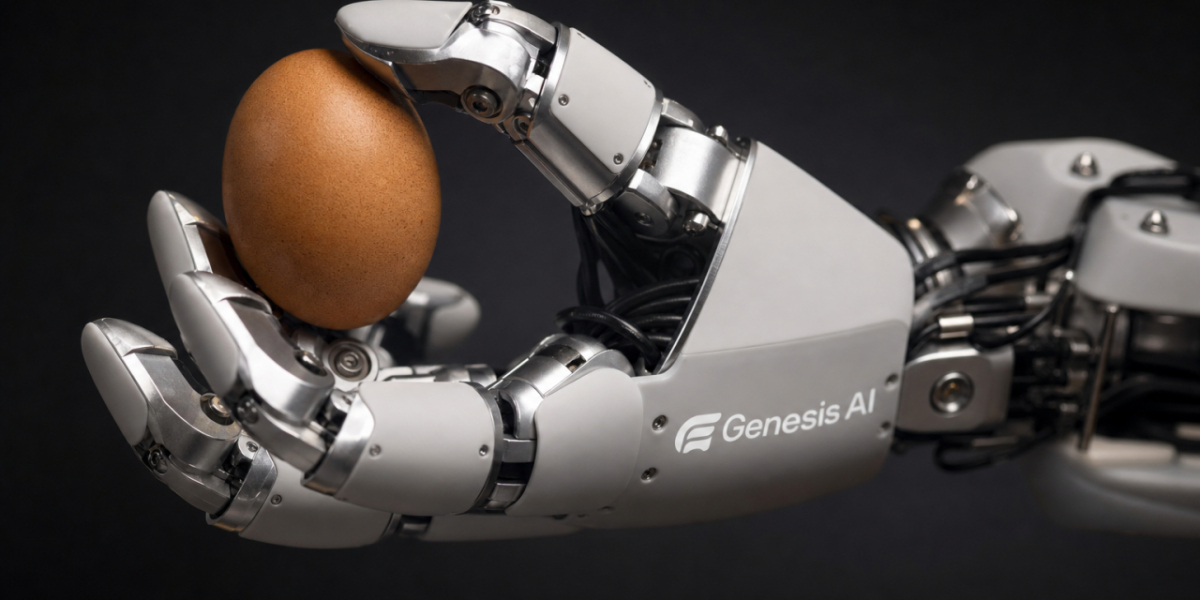
Genesis AI's robot AI model "GENE-26.5," unveiled last May, is the result of this philosophy condensed into a single product. Two hardware items were announced alongside it: a proprietary robotic hand designed to match the size and scale of a human hand, and a data collection glove equipped with tactile-sensing electronic skin.
The core concept is "one-to-one-to-one (1:1:1) mapping." When a person wears gloves and works as usual, the glove, the human hand, and the robot hand are connected within the same coordinate system, and their movements are immediately converted into learning data. No separate remote control equipment or specialized operator is required.
Je Reu-be (President) said, "The biggest challenge in robotics has always been data. Until now, there was no way to collect it in a scalable manner," adding that "since this technology can secure high-quality data simply by having people wear gloves, it is a true game-changer in solving the shortage of data."
Economic viability is also supported. The hardware cost of this exoskeleton is one-hundredth that of existing equipment, and internal tests recorded data collection efficiency up to five times higher than traditional remote operation. Based on this, Genesis AI has set its goal of building the "world's largest human technology library."
Superior performance was demonstrated through various demonstrations. GENE-26.5 autonomously performed 20 cooking tasks, including slicing tomatoes and cracking eggs with one hand; laboratory pipetting (a technique for transferring liquids); wiring harness organization, considered the fastest task in electronics and electrical fields; solving a LUVIXX cube in mid-air; and playing the piano at ultra-high speed.
Je Reu-be (President) explained the manipulation capability by dividing it into 'dexterity' and 'generalization'. He said, "Human-level dexterity seemed like an unreachable goal, but we showed that it is possible through GENE," adding, "The next challenge is generalization — the ability to immediately tackle entirely new tasks in completely new environments without retraining."
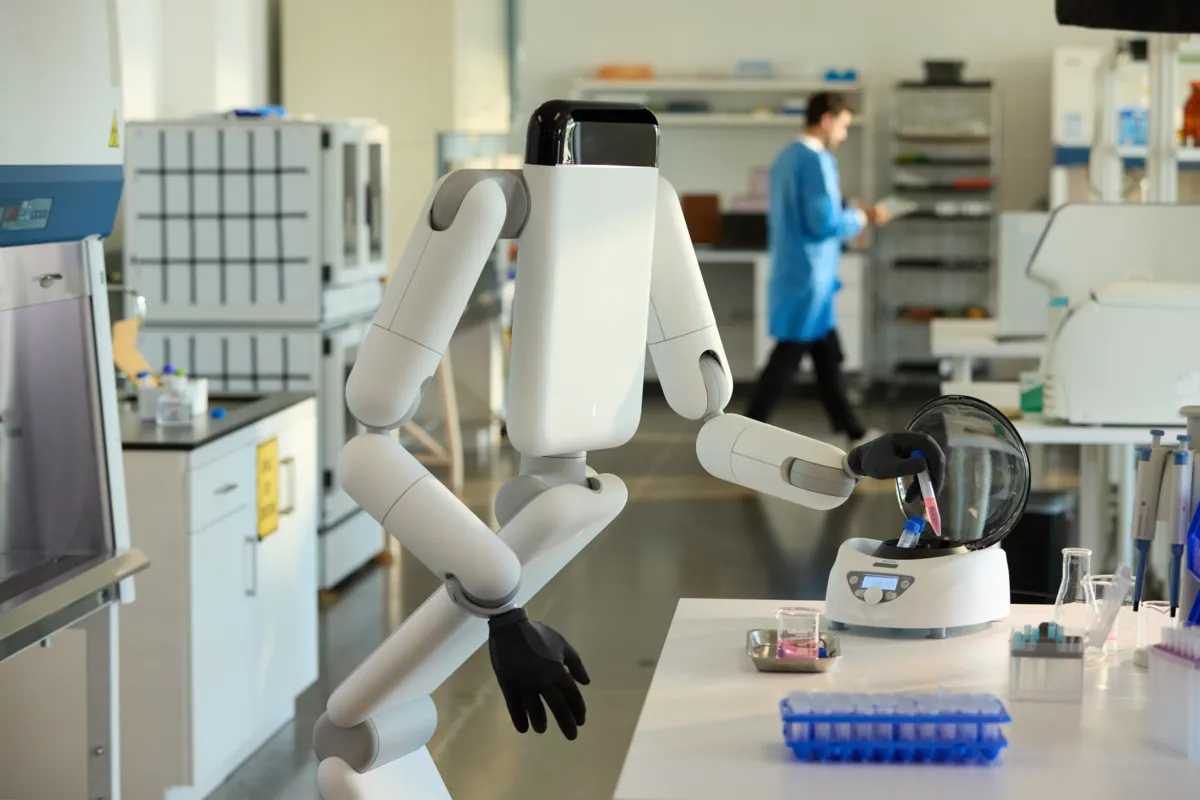
The first general-purpose robot "Eno," unveiled last June, broke away from the conventional grammar of humanoid robots. Instead of legs, it adopted a wheeled mobility system and did not mimic a human face. Rising above the wheels is a foldable articulated panel pillar that adjusts its height and reach in real time.
Je Reu-be (President) explained that the project started with a simple question: "What should robots actually do?" and added that they centered on human capabilities rather than human appearance, removing all elements that did not contribute to performance improvements.
The decision to adopt a wheel configuration was also made with customers as the top priority. He stated, "Most industrial customer work environments are flat and standardized," adding, "In such settings, wheels are faster and more efficient than legs. They also facilitate manufacturing, deployment, and expansion."
It partnered with LG CNS among Korean companies. The two sides have entered into a long-term cooperation agreement to identify manufacturing and logistics use cases targeting LG's U.S. facilities and LG CNS's customers, followed by multi-level expansion.
Je Reu-be (President) stated, "Global companies rely on firms like LG CNS to verify, install, and operationalize new technologies. This is a collaborative case that will make the large-scale adoption of physical AI a reality," adding that Eno's supply will expand from manufacturing, logistics, and laboratories to service industries such as hotels and hospitals, and eventually to homes.
He also left open the possibility of cooperation with other Korean companies. He said, "Korea has built an impressive robotics and advanced manufacturing ecosystem based on outstanding talent and a strong culture of innovation," adding, "We are always looking for opportunities to collaborate with organizations that can accelerate the spread of general-purpose robotics."
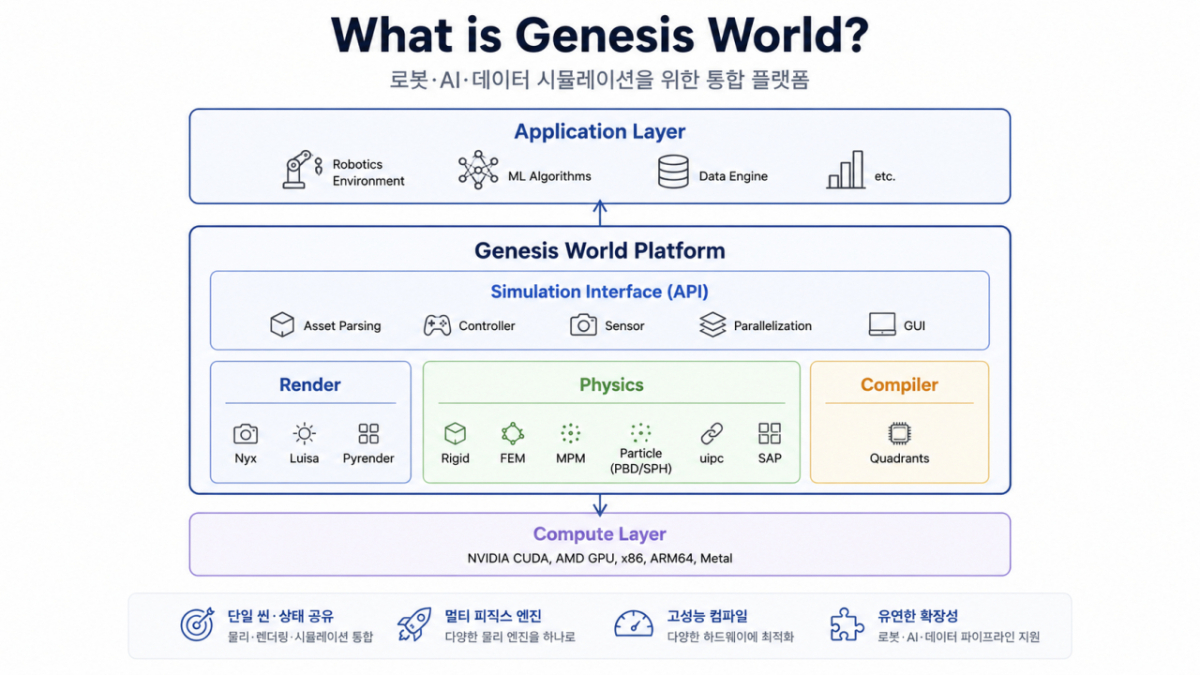
Another weapon of Genesis AI is the simulation platform "Genesis World 1.0." It is a tool that allows robots to perform tasks in advance within a virtual space before being deployed on-site. While most of the industry uses this space to generate training data, Genesis AI utilizes it as an "exam room" to evaluate the capabilities of a completed AI.
Je Reu-be (President) pointed out that "if the practice problems and exam questions are identical, it is impossible to tell whether skills have improved or answers were simply memorized," and added that "when learning data and evaluation environments come from the same simulator, one cannot distinguish whether a model has genuinely improved or merely become accustomed to that specific simulator."
Genesis World's approach is to train using only real-world data obtained from humans, while reserving the virtual space solely for grading. He stated, "Previously, evaluating a robot's capabilities required an operator to be constantly present with the robot, but now it is possible to run the process multiple times without any human presence and still achieve identical results."
Je Reu-be (President) emphasized that "it is possible to complete an evaluation requiring nearly a week of continuous testing in about 30 minutes," adding that "such a rapid feedback loop serves as the ultimate accelerator enabling much faster iterative development."
Genesis AI is reportedly moving to accelerate its technological advancement by seeking new investment of approximately $5 million won (about 70 billion won). The initiative is being led by Indian investor Premji Invest, and the company's corporate valuation is reported to be around $3 billion (about 4.2 trillion won).
Je Reu-be (President) emphasized that it aims to accelerate the spread of general-purpose robots in a way that benefits companies, workers, and society as a whole by creating "the most productive robot in history," with the goal of increasing productivity while giving people time to focus on meaningful and creative work.
[Money Today startup media platform 'Unicorn Factory']

 in FUTURE


