

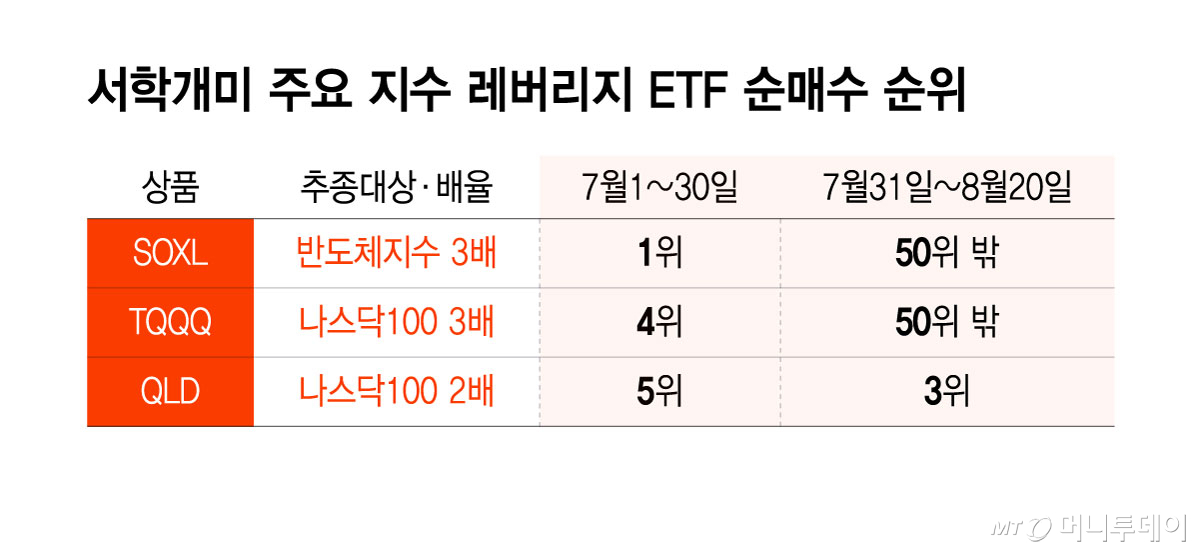
Although concerns were raised that investment demand would shift to overseas triple-index leverage products not subject to regulation, creating a 'secondary balloon effect' after the implementation of single-stock leverage product regulations, no such concentration actually occurred. Instead, the extreme high-multiple betting by retail investors in overseas stocks, which had been concentrated on triple-leverage products, appears to have subsided.
According to data from Save-Ro, the Korea Depository & Securities Clearing Corporation's Securities Information Portal, as of the 22nd, SOXL (which tracks one-day returns of the U.S. semiconductor index at three times) and TQQQ (which tracks one-day returns of the NASDAQ-100 index at three times) were both absent from the top 50 U.S. stocks by net purchase amount among domestic investors from July 31 to August 20, the period following the implementation of basic margin requirements for single-stock leverage products.
This stands in sharp contrast to the period just before the regulations. From July 1 to 30, SOXL's net settlement amount reached $3.33296 billion, ranking first among all U.S. stocks. TQQQ also ranked fourth with $326.26 million. At that time, extreme high-multiple betting had spread among retail investors in overseas stocks, with triple-leverage products occupying the top and fourth positions in net purchases.
Financial authorities raised the basic margin requirement for individual investors on domestically listed single-stock leverage ETFs (exchange-traded funds) and ETNs (exchange-traded notes) from 0.1 billion won to 0.3 billion won in cash, effective July 31. To prevent a balloon effect where investment demand would shift to overseas-listed single stocks if only domestic products were regulated, the same rules were applied to overseas products as well.
This raised concerns that overseas index leverage products not subject to regulation could become a new workaround—a 'secondary balloon effect' where high-risk investment demand shifts from single stocks to overseas products like SOXL and TQQQ that track indices at three times. Immediately after the regulations took effect, trading in single-stock leverage products plummeted, and signs of demand shifting to index leverage products were observed.
However, three weeks after the regulations were implemented, cumulative net purchases showed no continued concentration in triple-leverage products. Nevertheless, QLD, which tracks the NASDAQ-100 index at two times, ranked third with $157.85 million in net purchases, indicating that demand for leverage products remained at relatively lower multiples.
Ordinary individual stocks also occupied the top ranks in net purchases. SpaceX ($233.82 million), Alphabet ($219.63 million), Amazon ($156.47 million), Bloom Energy ($154.86 million), and Tesla ($120.93 million) were among them. Unlike the period before regulations when triple-leverage products dominated the top net purchase rankings, ordinary individual stocks surged into the upper ranks, showing a trend of reduced concentration in high-multiple products.
Experts noted that the disappearance of triple-leverage products from the top net purchase rankings was also influenced by an overall contraction in U.S. stock investments. Total net purchases of U.S. stocks fell sharply from $4.66862 billion (July 1–30) to $796.19 million (July 31–August 20), a drop of 82.9%.
However, it is difficult to view this contraction as entirely unrelated to the single-stock leverage regulations. In fact, trading volume for single-stock leverage products plummeted from 12.4 trillion won on July 30 to 70 billion won on August 11 following the implementation of the regulations. A financial industry official stated, "Since the leverage fervor was one of the drivers behind the surge in U.S. stock net purchases at the time, some contraction due to the regulations likely contributed to the overall decline in net purchases. However, we must also consider factors such as the high base effect from July and the state of the U.S. stock market."

 in STOCK
