

[For more diverse corporate information on the startups mentioned in this article, please visit the Unicorn Factory big data platform 'Data Lab'.]
"As I watched the rapid performance improvements of large language models (LLMs), I became convinced that when this advanced intelligence connects with physical hardware like 'robots,' it will create far greater value than anything previously seen in the world."
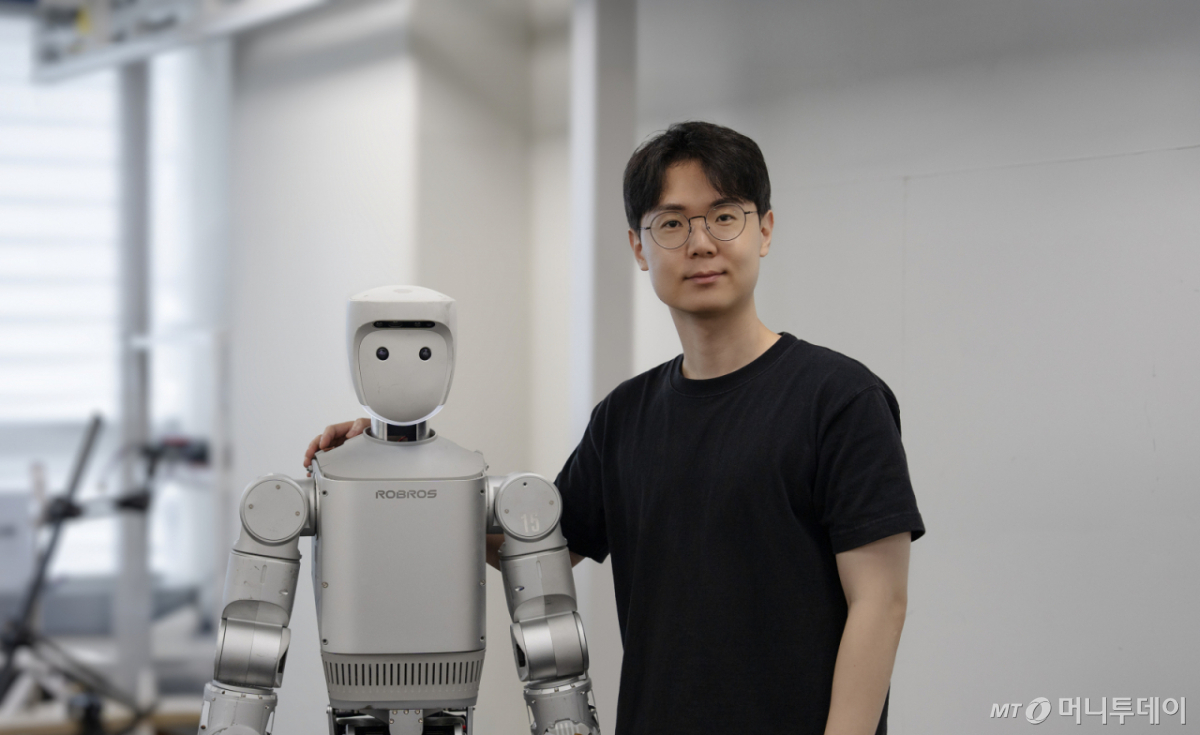
Kim Seung-yeon, CTO of Roboros, recently explained to Money Today's startup media platform "Unicorn Factory" why Roboros is pursuing full-stack humanoid development. After earning a doctorate in robotics from Seoul National University and working as a researcher at Samsung Electronics' Advanced Institute of Technology, Kim decided to enter the field of combining AI with robot hardware after witnessing the AI innovation triggered by the emergence of ChatGPT. Currently, he oversees humanoid robot development at Roboros and is focused on accelerating product commercialization.
Kim CTO stated, "For AI to enter the real world, it requires hardware as an essential platform," adding, "Conversely, no matter how excellent the hardware is, it cannot perform its full function without AI." He further explained that Roboros adopted a full-stack approach from the beginning because both AI and hardware must be optimized simultaneously.
Roboros is a startup specializing in humanoid robots, developing both robot hardware and AI control models concurrently. Its flagship model, the bipedal humanoid "IGRIS-C," stands 154 cm tall and weighs 56 kg. The company has developed all aspects of the product independently, from mechanical design to control algorithms and AI software.
In the past, robot control relied on a model-based approach where humans meticulously planned and input each movement. However, Kim CTO explained that today's robots have evolved to accumulate experiential data through cameras and sensors like humans, then autonomously infer actions based on that data. To achieve this, Roboros has built its own Vision-Language-Action (VLA) model to drive the robot.
Recently, the company is also conducting research to maximize cognitive and control performance by comprehensively utilizing not only cameras but also force sensors and tactile sensors. He noted, "As AI-based control becomes a global standard, the very definition of a 'good robot' has completely changed." In the past, robots were considered superior if they possessed strong physical power or high functional precision. Now, however, robots that are optimized for AI and can effectively perform actions learned in virtual environments within real-world settings are recognized as demonstrating comprehensively higher performance.
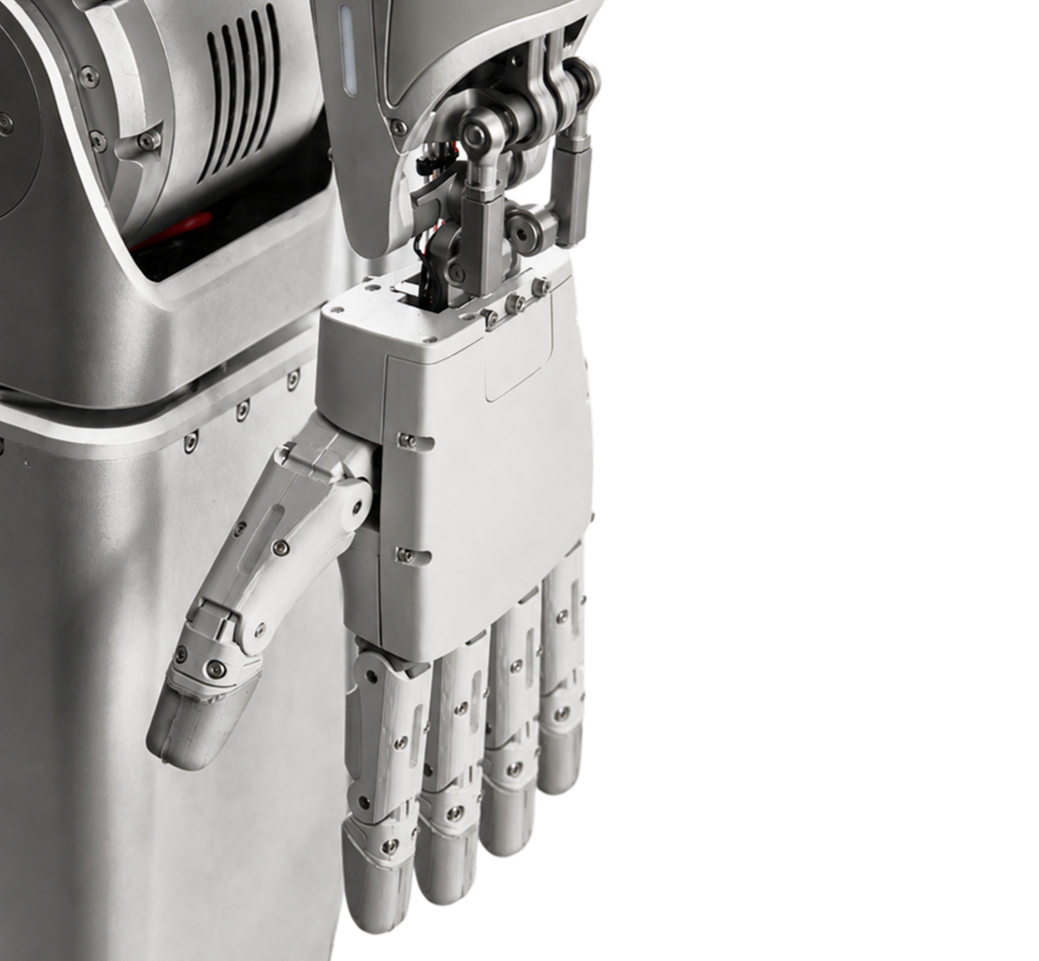
Currently, the component receiving the most R&D focus at Roboros is the "hand." This is because it is the part that directly contacts the environment when the robot grasps objects and performs tasks. Explaining why they develop components in-house rather than purchasing off-the-shelf robot hands, Kim CTO stated, "Off-the-shelf products often fail to meet the high standards required by actual industrial sites in terms of durability, grip strength, and heat control."
The most distinctive feature of Roboros' hand is its design, which places actuators in the forearm (lower arm) and uses wires to pull joints for movement. Kim CTO explained, "While embedding motors inside the hand may offer slightly higher precision for fine movements, this wire-driven approach is more suitable for meeting the strong force requirements and high durability demanded in industrial settings."
The fingers are designed with five digits, similar to humans. This choice was made to facilitate data collection and application. Since human hand movement data is most abundant, it allows for efficient learning, and tools used by humans can be utilized without any additional modifications.
Roboros is currently conducting technology proof-of-concept (PoC) projects with various companies, primarily in logistics and manufacturing sites. The robots are not yet at the fully autonomous stage; instead, they are accumulating field data and improving model performance through teleoperation, where humans remotely control the robots from a distance. Based on this acquired data, the company plans to finalize models applicable to industrial settings before launching full-scale Yangsan operations.
Kim CTO stated, "There are still many complex sites in Korea that cannot be automated solely with collaborative robots, so we are targeting those gaps." He added, "As real-world data continues to accumulate, robots will be able to perform humans' complex tasks quickly and accurately without requiring additional learning."
At the Yangsan stage, the biggest technical challenge identified is achieving "uniform performance." For AI to deliver consistent results, it is crucial that each robot implements hardware of identical quality. To address this, Roboros designs and produces approximately 60% of its key components, including actuators, in-house, thereby increasing the rate of component localization.
While IGRIS-C currently stands at 154 cm, future models are planned to have increased height and body size. Although the current model is equipped with a single battery, the company is considering installing two or more replaceable batteries to enable extended operation. This will allow work to continue using one battery while the other is being replaced.
He remarked, "If humanoid robots demonstrate their effectiveness in industrial settings within Korea, which boasts excellent manufacturing capabilities, it will naturally lead to overseas demand." He further stated, "We plan to continue development with an eye toward platform scalability to respond to varying requirements across different sites."
[Money Today startup media platform Unicorn Factory]

 in FUTURE


