

[For more diverse corporate information on the startups mentioned in this article, visit Unicorn Factory's big data platform 'Data Lab'.]

"The VPP (Virtual Power Plant) we envision is one that consolidates diverse energy resources such as solar power, wind power, ESS (Energy Storage Systems), and DR (Demand Response) into a single portfolio and operates them like a massive power plant. Since accurately predicting and controlling the generation output and demand of multiple resources is crucial, we have been advancing related prediction technologies over the years. Based on this foundation, we plan to challenge for listing under KOSDAQ's technology-specific exemption."
Energy IT platform company Enlightenis aiming for a KOSDAQ listing by leading with its Virtual Power Plant (VPP) business. The company plans to consolidate small-scale solar power plants scattered across the country to expand its VPP operations and become Korea's first listed VPP company.
Lee Yeong-ho (CEO)explained that "for customers building new power plants, we construct and operate them on their behalf while charging fees; for already-operating power plants, we bundle them through electricity brokerage to generate revenue." He added, "Combining these two approaches ultimately creates a VPP," presenting the company's decade-long business journey as culminating in the VPP model.
Now in its 10th year since founding, Enlighten is an energy platform covering everything from solar power plant construction and operation to electricity sales. It manages approximately 30,000 solar power plants nationwide, with a total capacity of 8 gigawatts (GW). Lee (CEO)stated, "Considering that the total investment-type solar power capacity in Korea is about 30 GW (excluding cases where generated electricity is used directly), Enlighten's managed plants account for roughly 24% of the market."
Building on this network of power plants and data, Enlighten is expanding its VPP business. The strategy involves advancing technologies to predict individual plant generation outputs and integrate them into a single electricity portfolio.
The traditional electricity market has operated primarily around generation sources with relatively predictable output, such as nuclear, thermal, and hydro power. In contrast, renewable energy sources like solar and wind vary in output depending on weather conditions, making it difficult for individual plants to respond stably to the electricity market.
Enlighten uses VPPs to aggregate multiple solar power plants, increasing both scale and predictability for responding to the electricity market. Since about 80% of Korea's solar power plants are under 1 megawatt (MW), bundling multiple plants is necessary to create a scale capable of trading electricity with large corporations.
Recently, Enlighten secured Power Purchase Agreements (PPAs) with subsidiaries of major conglomerates, linking its business model to actual electricity transactions. Lee (CEO)said, "Gathering these power plants and securing PPAs with large corporations is also our role."
Enlighten installs self-developed equipment at each power plant to collect generation data. This ensures consistent data acquisition even when inverters and module manufacturers differ across plants. The collected data is then used for integrated plant management and market response.
Based on this, Enlighten currently manages the prediction error rate of its electricity brokerage business at around 4–5%. In tests of semi-centralized dispatch systems, it achieved a resource aggregation output control compliance rate of 99.65%. The company plans to further enhance its prediction and control capabilities in preparation for the renewable energy bidding market scheduled for introduction next year.
Lee (CEO)stated, "A true VPP must not only predict generation output but also possess real-time control capabilities to respond to Korea Power Exchange directives. Therefore, we are advancing our technologies accordingly."
The background behind Lee (CEO)founding Enlighten lies in 10 years of financial investment experience. Having worked at a securities firm managing alternative investments in renewable energy and gaining experience in overseas electricity trading and sales markets, he recognized the potential for growth in Korea's related market and founded Enlighten in 2016.
In its early days, Enlighten focused on creating funding structures that allowed investment in solar power plants using government subsidies. Around 2020, as industrial electricity rates rose, the price competitiveness of electricity generated from solar increased. With enterprises becoming more motivated to utilize solar power, Enlighten developed a business model enabling companies to use solar facilities without initial investment burdens and concentrated on this area.
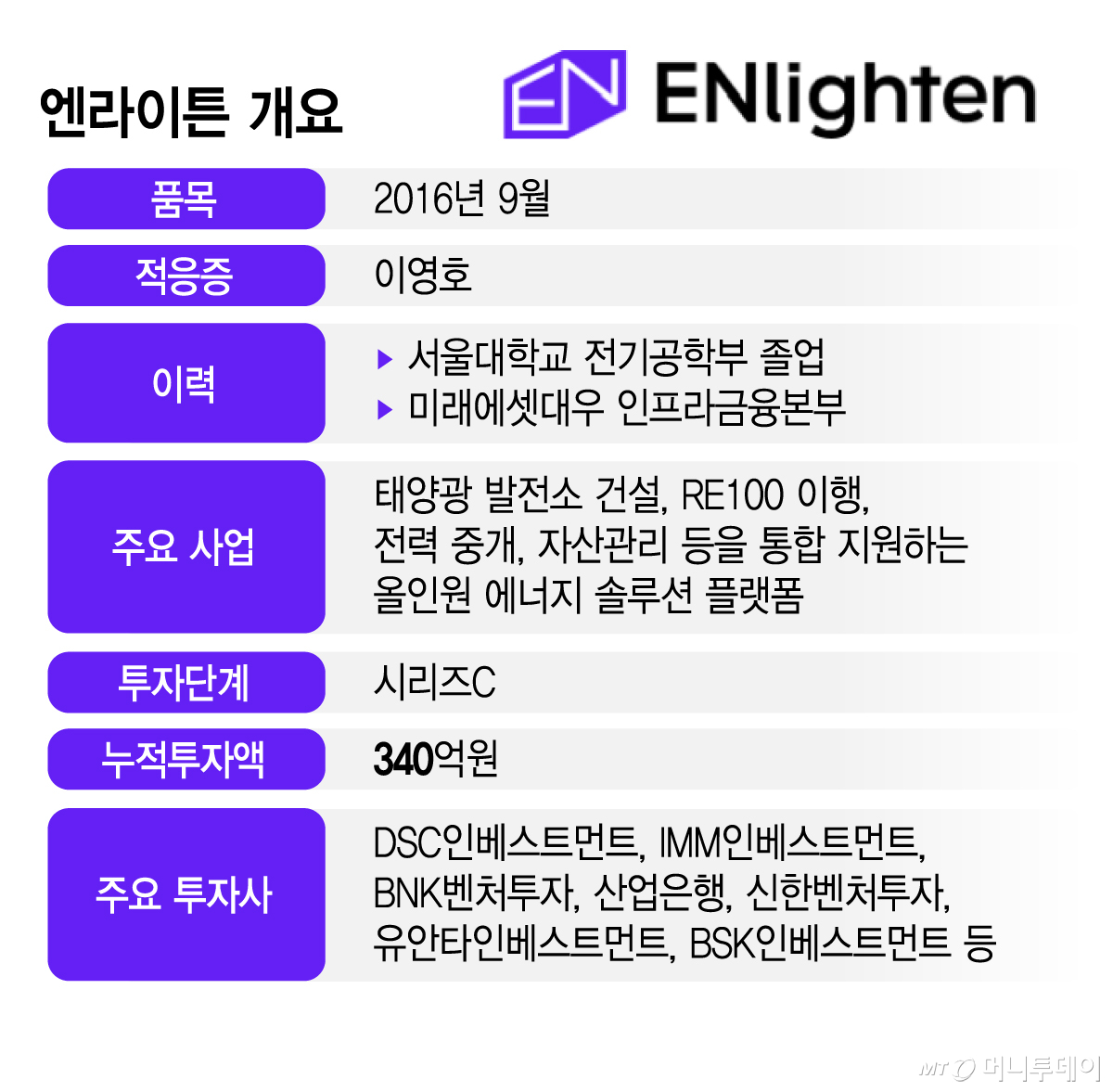
Enlighten received an A-grade rating in preliminary technical evaluations last July, initiating the technology-specific listing process. After completing the main evaluation, it plans to request a preliminary review in November and finalize its listing by next year at the latest.
Last year's consolidated revenue was 48.5 billion won, with both operating profit and net income showing profits. Lee (CEO)said, "Since last year's annual revenue reached the 50 billion won range and we recorded a profit, financial aspects should not pose issues during the exchange review."
Funds secured through the listing will be concentrated on VPP operations. The company plans to expand its resource portfolio beyond solar to include ESS and invest in personnel and technologies needed to respond to the renewable energy bidding market. It may also consider acquiring related companies if necessary.
In overseas markets, Enlighten will separately target power plant construction projects and electricity trading technologies. For plant construction, it prioritizes Southeast Asian countries such as Vietnam, Indonesia, and Malaysia, noting that many domestic clients already have production facilities there, enabling expansion into foreign markets by following existing customers. For electricity trading technology, Japan is the top priority market.
The model Enlighten aspires to emulate is UK-based Octopus Energy. The goal is to evolve from a company focused on power plant operations and electricity trading into a comprehensive energy enterprise covering power supply and tariff plans. Octopus Energy supplies electricity based on its proprietary energy platform and operates various smart tariff plans.
Lee (CEO)remarked, "The term 'VPP' itself is difficult for many to understand," adding, "We aim to create services where customers can easily use the electricity they need without worrying about power plant operations." He further stated, "Our vision is to offer diverse electricity tariff plans similar to mobile communication plans."
[MoneyToday startup media platform Unicorn Factory]

 in FUTURE

