

As the government signals its intention to implement virtual asset taxation as scheduled starting next year, backlash from the industry and investors intensifies. The current structure requires investors to file comprehensive income taxes annually on their own, which is complex and difficult, raising concerns that it will create countless lawbreakers Yangsan. A national petition calling for a deferral of virtual asset taxation has surpassed 50,000 signatures, and the industry is taking countermeasures, including holding policy seminars with opposition parties.
According to relevant industry sources on the 19th, Lee Hyung-il, nominee for Minister of Economy and Finance, stated during his confirmation hearing on the 16th regarding virtual asset taxation that "the situation has been delayed significantly," adding, "Starting now will not cause as much shock as expected." Earlier, in written responses to the confirmation hearing, he also clarified that "it is desirable to implement taxation as scheduled from 2027 in accordance with basic tax principles," further fueling controversy over virtual asset taxation.
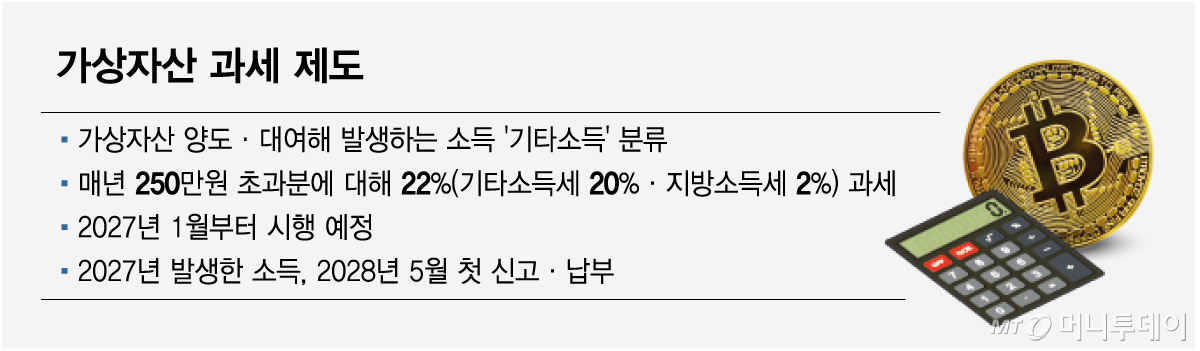
Virtual assets were first included in the taxable scope following an amendment to the Income Tax Act in December 2020 but were postponed multiple times due to reasons such as the lack of a prepared tax system, and have now been delayed until January next year. Since the current tax reform plan does not include a deferral provision, taxation is set to proceed as scheduled starting next year. If virtual asset taxation is implemented, investors earning annual profits of 2.5 million won or more from virtual asset investments will be required to pay taxes amounting to 22% of their income (20% miscellaneous income tax and 2% local income tax) starting next year.
Virtual asset investors are objecting. The petition titled "Petition for a Two-Year Deferral of Coin Taxation," which was posted on the National Consent Petition site at the end of last month, received agreement from approximately 50,000 people in less than a month. Investors argue that "coin taxation should be properly implemented only after a two-year deferral to establish the necessary tax infrastructure."
The industry has also begun taking countermeasures. The Digital Asset Exchange Joint Consultative Body (DAXA) plans to hold a 'Policy Seminar on Improving the Digital Asset Taxation System' with the People Power Party at the National Assembly on the 21st to discuss the current status of virtual asset tax preparation and proposed system improvements. Since the People Power Party adopted the abolition of virtual asset taxation as its official party stance in March, it is expected to emphasize the need for a deferral.

While there are numerous grounds for criticism, including fairness issues compared to the deferred financial investment income tax and insufficient tax infrastructure, the industry's core opinion is that damage to investors is most concerning.
Virtual asset income is classified as miscellaneous income, requiring investors to file separately and pay taxes during the annual comprehensive income tax filing period. While this can be easily resolved when trading on domestic virtual asset exchanges such as Upbit or Bithumb, the problem lies in investors using multiple overseas virtual asset exchanges. Investors must collect transaction information distributed across various exchanges themselves, calculate profits and losses, and file reports every time. The main investor demographic for virtual assets consists of people in their 20s and 30s who are not accustomed to tax filing or payment, and the requirement to gather and report relevant data individually is expected to create countless tax defaulters Yangsan.
A virtual asset industry official stated, "Investors using only domestic exchanges may face no issues, but those using multiple overseas exchanges must create Excel files themselves to consolidate transaction records and calculate income," adding, "It is extremely complex and cumbersome, leading many to give up on tax filing, which will ultimately result in the appearance of countless tax defaulters."
The official continued, "The National Tax Service must be able to verify taxpayers' filings by having full knowledge of transaction records from major overseas exchanges as well, but the infrastructure is still insufficient," and noted, "If blind spots emerge, fairness issues in taxation between users of domestic and foreign exchanges could also arise." The National Assembly Budget Policy Office also pointed out in a report on the 17th that it is difficult to identify transaction records and actual owners for decentralized exchanges (DEX), personal wallets, and overseas exchanges.
Critics also point out that while virtual asset taxation has been postponed multiple times, the government has failed to properly prepare tax system infrastructure or related regulations. Another official stated, "The industry does not oppose taxation itself but argues that taxation should be implemented properly by considering factors from tax classification and criteria to infrastructure construction and consistency with the Digital Asset Basic Act."

 in STOCK

