

The technology of "continual learning," where artificial intelligence (AI) continuously learns new information, is emerging as a new growth driver for the memory semiconductor (hereinafter referred to as memory) market. Despite recent concerns about "slowing down AI development," if continual learning gains momentum, demand for AI memory, previously concentrated on HBM (high-bandwidth memory), is expected to expand to server-grade DRAM and NAND flash (hereinafter NAND). The beneficiaries are also expected to broaden for Samsung Electronics and SK Hynix.
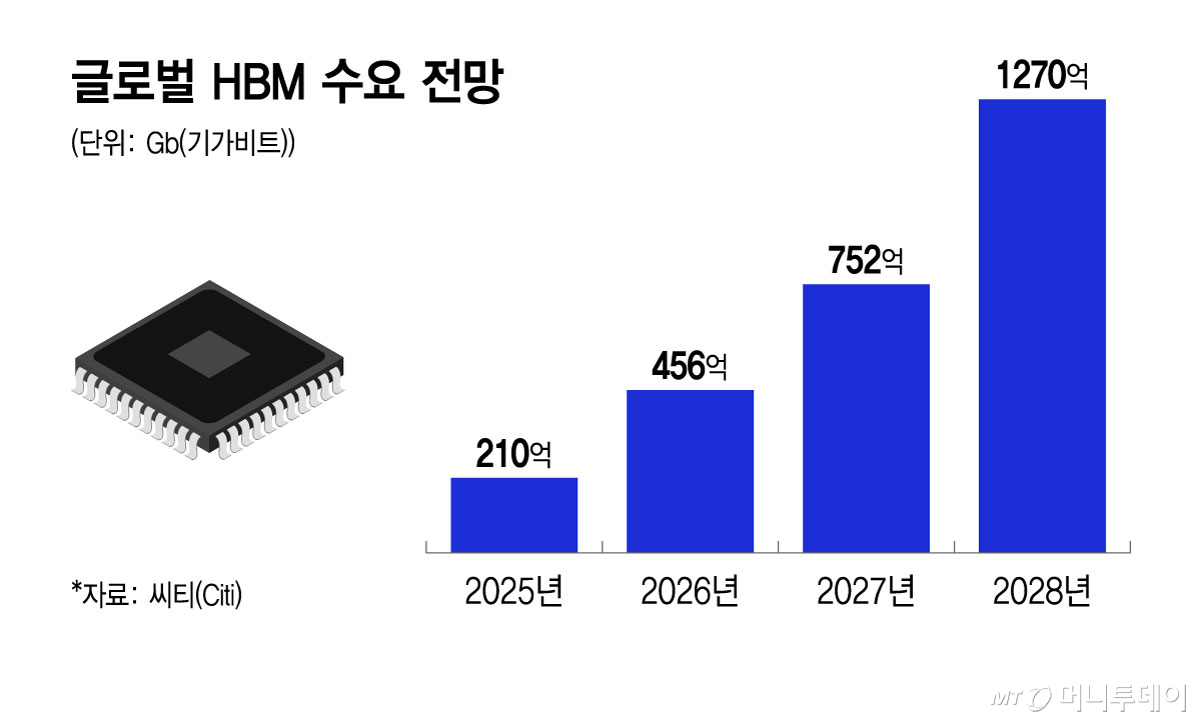
According to the electronics industry on the 19th, global investment bank Citi recently forecast that next year's global HBM bit demand will reach 752 billion gigabits (Gb), a 62% increase from this year. By 2028, it is projected to grow 2.8 times from this year's level, reaching 127 billion Gb.
Citi cited "continual learning" as one of the main drivers behind the surge in HBM demand. Continual learning is a method where AI continuously learns new data and experiences while retaining previously acquired knowledge. The analysis suggests that as AI repeats learning and reasoning, demand will rise simultaneously for not only HBM but also server-grade DRAM and eSSD (enterprise solid-state drives).
Citi explained, "Despite downward revisions in memory specifications and recent concerns over AI safety, AI's continual learning will reshape long-term memory demand." The bank forecast that as continual learning emerges as a core theme for AI over the next five years, memory supply shortages will persist until 2031.
Currently, most generative AI models are trained on large datasets in advance and generate responses based on that pre-learned knowledge. New information encountered during the service process is not automatically reflected as long-term knowledge within the model. This leads to inefficiencies such as re-reading past conversation records every time a question is asked.
However, in continual learning, the boundary between learning and reasoning becomes blurred. The goal is for AI to learn new data and experiences while providing services and combine them with existing knowledge. If traditional AI resembles "a student who has finished studying and is now taking an exam," continual learning AI is closer to "a student who continues to study new material even while taking the exam."
Continual learning models require more memory capacity. This is because they must continuously learn new information while simultaneously accessing vast amounts of previously acquired data. Since not all data can be stored in expensive HBM, the strategy of deploying server-grade DRAM and NAND-based eSSD alongside HBM becomes crucial. This signifies that benefits in the AI memory market may expand from being HBM-centric to including server-grade DRAM and NAND.
The role of memory is also changing. Since learning continues even during the AI model's reasoning process, simply expanding memory bandwidth will not easily resolve data movement bottlenecks. Consequently, there is growing need for technologies like PIM (Processing-In-Memory), which perform computations directly within or near the memory itself.
Samsung Electronics and SK Hynix are also responding to these structural changes in AI memory. At the "AI Infrastructure Summit 2026" held on the 16th (local time) in California, U.S., both companies unveiled next-generation technologies aimed at overcoming limitations of existing AI infrastructure centered on GPUs (graphics processing units) and HBM.
Samsung Electronics proposed "zHBM," a three-dimensional stacked memory that directly stacks HBM on top of an AI accelerator, as a solution. Moving away from the conventional 2.5D structure where HBM is placed beside the accelerator, the plan involves stacking HBM directly atop the accelerator to reduce data movement distances. The goal is to increase AI response speeds by tenfold.
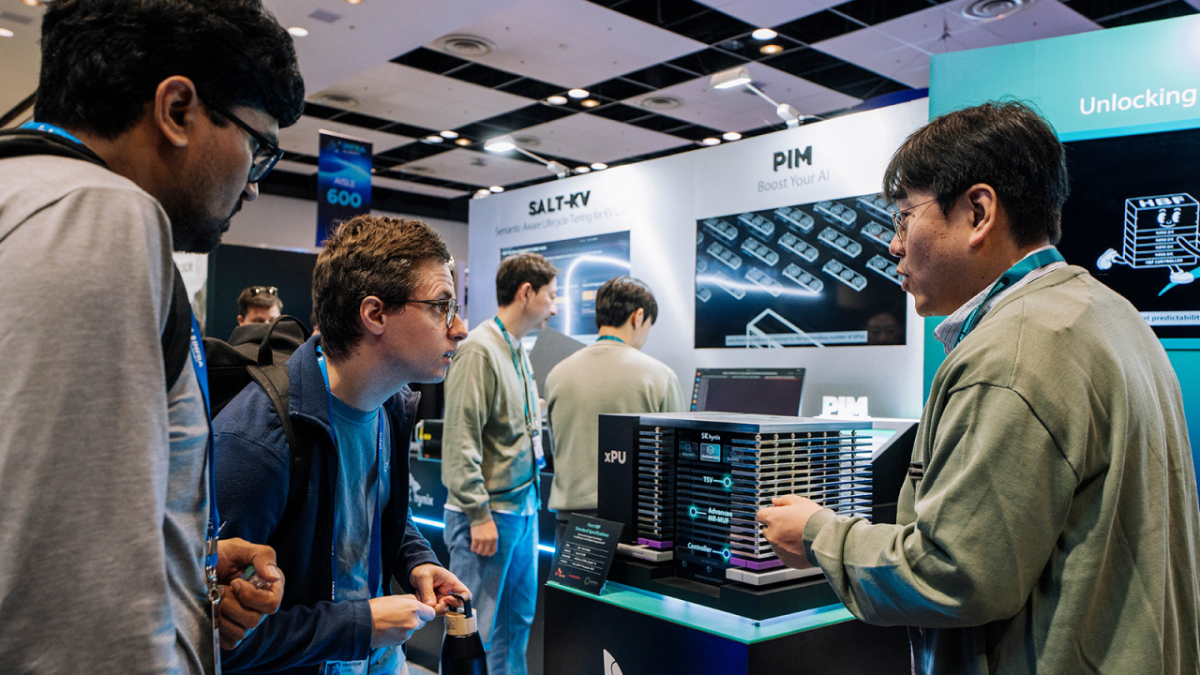
SK Hynix introduced technologies such as PIM and SALT-KV (Semantic-Aware Lifecycle Tiering for KV Cache), and also displayed a model of its HBF (high-bandwidth flash) structure. SALT-KV is a technology that places data utilized by AI into the most suitable storage layer among HBM, DRAM, and SSD based on data characteristics, thereby improving memory resource efficiency. Earlier, Lim Ui-cheol of SK Hynix stated during his presentation at the "AI Infrastructure Summit," "It is becoming increasingly difficult to meet new requirements with only the existing GPU-HBM structure." He added, "To accommodate changing workloads, we are preparing new solutions that encompass both hardware and software, including PIM, HBF, and SALT-KV."

 in INDUSTRY

