

[For more diverse corporate information on the startups mentioned in this article, visit Unicorn Factory's Big Data Platform 'Data Lab'.]
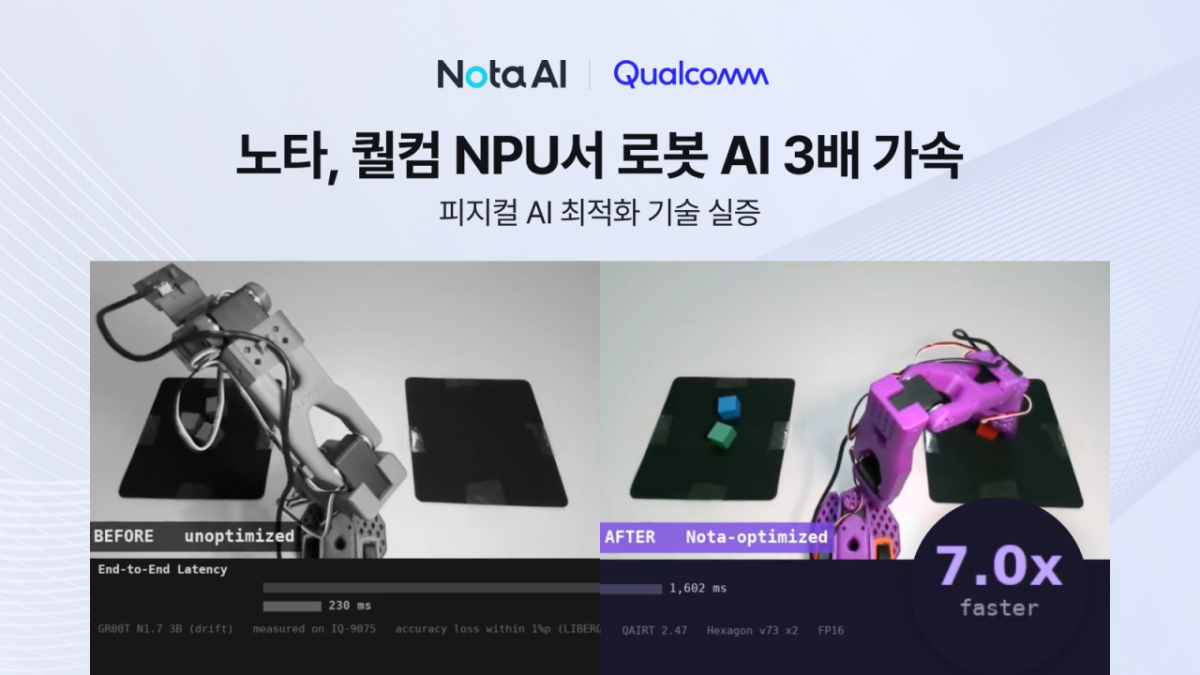
On the 22nd, AI model lightweighting and optimization technology company Notta announced that it optimized robot AI models and execution environments on Qualcomm Technologies' industrial system-on-chip (SoC), increasing actual robot arm task speed by three times compared to before.
In this demonstration, Notta drove the Vision-Language-Action (VLA) model directly on the Neural Processing Unit (NPU) of the 'Qualcomm Dragonwing IQ-9075' processor inside the robot without relying on external servers, leading to actual performance improvements in task execution.
Performance verification was conducted through a task where a robot arm picked up a cube according to a language command and moved it to a mat on the opposite side. The VLA inference speed increased by up to seven times, the actual object movement task speed improved by three times, and the task success rate reached 92%, confirming an accuracy loss of within one percentage point compared to the original model's 93%.
The core of this achievement lies in optimizing robot AI models that were previously run on high-performance GPUs or external servers so they can be executed directly on edge AI boards based on Dragonwing IQ-9075 connected to the robot. Notta translated inference speed improvements into tangible gains in actual robot task speed and success rates.
VLA models require significant computation and memory usage, necessitating overall optimization of both the model and execution environment to run inside robots with limited power and computing resources. Notta optimized the entire process, including △VLA-specific lightweighting △NPU computation graph optimization △multi-NPU runtime construction △and acceleration of action generation.
Subsequently, the system was connected to an actual robot arm to comprehensively verify inference speed, task speed, model accuracy, and task success rate in an end-to-end environment covering camera image recognition, language command understanding, action generation, and execution.
Inference speed refers to the time taken from when camera images and language commands are input until the model generates the robot's next action. Faster inference reduces the waiting time for the robot to decide and execute its next move, enabling real-time responses to changing environmental conditions.
A Notta representative stated, "Robot AI optimization goes beyond making large models smaller and running them faster; it is a technology that ensures actions learned by the model are performed stably at appropriate times even in actual environments."
Notta showcased a robot arm demonstration using this technology at 'KRAIN (Korea Real-World AI Network) 2026'. At the event booth, the company compared robot tasks and measured results before and after optimization to demonstrate how inference speed improvements impact actual task speed and stability.
Organized by the Ministry of Science and ICT, KRAIN is an AI network demonstration project promoted under the government's 'Hyper AI Network Strategy', designed to introduce AI network demonstrations and review industry-specific application cases and standard proposals. It was held as a pre-showcase ahead of the AI-RAN Alliance General Meeting scheduled for Seoul in the second half of this year.
Chae Myeong-soo Noh Ta (CEO) said, "This achievement demonstrates that Notta's accumulated AI optimization technology does not merely improve model size or inference speed but can translate into actual robot responsiveness and task performance."
He added, "We will continuously expand and enhance the optimization layer covering various AI models and hardware, extending technology applications and business domains beyond mobile, edge, and data centers to all areas of physical AI, including robots and humanoids."
[MoneyToday startup media platform 'Unicorn Factory']

 in FUTURE
