

[For more diverse company information on the startups mentioned in this article, please visit the Unicorn Factory big data platform 'Data Lab'.]

"I believe that conversing with artificial intelligence (AI) using natural language will become increasingly commonplace. Ultimately, the question is whether AI-based psychological counseling can fully realize the value of traditional human-led psychological counseling,"
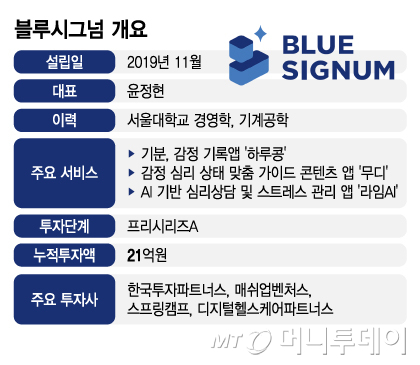
Yoon Jung-hyun, CEO of Blue Signum, explained as follows why his company's services remain competitive even in an environment where general-purpose AI models are becoming more advanced. Established in November 2019, Blue Signum is a mental wellness startup that operates the emotion-tracking app 'Haro-kong'.
The company currently operates four services: Haro-kong, the emotion guide app 'Moodi', the AI stress counseling service 'LimeAI', and the wearable-based stress measurement app 'Panora'. Haro-kong has surpassed 10 million cumulative downloads, with over 80% of its revenue coming from overseas.
The high proportion of overseas business stems from the fact that services were designed with a global market in mind from the outset. Although Haro-kong was initially launched in Korean, it began supporting multiple languages within three months. Yoon (CEO) stated, "I believe that for app businesses, considering the global market from the start is natural," and added, "Since it is a recording service centered on intuitive design, I believed it would not be heavily constrained by language."
All apps are developed with English as the baseline, followed by the addition of Korean and Japanese. The largest user base is in the United States, with Japan following closely after recent growth. User inflow is also gradually increasing in English-speaking countries such as the United Kingdom, India, and the Philippines.
The reason for operating multiple separate apps lies in the differing target audiences and use cases of each service. Haro-kong is used by late teens and women in their 20s as a daily diary app even when they do not experience depression. LimeAI has a higher proportion of users in their 30s who are office workers, and it is often sought out with a specific purpose when there is a clear problem to resolve. Panora was created to provide early signals to users who fail to quickly recognize their own stress levels.
However, the majority of revenue so far has come from Haro-kong. He stated, "Currently, about 90% of our revenue comes from Haro-kong, while the other businesses are now entering a phase of actively driving growth." The company applies a 'freemium' model that provides basic features for free and charges only for premium features.
Yoon (CEO) cited consumer culture accustomed to paying for software and active product feedback as key factors behind the service's popularity overseas. He also viewed the ability to rapidly improve services based on user feedback as a strength.
Blue Signum plans to expand its business beyond B2C into B2B solutions. The counseling solution LimeAI is conducting open innovation with Hyundai E&C, preparing for pilot testing within apartment complexes. This involves installing tablets in wellness spaces such as meditation rooms within the complex, allowing residents to receive counseling independently. It is expected that this will also assist in managing the mental health of residents.
Inquiries about adoption from schools and institutional investors are continuing. Regarding schools, there is demand because waiting times for adolescent counseling have lengthened, and there is a need for accessible channels where young people can comfortably share stories they find difficult to tell adults. While teachers cannot directly view counseling content, the company plans to implement features that use AI to identify high-risk students and connect them to professional counseling when necessary. The company is also considering targeting enterprises by offering group counseling services available to employees.
The company is also preparing to expand into the medical sector through digital therapeutics (DTx) for patients with schizophrenia. While medication can alleviate delusions and hallucinations in schizophrenia patients, their ability to read facial expressions or understand social situations may be impaired due to frontal lobe damage. Recognizing that rehabilitation of such social cognitive functions is currently limited mainly to regional centers, the company has initiated exploratory clinical trials. Yoon (CEO) noted that other digital therapeutics are shifting toward non-covered markets due to reimbursement issues and left open the possibility of collaboration with pharmaceutical companies.
The company does not plan to seek additional investment for the foreseeable future. Yoon (CEO) stated, "We have secured sufficient runway, so investment is a lower priority," adding, "If we were to accept investment now, it would likely lack a clear purpose." The company's stance is that it will consider investment with specific objectives in mind when funding becomes necessary for drug approval processes or when new breakthroughs emerge in marketing.
The short-term goal is to achieve break-even point (BEP) next year. He said, "If the currently operating services generate strong profits, there could be various exit strategies in the long term," and added, "For now, we plan to focus on improving operational performance."
[MoneyToday startup media platform Unicorn Factory]

 in FUTURE

