

[For more diverse corporate information on the startup featured in this article, visit the Unicorn Factory big data platform ‘Data Lab’.]
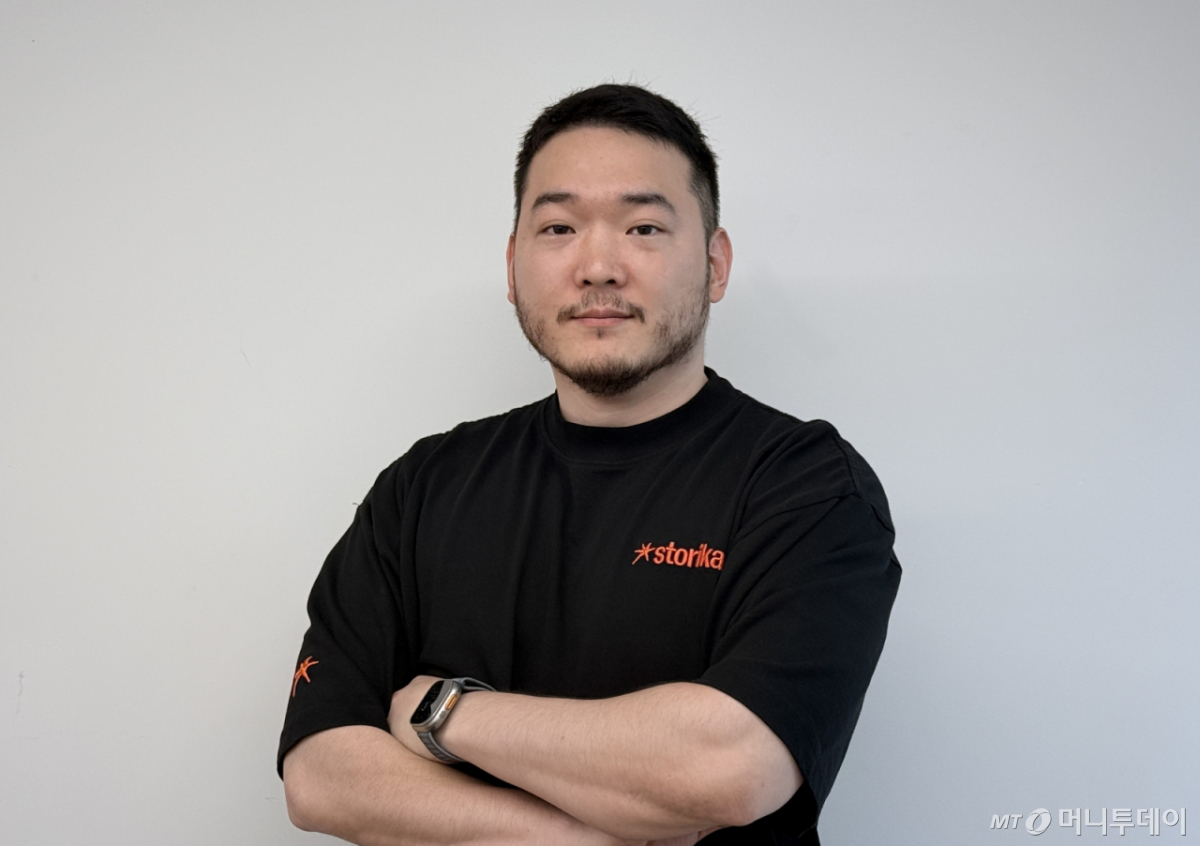
“The phrase 'nice vibe' is understood by humans, but while artificial intelligence (AI) can grasp the context, it cannot intuitively find something that fits perfectly. We aim to turn this kind of feeling into data so that marketing runs on its own.”
Lee Jae-han (Bryce Lee), founder of Storica, noted that even in an era where social media platforms such as Instagram and TikTok determine a brand’s success or failure, the marketing field still relies heavily on manual labor. One must directly find creators who match the product, reach out to them, answer their questions, send samples, and handle settlements one by one. He judged that this process could be automated through AI and founded Storica.
While attending university in the United States, Lee (CEO) read an article stating that the average age of founders who created unicorn companies was 34. He said, “I aimed to eventually do my own work and made efforts to gain diverse experiences until I turned 34.”
His first job was at Credit Suisse in New York. After joining as a technology analyst, he transferred to a newly established blockchain team through an internal recruitment process. By examining private companies, he naturally gained experience in startup analysis. Upon returning to Korea, he handled venture investments at Hyundai Motor’s CVC (corporate venture capital).
He said, “While learning by observing others and facing challenges was good, I felt that if I did not run around on the front lines myself, it would be difficult when I actually started a business.” Subsequently, he worked as a PM (product manager) at web novel platform Radish Korea, handling performance marketing. He also joined art-tech company Abitus Associates as an early member, experiencing the process of building a business from scratch.
Having felt the importance of marketing while working at startups, he focused on the repetitive manual work in creator marketing. From finding and contacting creators who match the product to managing content and handling settlements, many tasks required human intervention. Lee (CEO) viewed this as a bottleneck in the marketing field. The current team was formed when Park Jong-hyun, CTO (Chief Technology Officer), a college classmate who worked as a machine learning engineer at TikTok in the United States, joined.
Storica analyzed approximately 8 million creator profiles and over 100 million pieces of content, accumulating them in a database (DB). It used AI to analyze short-form videos, captions, product images, and engagement metrics to extract information and convert it into data.
Based on this data, the company developed a solution that finds creators matching the brand, message, and target customers. Lee (CEO) said, “When a brand marketing manager looks at the creators recommended by the solution and responds with 'good' or 'no,' that result is reflected in the next recommendation,” adding, “We also enabled message sending and content collection to be handled on a single screen.”
The market Storica is prioritizing is the United States. The company was established in the U.S. to target the North American market first. Recently, it has been upgrading its solution so that creators are not judged solely by information visible on social media. This decision stems from the judgment that to filter out individuals who could negatively impact a brand’s image, one must verify off-feed information such as past history and reputation. It is expanding the scope of creator verification by linking external information, such as web searches, with its DB.

Lee (CEO) aims to make the Storica service usable anywhere AI exists, rather than confining it to a specific platform. He said, “To differentiate from other marketing solutions, we are trying to allow our solution to be used as a plugin in AI tool markets such as Grok, Claude Code, and Codex.”
To this end, the company-wide goal has been set as 'AI native.' Since early this year, all employees, regardless of whether they are developers or non-developers, have started using AI coding tools, and each is creating and using their own work automation. The website has also been designed not only with a structure that is easy for humans to read but also in a format that makes it easy for AI to retrieve information.
He said, “Ultimately, the agent ecosystem will spread, so appealing to other AIs becomes as important as appealing to humans,” adding, “I believe that our way of working must be AI native for the services we offer to be AI native.”
The customer base is also planned to expand gradually. Domestic corporate customers using Storica’s solution are largely in lifestyle-related fields such as beauty and consumer goods, and hotels and resorts. However, recently, with increasing demand for self-service software (SW) usage in the United States, SW company customers have also been growing.
CEO Lee said, “In the U.S., UGC (user-generated content) creator marketing is widely practiced,” adding, “We currently view consumer goods and software as major customer groups with nearly equal proportions.”
Storica raised seed investment in early this year. Amorepacific, Schmidt, Hustle Fund, Bon Angels, and Crew Capital participated as investors. The partnership with Amorepacific led to investment and business cooperation following the 'New Beauty Innovation Challenge 2025.' Currently, the company is also carrying out the 'K-Tech Pioneers' project of the Ministry of Science and ICT.
Lee (CEO) said, “We plan to accept the next investment after achieving the break-even point (BEP) first.” As expectations for startups in the market have risen, the company plans to focus on securing profitability rather than external growth for the time being.
Lee (CEO), who set a goal to start a business at 34 and built his career accordingly, is now focusing on laying the foundation for the business. He said, “Making a product that customers pay for comes first,” adding, “After building that foundation, there are still many experiments I want to try.”
[MoneyToday startup media platform Unicorn Factory]

 in FUTURE

