

A proposal was put forward that to increase employment for older workers while also securing job opportunities for youth, changes must be made to corporate workforce management practices and wage systems alongside extending the retirement age. It was pointed out that continued employment methods tailored to each company’s conditions should be established, and support for workers who cannot work until the statutory retirement age should be provided in parallel.
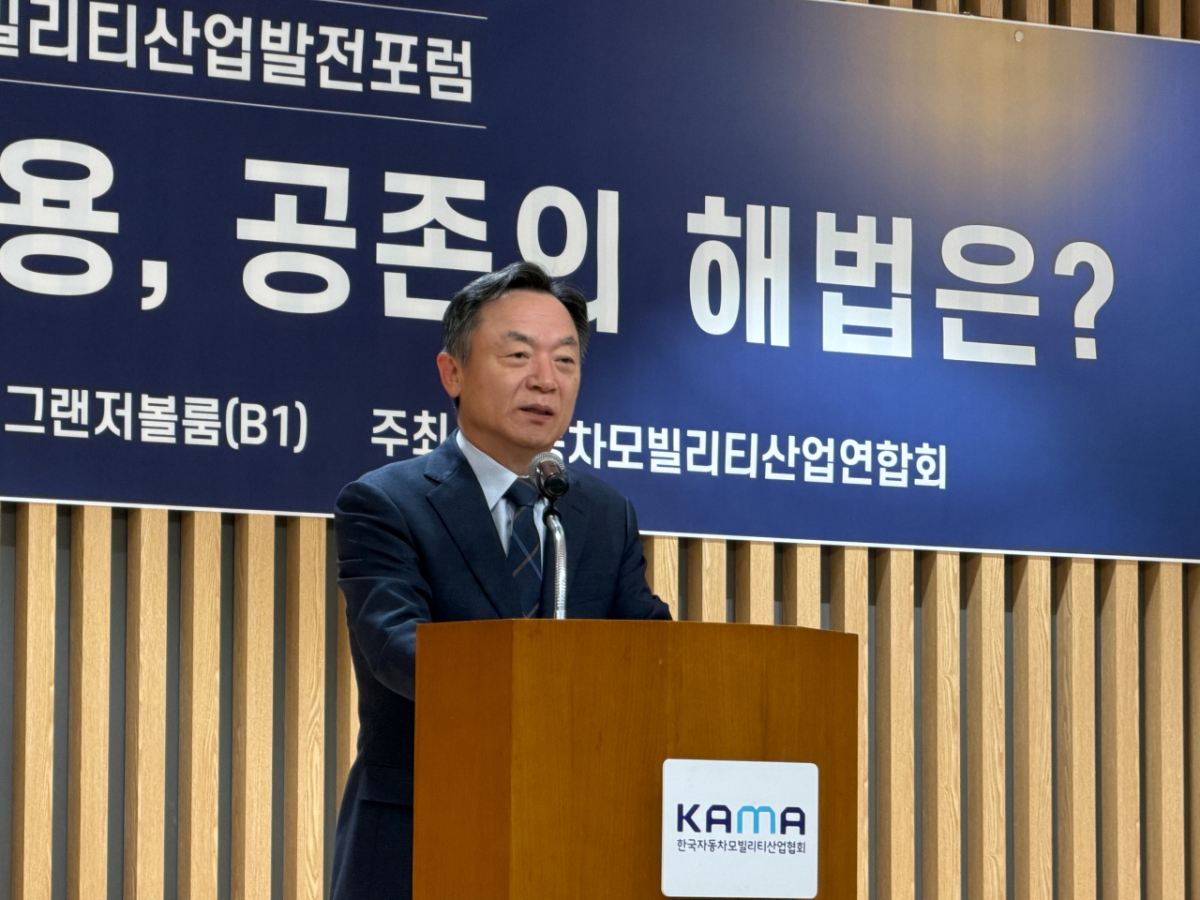
At the 48th Automotive Mobility Industry Development Forum held by the Korea Automotive Industry Association (KAIA) on the 10th at the Automotive Hall in Seoul Seocho-gu, discussions were conducted on the theme of “Extending the Retirement Age and Youth Employment: Solutions for Coexistence.”
Jeong Dae-jin, president of KAIA, diagnosed that the automotive industry faces the dual challenges of manufacturing innovation based on artificial intelligence (AI) and robotics, and maintaining employment. While expressing empathy with the need to leverage the skills of older workers, he explained that a uniform extension of the retirement age, without considering labor demand, capacity for new hiring, and labor cost burdens, could undermine competitiveness.
President Jeong emphasized, “We must discuss together employment methods suited to the conditions of industries and companies, as well as reforms in job and wage systems, so that extending the retirement age does not restrict job opportunities for future generations.”
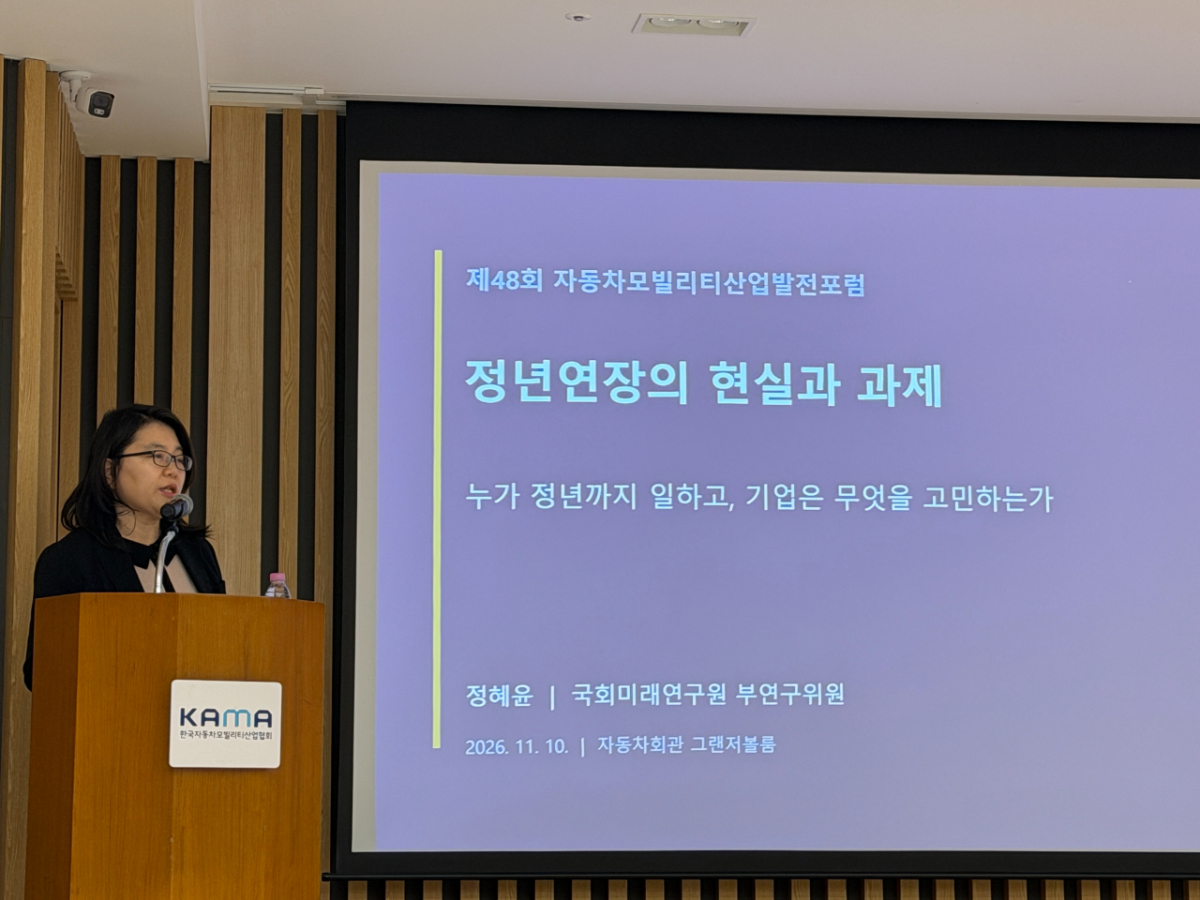
These concerns were also reflected in corporate hiring and promotion structures. Jeong Hye-yoon, research fellow at the National Assembly Future Research Institute, introduced the results of interviews with HR managers at large distribution and manufacturing companies, conveying that companies were concerned not only about labor costs but also about congestion in promotions and positions. This means that in a structure where hiring is based on vacancies from retirements, delayed retirements could reduce entry opportunities for youth.
Research Fellow Jeong explained that some corporate cases do not prove a causal relationship with the decline in youth employment. However, she pointed out that in a situation where hiring methods are changing due to automation and business restructuring, extending the retirement age could act as an additional variable. She stated, “Extending the retirement age to 65 is easily thought of as adding five years to age 60, but in reality, it is about redesigning the transition phase of HR management that begins from the mid-to-late 50s.”
She also proposed that while making re-employment and other methods optional for each company based on the principle of employment security until age 65, support for maintaining employment and re-employment for those who retire before the statutory retirement age should be provided in parallel. In a supplementary survey on the elderly conducted this May, cited by Research Fellow Jeong, the average age at which people left their longest-held jobs was 53. Among reasons for leaving, retirement due to reaching the statutory retirement age accounted for only 13.2%. This means that the benefits of retirement-age employment have not reached all workers.
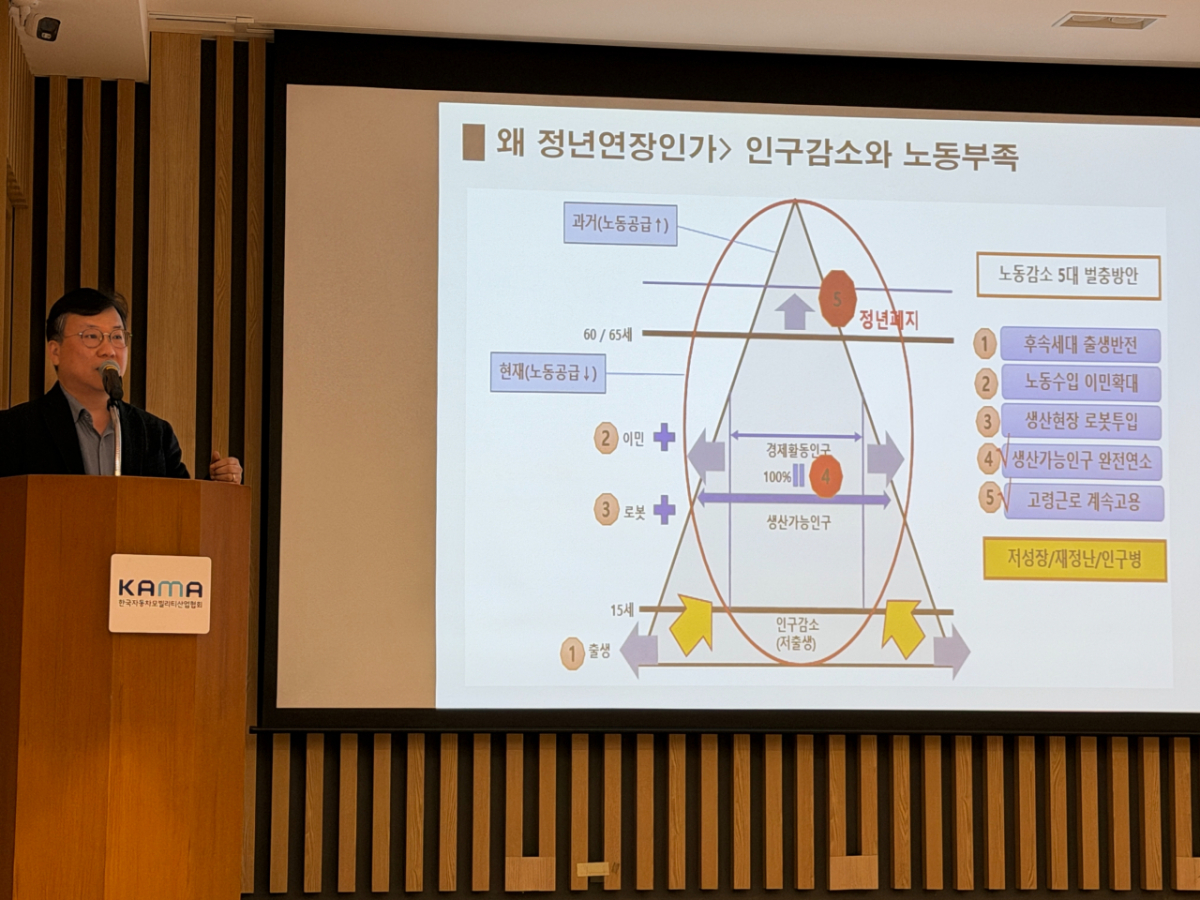
Plans to divide roles between older workers and youth were also presented. Jeon Yeong-su, professor at Hanyang University’s Graduate School of International Studies, proposed job redesign in which older workers leverage their skills in quality control, process improvement, and mentoring juniors, while youth take charge of introducing automation equipment, data analysis, and new digital technologies. The aim is to change the structure where generations compete for the same positions, making employment for both generations mutually complementary.
Professor Jeon explained that Japan has expanded elderly employment centered on long-term re-employment, adjusting wages and job duties in the process. However, he pointed out that since labor market conditions differ from those in Korea, implementation speed and cost sharing must be designed to fit the domestic industrial structure. He also proposed a plan to induce companies to use the resources secured through wage adjustments for new youth hiring.
In a designated discussion chaired by Lee Jeong, honorary professor at Hankuk University of Foreign Studies, following the keynote presentations, ways to reduce blind spots in support were discussed. Park Wan-soon, publisher of “Participation and Innovation,” stated, “The reality of our labor market is that youth cannot find jobs while middle-aged and older workers do not reach the retirement age,” and revealed that SME (small and medium-sized enterprise) support must be designed together to prevent benefits from being concentrated in a few employment-stable groups.
Opinions also followed on securing both corporate choice and support for youth employment. Lee Sang-ho, head of the Economic Division at the Korea Federation of Economic Institutions, called for autonomy to choose continued employment methods according to company size and industry, and to adjust wages, working hours, and job assignments. Moon Sang-gyun, research fellow at the Human Resource Development Service of Korea, stated that while maintaining employment for older workers, support must be provided for youth entry into the labor market, proposing a plan to link re-employment and wage adjustments with youth internships or government youth work experience programs.

 in INDUSTRY


