

LG Energy Solution successfully turned profitable in the second quarter of this year, breaking the loss streak that began in the fourth quarter of last year. This turnaround was driven by a significant surge in revenue from its energy storage system (ESS) sector amid growth in the artificial intelligence (AI) industry. The company plans to actively expand orders in the second half of the year based on its local production capacity in North America.
LG Energy Solution disclosed on the 30th that it recorded consolidated sales of 7.5602 trillion won and an operating profit of 113.3 billion won for the second quarter. Sales increased by 24.8% year-on-year, while operating profit declined by 77%. Compared to the previous first quarter, sales rose by 15.3%, and the company shifted from a loss to a profit in the second quarter. The second-quarter results included 241 billion won from the Advanced Manufacturing Production Credit (AMPC) under the U.S. Inflation Reduction Act (IRA). Excluding this credit, sales amounted to 7.3193 trillion won, and the company reported an operating loss of 127.7 billion won.
The turnaround in performance was led by the ESS sector. Revenue from this segment increased 4.6 times year-on-year, accounting for over 20% of total company sales. In the first half of the year, the company secured more than 3 trillion won in new orders, including projects with hyperscalers such as AI data centers as end customers.
LG Energy Solution forecasts that demand for ESS will continue to grow steadily due to the spread of AI and expanded investment in data centers, which require stable power supply. The company explained that demand is expanding not only for grid-connected ESS linked to renewable energy but also for standalone ESS and long-duration ESS aimed at resolving power supply imbalances. It anticipates that battery applications will broaden to include battery energy storage systems (BESS), uninterruptible power supplies (UPS), and battery backup units (BBU).
Accordingly, the company plans to steadily expand its pouch-type LFP-based ESS production capacity in North America this year to meet rising electricity demand there. By next year, it aims to secure cylindrical LINE capabilities as well, positioning itself as the largest ESS supplier capable of maximizing customers' benefits from investment tax credits (ITC). Leveraging its system integration (SI) competitiveness that spans from battery cell supply to software, the company also intends to provide solutions that enhance customer ESS operational efficiency.
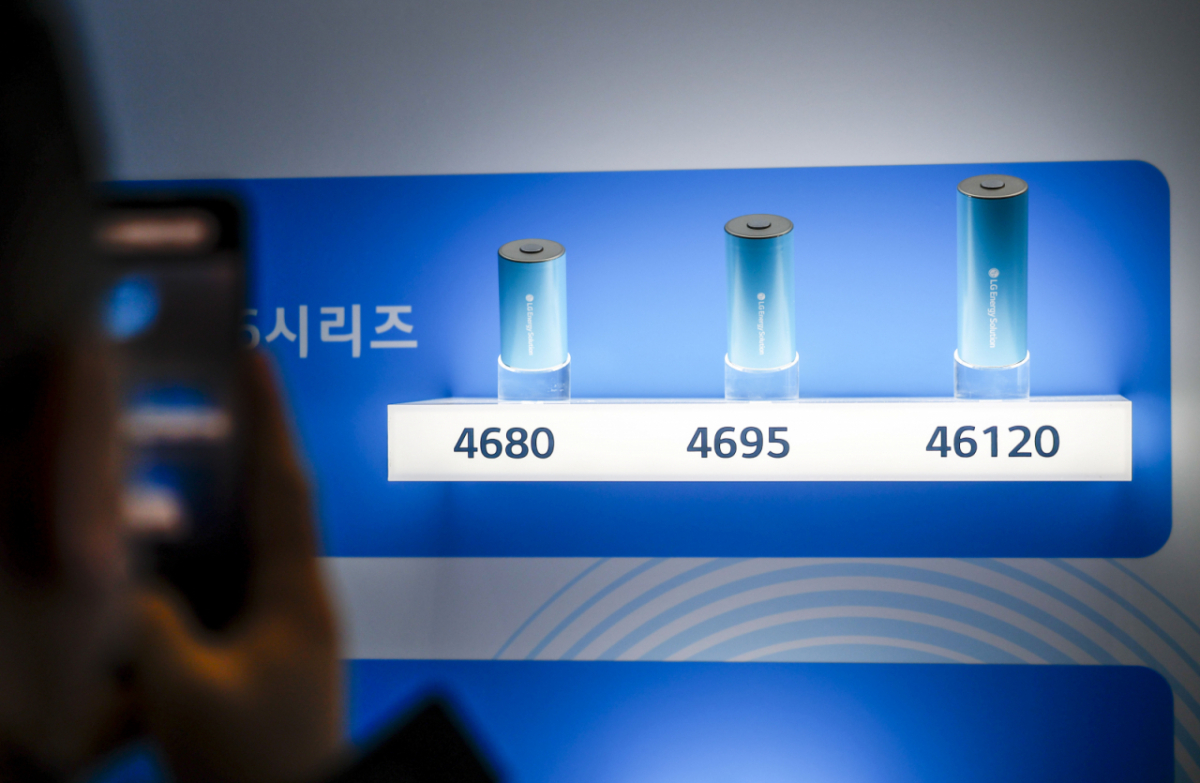
The electric vehicle (EV) business saw improved factory utilization rates in Europe and Asia, driven by shipments of mid-range and low-cost product lines such as high-voltage mid-nickel and LFP (lithium iron phosphate), as well as the 46th-series. In particular, cylindrical battery shipments increased 1.5 times year-on-year, supported by the stabilization of the 46th-series at the Yangsan facility and robust demand for the 2170 product.
The company is preparing to begin operations in the fourth quarter this year at its Arizona plant in the U.S., where a 46-series production line has achieved a 50% improvement in equipment efficiency compared to previous standards. It also plans to gradually increase utilization rates at its North American joint venture plants and expand shipments of mid-range and low-cost products from its Poland facility, thereby improving production efficiency in both the U.S. and Europe.
In the field of next-generation batteries, the company aims to target the BBU and robotics markets through new high-output tab-free 2170 products. For sodium-ion batteries, it plans to supply samples to ESS and automotive customers next year. Additionally, it will establish a pilot line applying dry electrode processes within this year to commence trial production of all-solid-state batteries with enhanced price competitiveness.
An LG Energy Solution official stated, "In the second half of the year, we will focus on improving ESS profitability, expanding order momentum, securing EV order opportunities and improving utilization rates, advancing product sophistication, and preparing for next-generation cells to sustain our growth trajectory."

 in INDUSTRY
