

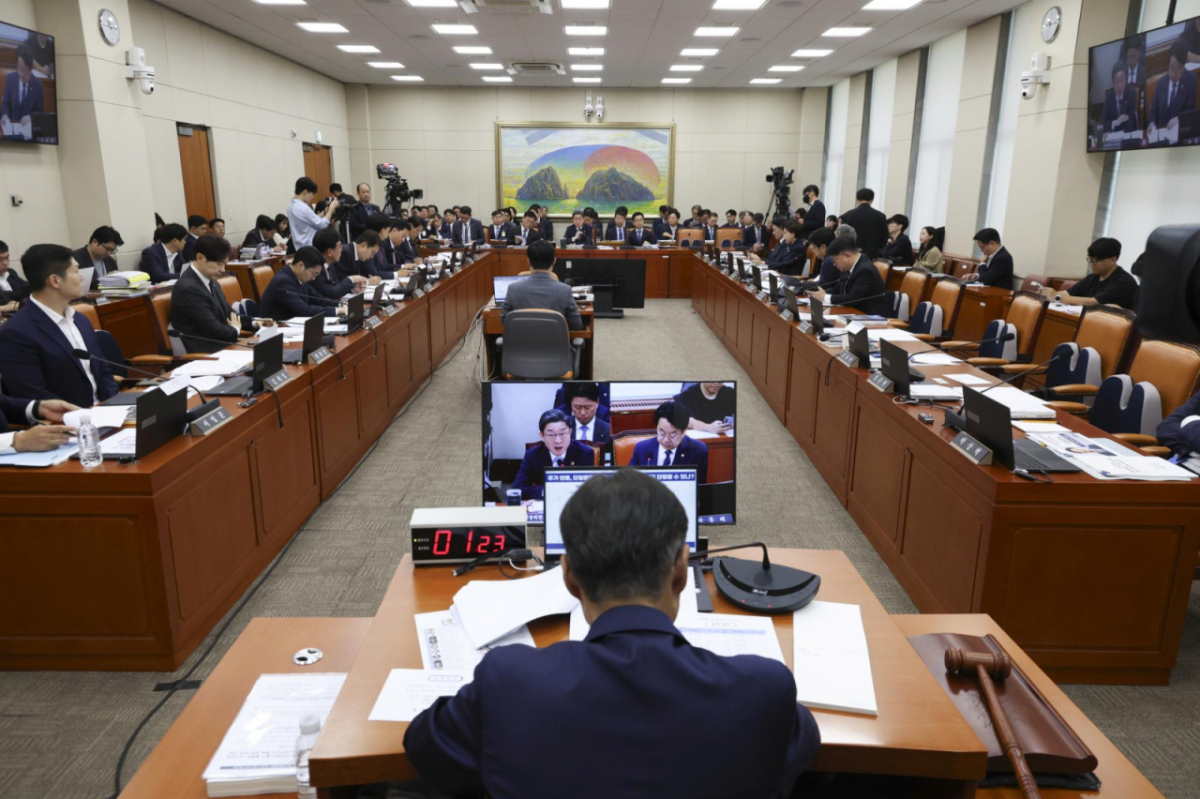
Ruling and opposition parties clashed head-on during the national audit on the 8th over responsibility for the launch of single-stock leveraged ETFs (Exchange-Traded Funds). The People Power Party accused former Cheong Wa Dae Jeong Chaek (Head) Kim Yong-bum and other Cheong Wa Dae officials of leading the launch, stating that “this is a matter in which someone will go to prison,” while the Democratic Party of Korea pushed back, warning against inflating losses and spreading conspiracy theories. The Financial Services Commission maintained its position that the products were not launched by order of the Cheong Wa Dae, but rather after consultation with relevant institutional investors.
During the Political Affairs Committee’s national audit of the Financial Services Commission held on the morning of the 8th at the Seoul Yeouido National Assembly, ruling and opposition lawmakers focused their questioning on the background of the single-stock leveraged ETF launch and the resulting investor losses. People Power Party lawmakers labeled former Director Kim Yong-bum and the Cheong Wa Dae as the “main culprits” behind the product launch, calling it a case where “someone will go to prison” and an act of “political breach of trust by the administration.”
In a statement on the conduct of proceedings, People Power Party lawmaker Park Sung-hoon said, “The single-stock ETFs were hastily launched one week before the June local elections, causing national damages amounting to 5.4 trillion won. This 5.4 trillion won represents someone’s dreams and future.” He pressed, “Suspicions have been raised that the Cheong Wa Dae stepped in and rushed the launch of such high-risk financial products. Why was former Director Kim Yong-bum, who served as Jeong Chaek (Head) at the time, not selected as a witness?”
A fellow party member, Park Jun-tae (Rep.), claimed, “At a closed-door Cheong Wa Dae meeting on January 13, the introduction was effectively finalized under the leadership of former Director Kim Yong-bum. The next day (January 14), former Director Kim told the media, ‘If it is possible on NASDAQ, why can’t we do it?’” He added, “Because everything was settled in the previous day’s meeting, this is essentially an admission that he led the process.”
Continuing, Park Jun-tae (Rep.) criticized, “Former Director Kim was the first to flee and also escaped witness selection today. The President is cutting off the tail by saying ‘someone must have done it.’” He denounced, “Right now, no one is willing to take responsibility. Whether through a national investigation, criminal probe, or special counsel, this must be re-investigated after a change in administration and clearly established. This is a matter in which someone will go to prison.”
Song Eon-seok, a People Power Party lawmaker with an economic bureaucrat background, asked, “The plan to resolve asymmetric ETF regulations indicated that products would be launched in the second half of the year, but at the joint meeting of relevant institutional investors on March 18, this was changed to a launch in the second quarter. Was this a directive from the Cheong Wa Dae?” Song (Rep.) criticized, “They claim a market impact assessment was conducted before the ETF launch, yet no data has been provided to date. If there was no Cheong Wa Dae directive, why were there no reports or meetings regarding early launch even within the Financial Services Commission itself?”
People Power Party lawmaker Cho Jung-hoon characterized the single-stock leveraged ETF incident as a “case of political breach of trust.” He stated, “Breach of trust occurs when a person obligated to protect and manage the property interests of others or a company violates that duty by conferring property benefits on themselves or a third party while causing damage to themselves or the company.” He pointed out, “While it may not constitute a legal crime of breach of trust, one cannot escape political breach of trust by the administration.”
Ruling party lawmakers acknowledged that insufficient investor protection and operational issues with ETFs should have been resolved in advance, but drew a line against excessive inflation of losses and conspiracy theories targeting the administration.
Democratic Party of Korea lawmaker Park Hong-bae said, “Exaggerated claims are being made, such as 18.2 trillion won in losses for the National Pension Service in some accounts and 5.4 trillion won in others.” He noted, “The figure of 18.2 trillion won in National Pension Service losses is derived by simply subtracting the end-of-June balance from the end-of-October balance.” It was pointed out that the return rate of the National Pension Service varies significantly depending on the reference point, making it difficult to view this as the scale of losses attributable solely to single-stock leveraged ETFs.
Park (Rep.) stated, “There is an aspect where opposition committee members are pushing conspiracy theories by claiming that the Cheong Wa Dae unilaterally forced the introduction of this product through processes on January 6 and 13.” He added, “I also believe that safety devices and consumer protection measures were insufficient and the timing of the launch was inappropriate. However, these products have been introduced overseas for a long time and have been actively traded in Hong Kong for the past year, so there was no choice but to introduce them to eliminate regulatory arbitrage.”
A fellow party member, Jeon Hyeon-hui (Rep.), argued, “Questioning why it was introduced is not the essence of the issue.” He claimed, “I believe that when criticizing policy, the appropriate question is why measures to prevent investor damage were not refined from the beginning.” Jeon (Rep.) explained, “Single-stock leveraged ETFs were launched in the United States in 2022 and in Hong Kong in 2025. Last May, when single-stock products for Samsung Electronics and SK Hynix were listed in Hong Kong, our country’s capital was flowing out massively.” He added, “The won-dollar exchange rate continued to rise from the 1,480-won level, creating a situation where a second foreign exchange crisis (IMF crisis) seemed imminent.”
Jeon (Rep.) addressed the opposition, saying, “If the authorities had not introduced this at that time, they would have criticized us for continuously allowing capital outflow overseas.” He stated, “Asking why it was introduced and who decided is nothing but political conflict for the sake of political conflict.”
The Financial Services Commission reaffirmed its position that the products were not created by order of the Cheong Wa Dae, but launched according to procedures after consultation with relevant institutional investors. Financial Services Commission Chair Lee Eok-yeon said, “I sincerely apologize for creating various situations contrary to the original intent of the introduction.” He explained, “At the time, the proportion of domestic individuals purchasing single-stock leveraged products was continuously increasing.”
In response to an opposition lawmaker’s question about whether it was a Cheong Wa Dae directive, Lee (Chairman) answered, “No. A necessity was raised asking why it is possible overseas but not domestically.” He also answered “No” to Song Eon-seok (Rep.)’s question, “Whose directive was the early launch? Was it a Cheong Wa Dae directive?”
He continued, “It was not an early launch; we launched according to schedule. We review securities registration statements and undergo listing reviews, proceeding according to the schedule. It is not something we can manipulate from behind the scenes.”

 in STOCK
