

'Chasing technology over money'
This is the core growth strategy of Chinese DRAM company CXMT (Changxin Memory Technologies). The background for rising to fourth place in the global DRAM market within 10 years lies in CXMT's chasing strategy, which overturned existing growth formulas, and over $100 billion (143 trillion won) in semiconductor support from the Chinese government. An unprecedented shortage of memory semiconductors (hereinafter "memory") also became a growth opportunity.
According to the electronics industry and foreign media on the 4th, HP, ASUS, Acer, and others have decided to adopt CXMT DRAM in small quantities for some laptop models. These companies are reported to have verified the performance of CXMT products this year in response to memory supply shortages.
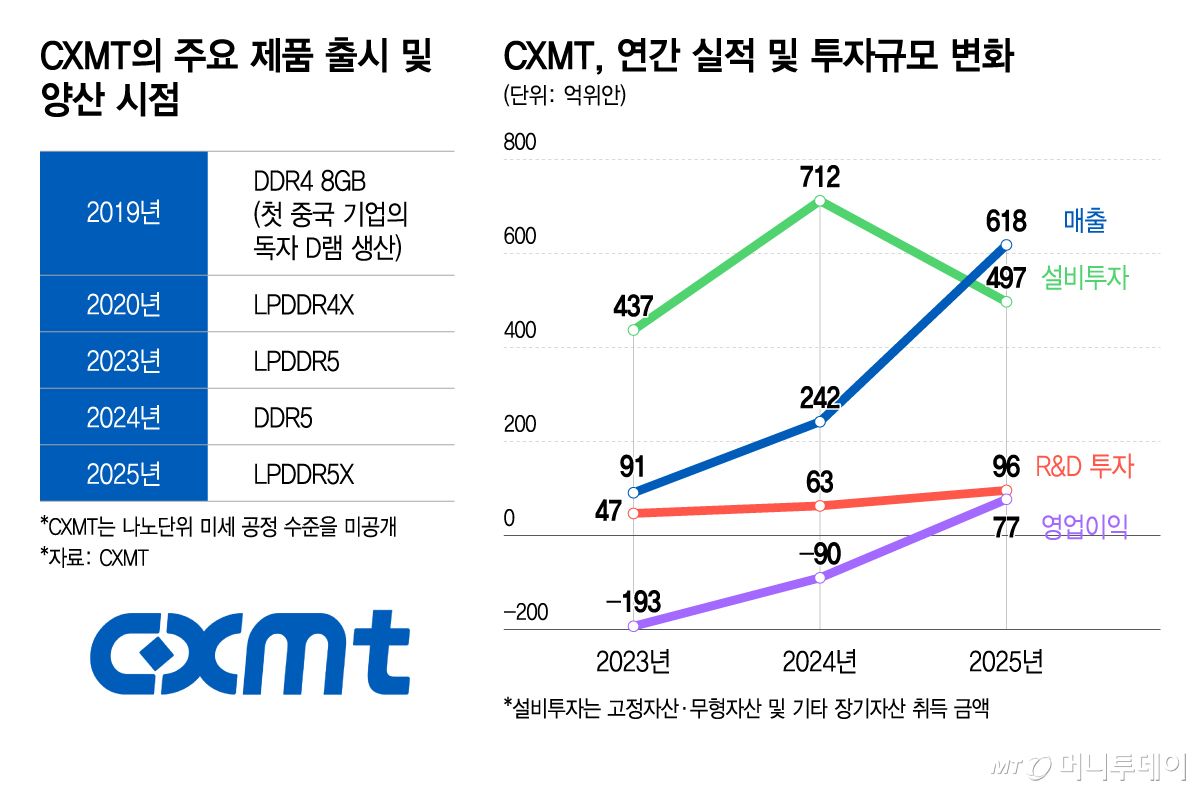
Although the supply scale is not large, it is significant that a Chinese company is supplying DRAM to global PC manufacturers. Established in 2016, CXMT has rapidly expanded its product lineup by successively launching LPDDR (low-power DRAM)4X (2020), LPDDR5 (2023), DDR5 (2024), and others after independently producing 8GB (gigabyte) DDR4 (Double Data Rate 4) in 2019, the first Chinese company to do so. Recently, it is reported that research and verification of LPDDR6 have also been completed.
'Generation-jumping R&D' strategy to catch up with leading companies... investment exceeding revenue
CXMT's growth to a 7% share of the global DRAM market in a short period was possible due to its "generation-jumping research and development" strategy. This involves skipping technology generations or compressing development periods as much as possible to chase leading companies.
In fact, CXMT began LPDDR5X Yangsan last year and is currently pursuing LPDDR6 Yangsan. LPDDR6 is a next-generation product that Samsung Electronics and SK Hynix are also preparing for Yangsan. While there is still a significant gap in cost, yield, and performance, the company is accelerating its chase by prioritizing technology over profitability.
Stopping DDR4 production is in the same vein. Even though DDR4 prices surged 10-fold last year alone due to supply shortages, CXMT focused on producing DDR5 and LPDDR5X instead of products with proven profitability. It boldly discontinued DDR4 production, choosing to secure next-generation technology over short-term performance.
CXMT has invested 185.2 billion yuan in research and development (R&D) and facility investment over the past three years (2023–2025). This is twice the scale of its revenue (95.1 billion yuan) during the same period. As of the end of last year, R&D personnel numbered 6,259, accounting for 32% of all employees. CXMT recorded its first profit since inception, reaching 7.7 billion yuan last year.
The process of securing technology also saw aggressive moves. The company actively purchased patents from foreign companies or entered into usage agreements. In Korean courts, former Samsung Electronics executives and employees have been sentenced to prison terms for allegedly leaking domestic semiconductor technology to CXMT.
The company also stated in its prospectus that "depreciation burdens from large-scale R&D and facility investments, combined with the fact that economies of scale have not yet been fully realized, result in high production costs." Some server DRAMs are reportedly priced higher than products from Samsung Electronics and SK Hynix.
China's semiconductor self-reliance goal... $100 billion support over 10 years
Such a strategy would be difficult for an ordinary company to sustain. The ability to endure even with investments exceeding revenue and declining price competitiveness is due to the massive support from the Chinese government. CXMT was established within the framework of China's semiconductor self-reliance strategy and has grown by receiving support from state-owned capital, including the National Integrated Circuit Industry Investment Fund (Big Fund).
According to the Semiconductor Industry Association of the United States, the Chinese government raised a total of $47.7 billion through the first and second Big Funds from 2014. Including the scale of 17 semiconductor funds created by local governments between 2015 and 2018 (estimated at $69.4 billion), the direct support scale is estimated to exceed $100 billion. Currently, a third Big Fund with a scale of $47.7 billion is in operation, with AI (artificial intelligence) semiconductors and HBM (high-bandwidth memory) also designated as key support targets.
China's vast IT ecosystem also serves as the foundation for CXMT's growth. Large "Red Tech" (China's state-led industrial technology system) companies such as Alibaba Cloud, ByteDance, Tencent, Lenovo, and Xiaomi are playing the role of stable demand sources. Most of CXMT's products are consumed in the domestic market.
The Chinese government is implementing preferential policies that evaluate domestic semiconductors at prices lower than their actual value during public procurement processes. Many local governments also provide subsidies to companies that purchase a certain volume of domestic chips. With the recent global memory supply shortage compounding the situation, CXMT's market position continues to expand.

 in INDUSTRY
