

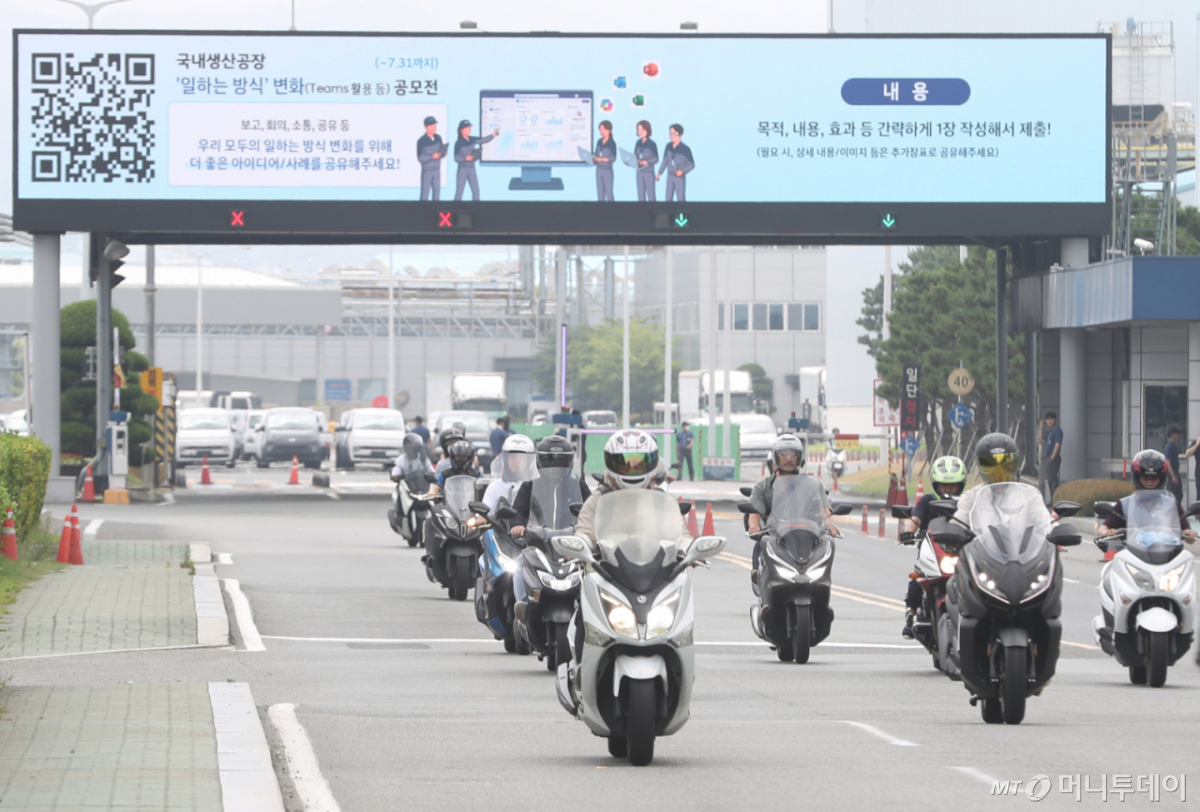
As Hyundai Motor's management and labor union continue to face difficulties in reaching an agreement on wages and collective bargaining (hereinafter referred to as "wage negotiations"), the company has released analysis data indicating that during past strike periods, deteriorating performance led to reduced compensation for employees. It is pointed out that prolonging the strike will cause irreversible damage not only to the company but also to each employee, urging an early conclusion to negotiations.
According to the automotive industry on the 11th, Hyundai Motor recently shared a booklet related to wage negotiations with its internal employees, presenting a comparison of past performance during periods of strikes and labor unrest. With this year's wage negotiations at Hyundai Motor stalling and the strike potentially extending, the company analyzed and presented how much damage could occur based on past cases.
Previously, Hyundai Motor concluded wage negotiations without any strikes for three consecutive years from 2009 to 2011; however, strikes occurred annually for the following seven years (2012–2018). Specifically, annual strike hours and instances of refusal to work overtime were as follows: △2012: 164 hours, 8 times △2013: 87 hours, 2 times △2014: 66.8 hours, 4 times △2015: 36.5 hours, 2 times △2016: 212 hours, 12 times △2017: 172 hours, 7 times △2018: 18 hours, 2 times.
In fact, during this period, Hyundai Motor's performance declined steadily. Operating profit, which was 8.4 trillion won in 2012, shrank to 8.3 trillion won in 2013, 7.5 trillion won in 2014, 6.4 trillion won in 2015, 5.2 trillion won in 2016, 4.6 trillion won in 2017, and 2.4 trillion won in 2018. While strikes may not have been the sole cause of deteriorating performance, it is clear that they had a significant negative impact.
Following this, during the strike-free years from 2019 to 2024, performance improved again. Operating profit rebounded to 3.6 trillion won in 2019 but decreased to 2.4 trillion won in 2020; however, it continued to rise, reaching 6.7 trillion won in 2021, 9.8 trillion won in 2022, and 15.1 trillion won in 2023. In 2024, operating profit stood at 14.2 trillion won but dropped sharply to 11.5 trillion won last year when the six-year streak of no labor unrest was broken.
Hyundai Motor publicly stated that during years with long-term strikes, timely investments and construction projects were delayed, leading to deteriorated performance, which in turn resulted in reduced total amounts for employee wages and bonuses. Conversely, during periods when negotiations concluded smoothly, timely investments and flexible responses to market changes led to performance rebounds, resulting in annual increases in wage and bonus compensation. The company further emphasized, "Strikes not only cause loss of current wages but also deprive employees of future compensation opportunities," urging everyone to reconsider the efforts they have built together.
Hyundai Motor also separately calculated the damage caused by three partial strikes held this year. The total loss in vehicle production due to 60 hours of strike was 42,510 units. According to the principle of "no work, no pay," each employee suffered a wage loss of 1.92 million won and a severance pay loss of 14.01 million won. Wages were calculated based on skilled workers including overtime hours, while severance pay was calculated for a skilled worker born in 1967 with 30 years of service.
Meanwhile, Hyundai Motor clearly stated its firm stance that the three issues raised by the union—reinstatement of dismissed workers, extension of retirement age, and increase in bonuses—are not subjects of wage negotiations. Regarding dismissed workers, the company reiterated that the court has already ruled their dismissal as justified, making them legally ineligible for negotiation. As for extending the retirement age, it is a matter requiring legislative changes that individual companies cannot decide on their own. Additionally, bonuses have been increasing annually, and the 2025 collective bargaining agreement remains in effect until March next year. Hyundai Motor stated that if the union independently organizes its "three demands" in line with the original purpose of wage negotiations—focusing on the distribution of wages and performance-based compensation—the company will consider additional proposals related to wage increases.

 in INDUSTRY

