

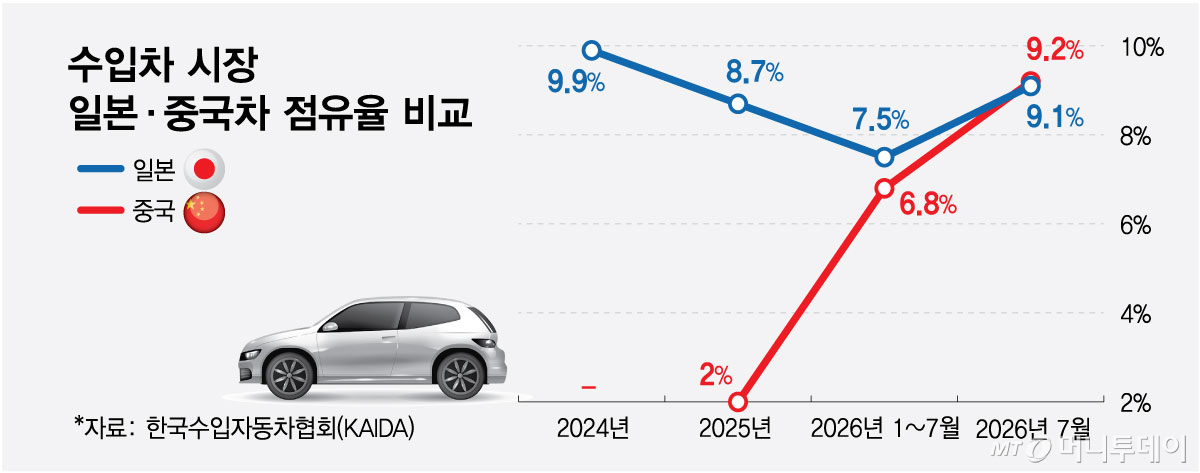
As Chinese vehicles show remarkable growth, the industry is watching closely. BYD has expanded its foothold to the point where, just one year after delivering its first vehicle in Korea, it now threatens the market share long held by Japanese cars as a pillar of the import car sector. Analysts suggest that the diverging fortunes of Japanese and Chinese automakers stem from how each formulated their response strategies during the transition from internal combustion engine vehicles to eco-friendly cars.
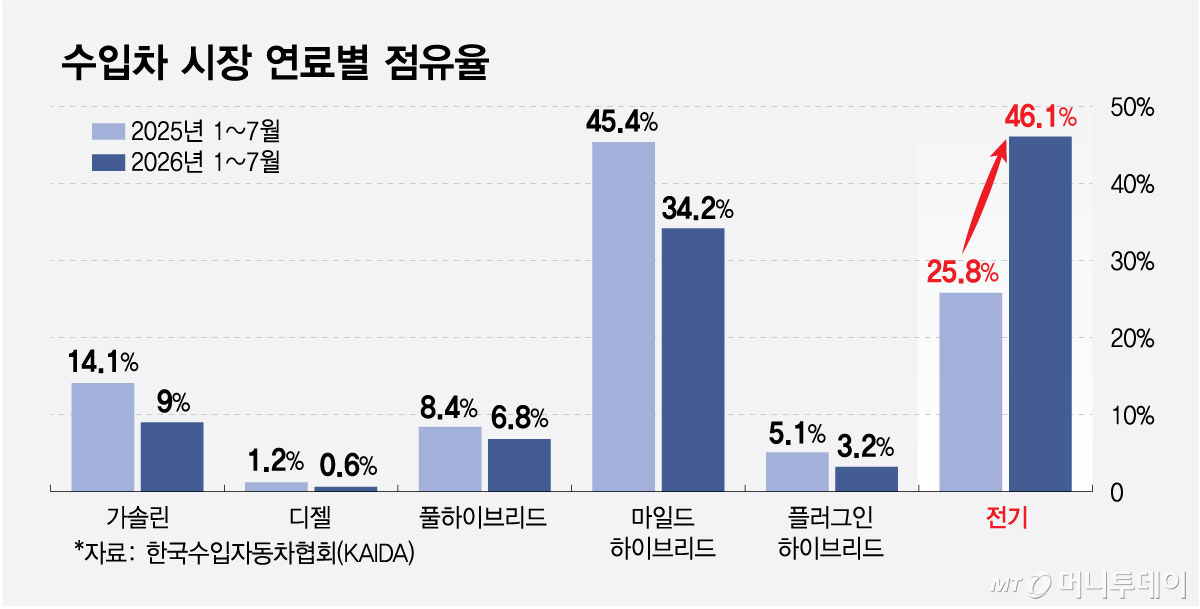
What has reshaped the landscape is electric vehicles. From January to July this year, new registrations of imported electric vehicles totaled 99,218 units, accounting for 46.1% of all imports — a jump of more than 20 percentage points from 25.8% in the same period last year. In contrast, imported Japanese vehicles declined by 2.3%, reversing their previous growth trend. Essentially, electric vehicles captured most of the expanded market. Last month’s top 10 best-selling imported electric vehicles included BYD Dolphin, Sealion 7, and Atto 3, but no Japanese brand made the list.
Of course, Toyota and Lexus were not idle. Both brands focused on achieving world-class HYBE-led technology, a strategy that remains valid today. The same approach helped lift Japan’s market share — which had plummeted after the “No Japan” sentiment — to 9.9% in September 2024. Japanese vehicles remain a major pillar of the import car market. From January to July this year, they registered 95,068 units, representing 44.2% of all imports. Last month’s top 10 best-selling imported cars overall were filled entirely by five Lexus models and five Toyota models.
Despite this, their market share has slipped — not because sales declined. Toyota and Lexus saw a 11.1% increase in registrations from January to July this year, while total Japanese vehicle sales rose by 4.5%. The issue is that the overall imported car market grew by 30.1% during the same period. Since electric vehicles drove this growth, Japanese brands that remained focused on internal combustion engines failed to claim a larger share of the expanding pie. Honda fell behind in this shift. It concentrated heavily on internal combustion engine vehicles, and its proposed HYBE-led models were overshadowed by Toyota’s offerings. Honda did not introduce an electric vehicle lineup. Once selling over 10,000 units annually in Korea in the early 2000s, Honda’s sales dropped to just 1,951 units last year, leading it to decide on withdrawal from the Korean market by the end of this year.
The favorable general conditions also motivated Chinese companies targeting the Korean market with electric vehicles. The U.S. imposes tariffs of up to 102.5% on Chinese-made electric vehicles, while the European Union applies rates as high as 45.3%. In contrast, Korea’s tariff rate stands at around 8%. With China’s domestic market saturated due to overproduction, geographically close South Korea — equipped with charging infrastructure — emerged as an attractive alternative. BYD, which entered first and rose to fourth place in imported car sales within just over a year, quickly reduced consumer resistance toward Chinese vehicles, further encouraging latecomers to enter the market.
The scope of their market penetration is also diversifying. ZEEKR, a premium electric vehicle brand under Geely Automobile Holdings, has appointed a CEO with prior experience in the import car industry and secured a dealer network. Even XPeng — dubbed “China’s Tesla” — is preparing to enter the Korean market. If successful, China’s EV lineup will expand beyond entry-level segments into premium brands, directly targeting positions long held by Lexus.
Movements to join the Korean market continue. Chery Automobile decided on the 3rd to make a strategic investment of $75 million (approximately 110 billion won) in KGM, securing a position as its second-largest shareholder while also leaving open the possibility of launching its own brand. Price competition remains intense. When BYD was removed from the government’s electric vehicle subsidy program last month, it immediately launched its own support initiative to maintain cost-effectiveness.
An industry executive expressed concern: “Chinese automakers have moved beyond competing solely on price; they are now entering with established brands and product lineups. Ultimately, they must prove their after-sales service and used car values to solidify their position. However, as the number of repeat buyers grows, their market entry speed is likely to accelerate.”

 in INDUSTRY

