

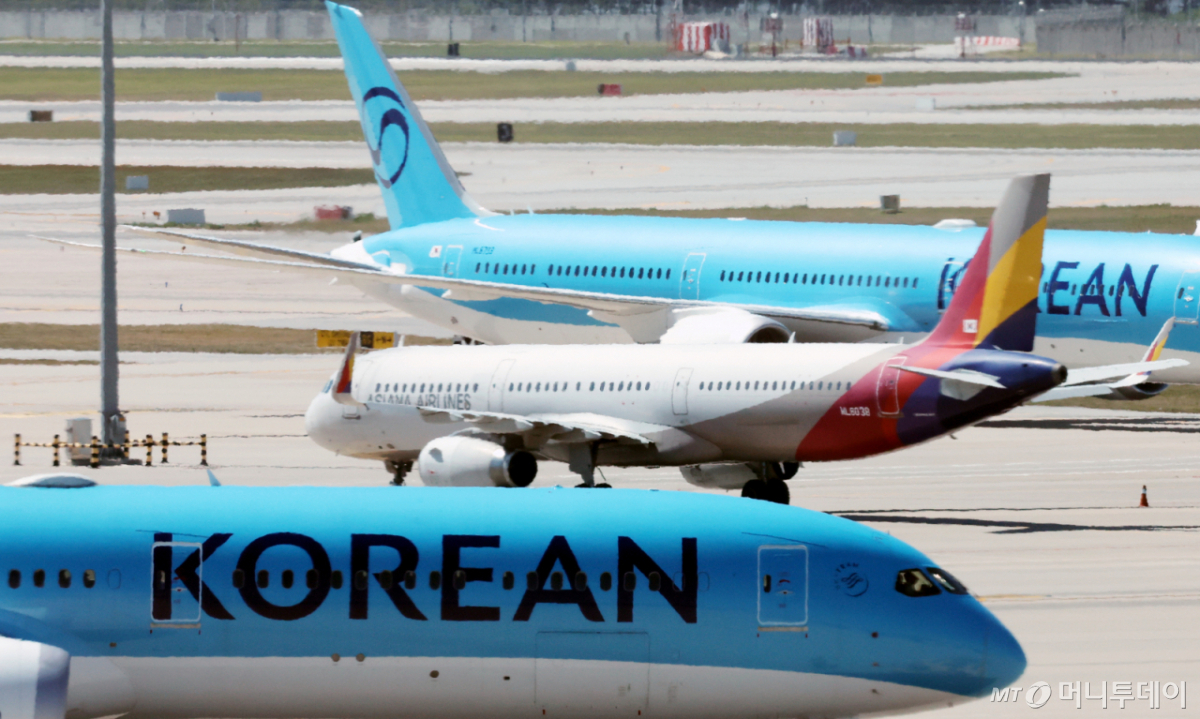
Although the approval process for the merger between Korean Air and Asiana Airlines has been completed, the core issue of mileage integration has not yet cleared the hurdle set by the Fair Trade Commission. With the launch of the merged Korean Air just four months away, concerns are rising that if approval is not granted before the merger deadline, the two companies will be legally consolidated into one entity while operating separate mileage systems, potentially causing significant inconvenience for consumers.
According to the aviation industry on the 14th, Korean Air approved the merger with Asiana Airlines at its board meeting on the 12th. Asiana Airlines also held an extraordinary shareholders' meeting and passed the merger plan with 99.3% approval from attending shareholders. Both companies plan to merge on December 16 and officially launch the integrated Korean Air the following day.
While shareholder approval procedures for corporate integration have been completed, the mileage integration proposal remains under review by the Korea Fair Trade Commission. In response to a request last December to improve plans for bonus tickets and seat upgrade services, Korean Air submitted a revised proposal on January 22 this year. More than 200 days have passed since then, but approval has not yet been granted.
During this process, the deferred revenue from miles recorded as liabilities in both companies' financial statements has also increased. According to the Financial Supervisory Service's electronic disclosure system, as of the end of the first quarter this year, the separate financial statement-based mileage deferred revenue was 2.9322 trillion won for Korean Air and 934.5 billion won for Asiana Airlines. Simply adding the two companies together totals 3.8667 trillion won, an increase of approximately 86.1 billion won compared to 3.7806 trillion won at the end of last year. Including the second quarter, it is expected to reach 4 trillion won.
Mileage deferred revenue represents the monetary value of an airline's obligation to provide customers with services such as bonus tickets and seat upgrades, which is reflected as a liability on financial statements.
The integration plan submitted by Korean Air centers on managing existing Asiana Airlines miles separately for 10 years after the merger. Miles accumulated after the integration will be credited through SkyPass, while existing Asiana Airlines miles can be used for Korean Air bonus tickets and other services according to Asiana Airlines' deduction standards.
If customers wish to convert their miles to SkyPass miles, a 1:1 ratio will apply to miles earned from Asiana Airlines flights, while a 0.82 ratio will apply to miles earned through credit cards, hotels, and other partner programs. However, the 10th-year separate management period, conversion ratios, and bonus seat supply plans all require final approval from the Korea Fair Trade Commission to be finalized.
The Korea Fair Trade Commission is examining not only the conversion ratio but also whether consumers are sufficiently guaranteed opportunities to actually use their miles. This is because if the supply of bonus seats and seat upgrades is insufficient, it may become difficult for consumers to use their miles at their desired time, even if the nominal value of the miles is maintained. It is also reported that discussions are underway regarding a plan to utilize expiring miles as regional currency.
If the integration plan is not approved by the merger deadline, both Korean Air and Asiana Airlines' existing mileage systems must continue to operate separately even after the launch of the merged entity. Korean Air also recently stated in its securities registration statement that it can operate both companies' mileage systems separately until the Korea Fair Trade Commission grants approval.
If this separate operation becomes a reality, passengers using the integrated airline will need to check each company's deduction standards, partner locations, and bonus seat usage conditions individually. The longer the confirmation of the mileage integration plan is delayed, the more confusion consumers will face.
An aviation industry official stated, "At a time when the integration of Korean Air and Asiana Airlines has essentially reached its final stage, delays in approving the mileage integration plan are increasing confusion." He added, "From the perspective of the Korea Fair Trade Commission, it appears they are adjusting the timing to approve the integration plan under conditions that minimize controversy as much as possible, thereby reducing their burden."

 in INDUSTRY
