

The recent success of KZAM, a copper foil manufacturer under Korea Zinc—a latecomer in the domestic copper foil industry—in its first product supply reflects the shifting dynamics of the battery market. Amid growing momentum to decouple battery supply chains from China, centered on North America, and with expanding demand for ESS (energy storage systems), domestic copper foil companies have seized opportunities for recovery.
According to industry sources on the 13th, global battery makers have increasingly inquired about supplying copper foil to domestic Korean firms. Driven by recovering product demand, major companies' second-quarter performance indicators have uniformly improved. SK Nexilis, an investment subsidiary of SKC's copper foil business, recorded revenue of 254 billion won in the second quarter, achieving its highest quarterly result on record. Sales of copper foil for ESS and electric vehicles rose by 76% and 28%, respectively, compared to the previous quarter.
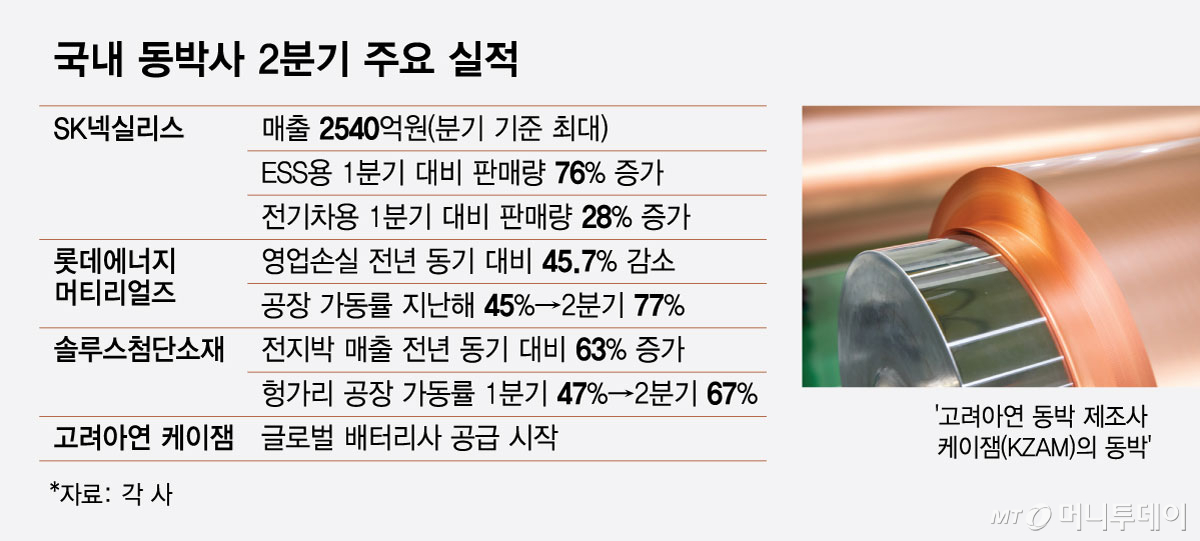
Lotte Energy Materials' average factory utilization rate, which had hovered in the high 40s last year, surged to 77% in this year's second quarter. This was driven by increased sales of battery foils for electric vehicles and ESS, alongside a sharp rise in demand for circuit foils used in AI (artificial intelligence) servers and network equipment. Solus Advanced Materials also saw its battery foil revenue reach 75 billion won in the second quarter, up 63% from 46 billion won in the same period last year. With shipment volumes rising 40% compared to the previous quarter, factory utilization at its Hungarian plant increased from 47% in Q1 to 67% in Q2. Korea Zinc's KZAM, which had previously struggled to secure customers, has recently begun supplying copper foil to global battery makers.
At the center of this transformation is the restructuring of global battery supply chains. As the United States strengthened regulations prohibiting companies from receiving Advanced Manufacturing Production Tax Credits (AMPCTC) if more than 40% of battery costs are sourced from China or other Prohibited Foreign Entities (PFEs), domestic copper foil firms emerged as key beneficiaries. Excluding China, only Korean companies possess large-scale copper foil production capacity.
The rapid growth of the ESS market further bolstered this trend. According to SNE Research, a market analysis firm, global lithium-ion battery shipments for ESS reached 461.3 GWh (gigawatt-hours) in the first half of this year, a 71% increase from 269.7 GWh in the same period last year. The three major domestic battery makers—LG Energy Solution, Samsung SDI, and SK On—achieved simultaneous profitability for the second quarter of this year, marking their first joint profit in seven years based on ESS orders.
Driven by demand recovery, domestic copper foil companies have resumed postponed investments and expanded production capacity. Lotte Energy Materials plans to fully convert its Malaysian plant, a key hub for battery foil production, into a 100% production-and-sales system. Following the activation of Plant No. 5 last month, the scheduled start-up date for Plant No. 6 has been advanced from next year to the fourth quarter of this year. The company is also focusing on enhancing cost competitiveness. Korea Zinc's strength lies in its ability to self-supply key raw materials such as copper and sulfuric acid, securing price competitiveness. SK Nexilis plans to increase the production share at its Malaysian plant to boost profitability.
Industry observers also anticipate further profit improvements in the second half of the year due to rising copper foil prices. With China's government industrial restructuring and U.S. tariff barriers intersecting, excess supply accumulated primarily among Chinese companies is expected to ease. It has been reported that major Chinese copper foil manufacturers have already begun raising prices since the second half of last year.
An industry executive stated, "As domestic battery makers secure ESS volumes based on local production capacity in the U.S., benefits are spreading to domestic copper foil companies." He added, "With demand growing rapidly centered on AI data centers, positive trends are expected to continue into the second half of the year."

 in INDUSTRY
