

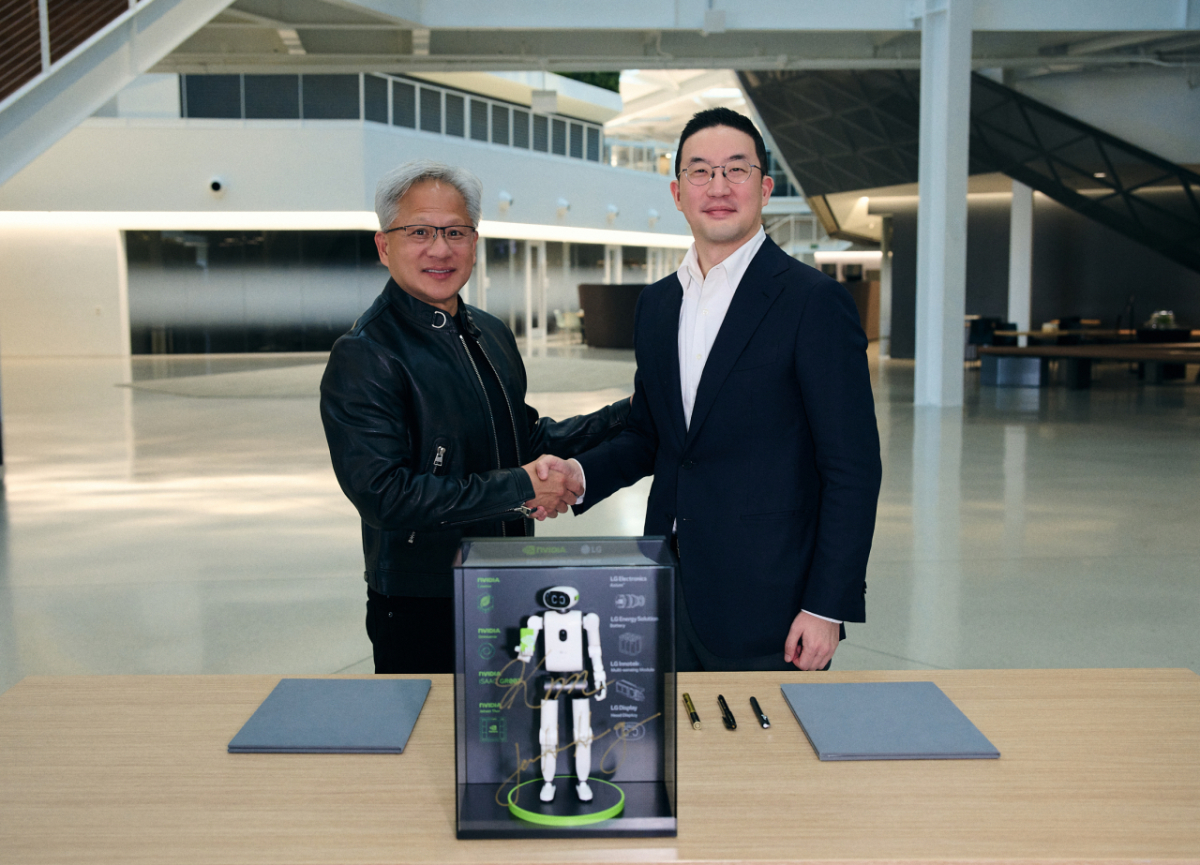
LG Group Chairman Koo Kwang-mo and NVIDIA CEO Jensen Huang met again after about two months to concretize their 'AI alliance.' Both companies have set robotics, AI factories, and mobility as three core pillars of cooperation to target the physical AI market. A bipedal humanoid robot based on NVIDIA's AI technology is currently under development with a goal to be unveiled in the first quarter of next year.
LG Group announced on the 14th that it signed an MOU (Memorandum of Understanding) for strategic business cooperation with Koo (Chairman) and CEO Huang at NVIDIA headquarters in Santa Clara, California, USA, on the 13th (local time). Also present at the event were Kwon Bong-seok, COO (Chief Operating Officer) of LG Corporation; Ryu Jae-cheol, CEO of LG Electronics; Hong Beom-sik, CEO of LG Uplus; Hyun Shin-kyun, CEO of LG CNS; Jung Soo-heon, Representative Director of LG Science Park; and Lee Hong-rak, Co-Yeon Gu (Director) of the LG AI Research Institute. Executives from major group affiliates also attended.
This MOU is a collaborative outcome following a meeting between the CEOs of both companies held in June at the LG Twin Towers in Yeongdeungpo-gu, Seoul. At that time, CEO Huang stated, "We are working with LG Group as one team across all of NVIDIA's business areas, from robotics systems to AI factories."
Koo (Chairman) has championed AI as a future growth pillar for the group since taking office. Ahead of the June executive meeting, during a 'samgyeopsal (grilled pork belly) + soju' gathering, he even grilled meat himself, actively engaging in 'selling' the vision. CEO Huang put his arm around Koo (Chairman), calling him "My Good Friend," demonstrating their close relationship.
LG Group plans to accelerate its entry into the physical AI market by combining its 'One LG' technology with NVIDIA's AI infrastructure capabilities. Global investment bank Morgan Stanley recently evaluated in a report that LG's strength lies not in individual AI technologies but in its group-level 'physical AI stack.' The analysis suggests that as major affiliates possess relevant capabilities in robotics, sensing, batteries, and enterprise AI, synergies between businesses will grow as AI expands into the real world.
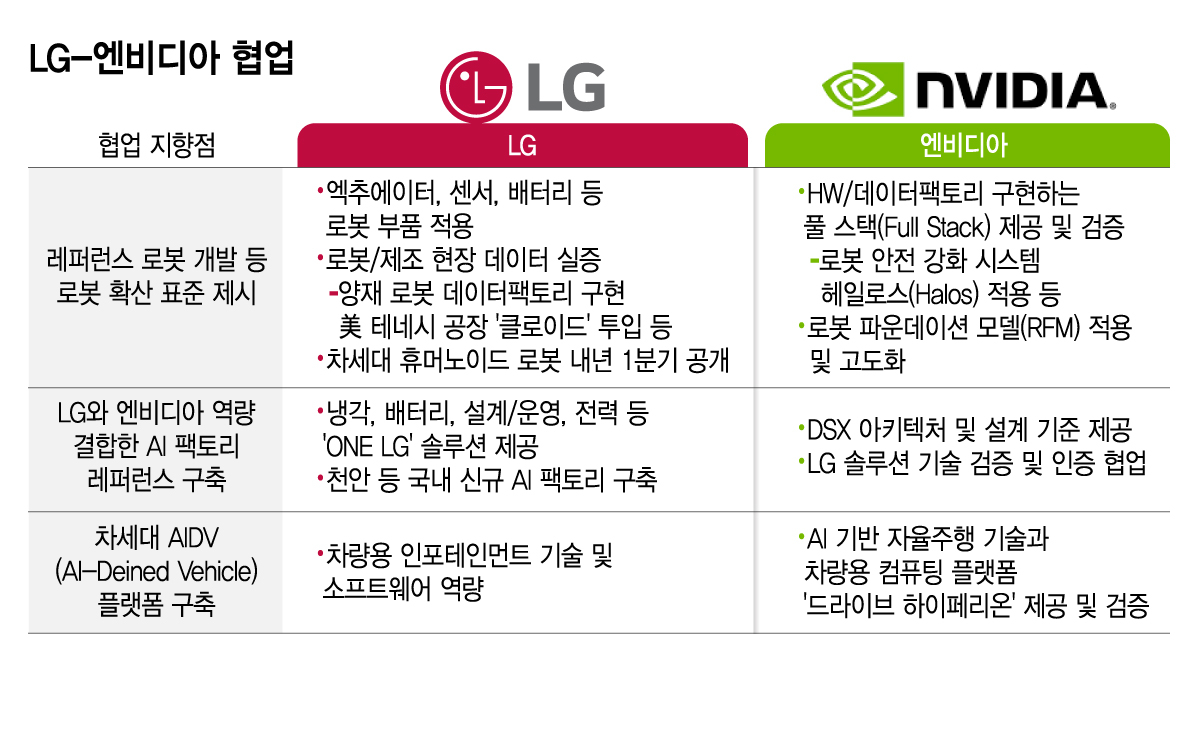
Both companies will collaborate throughout the entire process from physical AI development to on-site deployment. LG is developing next-generation bipedal humanoid robots based on NVIDIA's humanoid foundation model 'Isaac GR00T' and its integrated safety system 'Halos for Robotics.' It will also be equipped with the high-performance robotics computing platform 'Jetson Thor.' The goal is to unveil it in the first quarter of next year.
The humanoid robots will incorporate actuators from LG Electronics, sensors from LG Innotek, and batteries from LG Energy Solution. LG plans to deploy its wheel-based home robot 'LG CLOi' on a washing machine production line at its Tennessee factory in the U.S. this year for proof-of-concept (PoC) testing, with plans to later expand its application scope to homes and commercial spaces.
Collaboration will also take place in building a robot data factory based on LG CNS's robot platform 'PhysicalWorks.' The companies aim to implement a system at the site that repeatedly cycles through data collection, generation, learning, and verification. The secured data and validation experiences will be utilized to advance LG's own developing robot foundation model. Both parties plan to establish a Task Force (TF) composed of technology and business experts to collaborate on R&D (Research and Development), on-site validation, and overall commercialization.
A reference site will also be established to apply and verify LG's cooling, power, and IT (Information Technology) technologies based on NVIDIA's next-generation AI accelerator 'Vera Rubin' in the first half of 2027. In the first half of 2028, it will be expanded and built with a capacity of 80MW (megawatts) in Cheonan, South Chungcheong Province. The plan is to reduce construction time by more than 20% through prefab (Prefabricated) modular design. AI factories will be utilized for advancing physical AI and robot foundation models.
In the mobility sector, the companies are pursuing the development of a high-performance computing (HPC) platform for next-generation AIDV (AI-defined vehicles) by combining NVIDIA's Hyperion platform with LG's vehicle infotainment (IVI) and vehicle software capabilities. The strategy is to provide next-generation vehicle solutions that integrate autonomous driving functions and in-vehicle AI services to global original equipment manufacturer (OEM) customers, thereby securing new growth opportunities.
Koo (Chairman) emphasized, "As our collaboration accelerates, the tasks we will tackle together in the fields of AI factories, physical AI, and mobility have become clear," adding, "We will accelerate the spread of AI by establishing references that lead the industry."
![[Seoul=NEWSIS] Reporter Cho Sung-woo = NVIDIA CEO Jensen Huang poses while distributing snacks to citizens during a so-called 'samgyeopsal (grilled pork belly)·soju' gathering with SK Group Chairman Choi Tae-won, LG Group Chairman Koo Kwang-mo, and Naver Chairman Lee Hae-jin at a Korean barbecue restaurant near Hongdae in Mapo-gu, Seoul, on the 5th. 2026.06.05. xconfind@newsis.com /Photo=Cho Sung-woo](https://thumb.mt.co.kr/cdn-cgi/image/f=avif/21/2026/08/2026081408325749653_2.jpg)

 in INDUSTRY


