

As memory semiconductor (hereinafter "memory") prices surged nearly threefold, Samsung Electronics experienced mixed outcomes internally. The DS (Device Solutions) division that sells memory recorded record-breaking results, while the MX (Mobile Experience) business unit that purchases memory to manufacture smartphones posted its first quarterly loss in a quarter. Mobile memory procurement costs increased by approximately 1 trillion won within three months.
According to Samsung Electronics' semi-annual report filed on the 18th, the average selling price of memory for the DS division in the first half of this year rose by about 220% compared to last year's annual average. Compared to a 146% increase in the first quarter of this year, the pace of price increases accelerated further in the second quarter.
Thanks to rising memory prices, the DS division's first-half sales reached 209.2317 trillion won, accounting for 68.5% of total sales. This represents nearly a fourfold increase compared to the same period last year. The first-half operating profit was 142.8593 trillion won, with an operating profit margin reaching 68.3%.
Server demand driven by AI (artificial intelligence) data center expansion boosted performance. Samsung Electronics recorded its highest-ever sales volume in both DRAM and NAND based on bit count in the second quarter. The share of server memory sales also reached a historic high. This resulted from increasing sales focused on relatively more profitable, high-value-added server products amid difficulties in rapidly expanding production capacity.
While the DS division achieved record-breaking results, profitability in the DX (Device Experience) division deteriorated significantly. The DX division's operating profit fell from 8.0846 trillion won in the first half of last year to 2.1489 trillion won in the first half of this year. The operating profit margin was only 2.1%.
Notably, the DX division posted an operating loss of 818.8 billion won in the second quarter. This was largely influenced by a loss of approximately 700 billion won from the MX business unit responsible for smartphone operations. It marks the first quarterly loss since the establishment of the MX business unit.
Cost burdens due to sharp memory price hikes are cited as the main cause of the shift to losses. In the first half of this year, mobile memory procurement prices for the DX division rose by about 211% compared to last year's average. Samsung Electronics also procures memory from Micron in the United States and Kioxia in Japan. Beyond memory, prices for mobile AP (application processor) solutions and camera modules increased by 6% and 5%, respectively, further raising cost burdens.
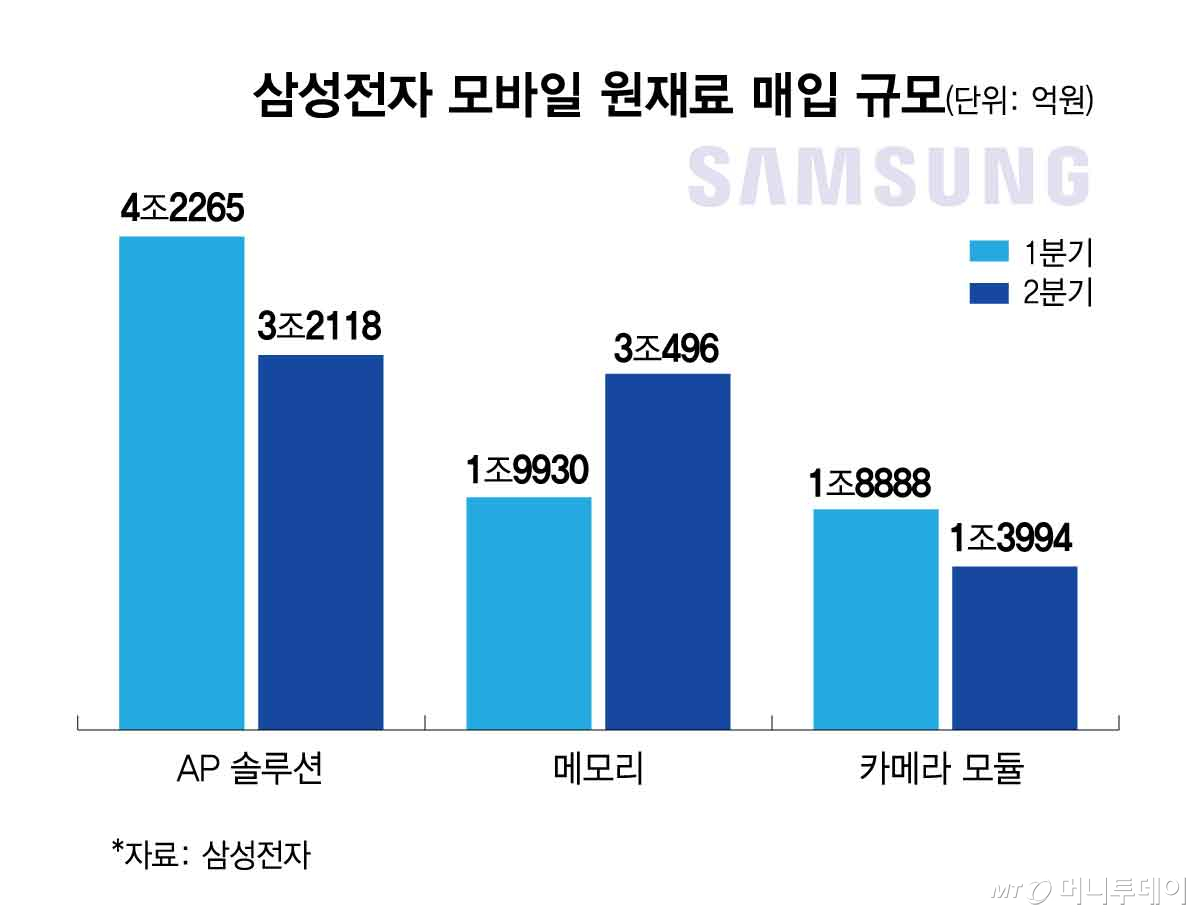
In fact, mobile memory procurement costs in the second quarter of this year reached 3.0496 trillion won, a 53% increase (approximately 1 trillion won) from the previous quarter. This contrasts with decreases of 24% and 25.9%, respectively, in AP solution and camera module procurement costs during the same period. The share of mobile memory in total raw material procurement for the DX division also rose from 9.4% in the first quarter to 15% in the second quarter.
Although component cost burdens increased, they were not sufficiently reflected in smartphone selling prices. In the first half of this year, Samsung Electronics' average smartphone selling price rose by about 7% compared to last year's average. While MX business unit sales in the second quarter fell 13.9% from the previous quarter to 32.3 trillion won, major component procurement volumes decreased by only 5.5%.
According to market research firm Counterpoint Research, memory (DRAM + NAND) accounted for 42% of component costs in premium smartphones in the second quarter of this year. This is a 29 percentage point (P) increase compared to the same period last year. The shock of rising memory prices is being felt more acutely in budget smartphones. For budget smartphones, product costs surged by 70% compared to last year.
It has been reported that Samsung Electronics' entry-level Galaxy A series has also begun operating at a loss in some countries. Samsung Electronics is pursuing a strategy of maintaining and expanding its share in the entry-level market even at the cost of short-term profitability deterioration. The company judges that once memory prices stabilize, it can recover profitability based on the market share it has secured. Samsung Electronics' smartphone market share stands at 22%, up 2.8 percentage points from last year.
An industry source stated, "In the case of smartphones, despite recent consumer price increases, margins have reportedly fallen further due to cost burdens from rising memory prices," and added, "The share of memory in component costs will likely continue to grow for some time due to rising memory prices."
Meanwhile, Samsung Electronics fully repaid 20 trillion won in unsecured loans borrowed from Samsung Display during the second quarter of this year. Previously, in February 2023, it had borrowed and used 20 trillion won from Samsung Display for working capital purposes. The interest rate was an annual 3.9% based on last year's loan maturity extension.

 in INDUSTRY
