

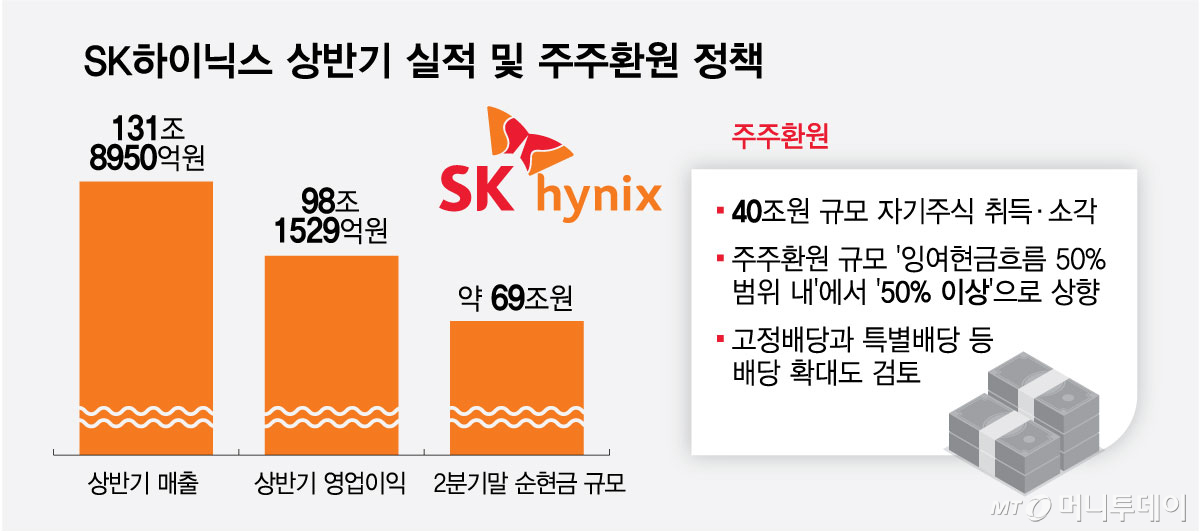
SK Hynix has unveiled a record-breaking shareholder return card: the repurchase and cancellation of its own shares worth 40 trillion won. Fueled by a boom in AI memory, net cash increased by over 34 trillion won in just three months, creating room to simultaneously pursue large-scale investments, ensure financial stability, and deliver shareholder returns. Evaluations suggest that the weight of capital allocation has shifted from "investment first" to a dual approach of "investment and shareholder return."
On the 19th, SK Hynix held a board meeting and decided to expand its shareholder return scale from within the range of "50% of cumulative free cash flow (FCF)" to "more than 50%," alongside the repurchase and cancellation of its own shares worth 40 trillion won. The company will proceed with both share buybacks and cash dividends, while also reviewing plans to expand dividends, including fixed dividends and special dividends. Additional shareholder return plans are expected to be announced in conjunction with the third-quarter earnings report.
The 40 trillion won figure represents the largest-ever case of own-share cancellation among domestic listed companies. This is more than double the plan announced by Samsung Electronics in March through its "2025 Business Report," which revealed a plan to cancel its own shares worth 16 trillion won in the first half of this year. Analysts interpret this as a signal sent to the market that SK Hynix intends to directly break through the current undervaluation of its stock price through large-scale share cancellations.
SK Hynix appears to have substantial capacity for shareholder returns. Previously, Mirae Asset Securities estimated SK Hynix's FCF for this year at approximately 180 trillion won. A simple calculation shows that even returning just 50% of this amount would reach 90 trillion won. With the return threshold raised to "more than 50%" this time, there is a possibility that the scale of shareholder returns could grow further depending on future performance and cash flow.
The background behind this record-breaking shareholder return decision lies in the rapid accumulation of cash due to the AI memory boom. Initially, SK Hynix set a goal of maintaining net cash above 100 trillion won as a target for financial stability, prioritizing stable financial structure building and future business investments over short-term shareholder returns. Even during the first-quarter earnings release, it emphasized that "reinvesting generated cash into the business is currently the best method of capital utilization."
However, as cash accumulated faster than expected, the calculation changed within three months. SK Hynix posted operating profits of 98 trillion 152.9 billion won in the first half of this year alone. Net cash, which stood at 35 trillion won at the end of the first quarter, increased by over 34 trillion won to reach 69 trillion 400 billion won by the end of the second quarter within just three months.
If this cash generation capability continues, SK Hynix could quickly approach its financial stability target of 100 trillion won in net cash. Furthermore, long-term supply contracts (LTA) with major customers have increased visibility into medium-to-long-term demand. With reduced uncertainty regarding investment and production plans, the company now has greater room to expand long-term capital allocation and shareholder returns.
Moreover, market voices calling for insufficient shareholder returns relative to profit size were growing louder. Since 10% of operating profits are utilized as a source for employee performance bonuses, there were demands to also expand shareholder returns commensurate with the profit scale. The declining stock price was also a concern. On this day, SK Hynix shares closed at 1.5 million won, which is half the level compared to the all-time high closing price of 2.919 million won on June 22.
The judgment that the stock price does not fully reflect corporate valuation despite record-breaking profits and cash generation capabilities influenced this decision. An SK Hynix official stated, "The company's intrinsic value, including business competitiveness, cash generation capability, and medium-to-long-term growth potential, has not been sufficiently reflected in the current stock price."
This also signifies an early implementation of the shareholder return policy announced in November 2024. At that time, SK Hynix stated it would implement shareholder returns within the range of 50% of cumulative FCF from 2025 to 2027, but if FCF increased significantly due to improved performance, it would consider early returns even before the policy expiration. The boom in AI memory has fulfilled the early return conditions previously set faster than expected.
The market had already shown significant interest in additional shareholder returns since the second-quarter earnings release last month. This was due to funds flowing in from the sale of Kioxia shares and the issuance of American Depositary Receipts (ADRs), as well as a substantial increase in cash generated from core operations. However, the company did not disclose specific details regarding the method, scale, or timing of shareholder returns at that time.
This was due to information disclosure restrictions associated with the ADR listing. SK Hynix explained that the 25th-day prospectus delivery period following its ADR listing on July 10 overlapped with the timing of the second-quarter earnings release. Because there were constraints on disclosing new material information not previously revealed during the public offering process, the company could not explain specific shareholder return plans at that time.
Indeed, during the conference call at that time, SK Hynix drew a line by stating, "Due to regulations and procedural constraints related to the ADR public offering, there are certain limitations on providing additional new material information that was not disclosed during the offering process at this point in time." Once this period ended in early this month, the board of directors convened and decided on the repurchase and cancellation of its own shares worth 40 trillion won and the expansion of shareholder returns.

 in INDUSTRY
