

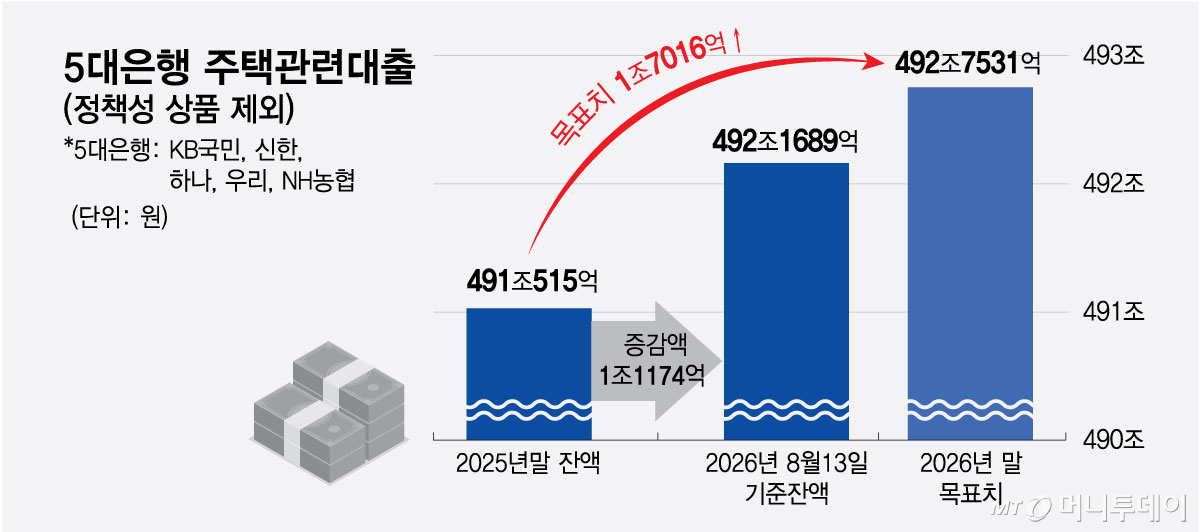
The financial authorities have begun coordinating the allocation of total household loan limits by bank as a follow-up measure to the the 13th policy. The authorities plan to adjust approval ratios for loans to young people and those with low-to-mid credit scores to ensure sufficient supply.
According to the financial sector on the 19th, the Financial Supervisory Service held a "Practical Meeting of Banks on the Second-Half Household Loan Management Plan" at its headquarters this afternoon. Practitioners in charge of household loans from the five major banks (KB Kookmin Bank, Shinhan Bank, Hana Bank, Woori Bank, and NH Agricultural Cooperative Bank), IBK Industrial Bank of Korea, local banks, and KakaoBank attended the meeting.
The meeting discussed plans to adjust total household loan targets by financial institution. Following the financial authorities' decision on the 13th to raise this year's household loan growth rate management target for the entire financial sector from 1.5% to 3.0%, opinions were gathered on how to specifically allocate total limits to each financial institution.
The upward revision of the management target has created additional lending capacity of approximately 30 trillion won for the entire financial sector. However, the full 30 trillion won will not be uniformly allocated as a limit for each bank. The financial authorities plan to set targets by comprehensively considering each bank's first-half household loan handling performance and compliance with existing total limits.
Group loans related to housing supply, such as relocation funds for reconstruction and redevelopment projects and interim and final payment loans for new construction complexes, will be managed separately from the total limit targets of individual financial institutions. Although group loans are included in the overall 3% growth rate target for the entire financial sector, they will not exhaust the limits of individual banks handling them.
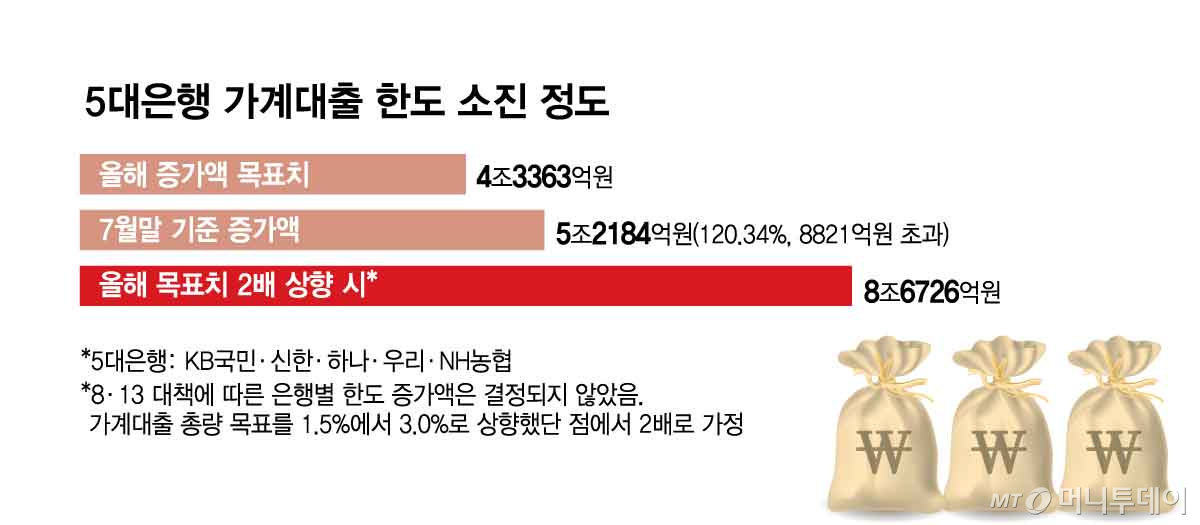
During the meeting today, the authorities conveyed guidelines to aggressively approve loans for those with low-to-mid credit scores and young people. Currently, only 30% of increases in high-interest-rate loans are reflected; attention is focused on whether additional policy measures will follow. Regarding loans for young people, it is understood that the authorities are considering a plan to exclude a certain portion from the total limit for financial products related to youth housing support included in the the 13th policy.
There was also a request to avoid creating so-called "open runs." This appears to reflect awareness of situations where financial consumers seeking mortgage loans through internet banks compete in an "open run" starting at dawn. It is interpreted as a request to increase limits while minimizing inconvenience for genuine demanders.
However, when asked whether group loans would be completely excluded from the total limit target, the authorities replied that they are reviewing the matter. Regarding credit loans, they urged continuous monitoring by the banking sector.
It is understood that before convening today's meeting, the banking sector was requested to submit data on the scale of business sites based on contracted volumes in second-half group loans. The financial authorities are expected to individually notify additional limits for each financial institution soon after gathering demand and opinions from banks today.
The banking sector is highly likely to gradually relax voluntary measures previously implemented to suppress household loan demand as household loan limits increase.
NH Agricultural Cooperative Bank announced just before the meeting that it would resume handling its variable-rate mortgage product "NH Home Mortgage Loan" starting on the 20th. In terms of managing total household loans, new applications for variable-rate mortgages were temporarily restricted since June, but as recent loan balances have fallen within the total limit target, the bank decided to resume handling loans again. An NH Agricultural Cooperative Bank official stated, "There are repayments coming in and capacity has increased, so we are relaxing the measure."
However, it remains to be seen whether this trend will spread across the entire banking sector. KB Kookmin Bank has not yet lifted its reduction of mortgage loan limits per person from 600 million won to 300 million won. Woori Bank continues to maintain a limit of 1 billion won per branch for mortgage loans.
An official at a commercial bank stated, "Rapidly lifting existing restrictions would have too large an impact on the market. If demand suddenly concentrates, it will be twice as difficult to restore the original situation." He added, "We will first wait for the total limits by bank to be finalized and then decide based on observed trends."

 in FINANCE

