

The "memory supercycle (super-boom period)" of Samsung Electronics and SK Hynix is expected to extend further. This follows Nvidia, a key customer of both companies, demonstrating robust demand for AI (artificial intelligence) data centers, with supply shortages projected to continue at least through 2028. In response to surging memory semiconductor (hereinafter "memory") demand, Samsung Electronics and SK Hynix are accelerating capacity expansion.
Earlier, Collette Kress, Nvidia's CFO (Chief Financial Officer), stated during the Q2 earnings conference call for fiscal year 2027 on the 26th (local time) that Vera Rubin is expected to account for about 20% of data center revenue, and FY2028 revenue will grow approximately 70% year-on-year. She added that supply shortages are expected to persist through the end of fiscal year 2028.
Vera Rubin is Nvidia's next-generation AI computing platform, which began production in Yangsan this month. It combines structures such as "Rubin GPU (graphics processing unit)" and "Vera CPU (central processing unit)." Each Rubin GPU is equipped with 288GB of HBM4 (6th-generation high-bandwidth memory), while each Vera CPU is loaded with 1.5TB of LPDDR5X (low-power double data rate). Samsung Electronics and SK Hynix are the core suppliers for both products.
Memory supply shortages are cited as a factor exacerbating Nvidia AI system supply constraints. CFO Kress explained, "Memory supply shortages are a sign of surging demand driving Nvidia's growth," adding that the company is closely cooperating with three major memory suppliers to further expand production capacity. Consequently, global big tech firms are increasingly proposing LTA (long-term supply agreements) first to Samsung Electronics and SK Hynix to secure volumes.
![[Gyeongju=NEWSIS] Reporter Choo Sang-cheol = Nvidia CEO Jensen Huang attended the Asia-Pacific Economic Cooperation (APEC) CEO Summit held at Gyeongju Arts Center in Gyeongju, Gyeongbuk Province on the 31st, where he received HBM4 semiconductor wafers from SK Hynix as a gift from SK Group Chairman and Korea Chamber of Commerce and Industry President Choi Tae-won. (Joint reporting) 2025.10.31. photo@newsis.com /Photo=](https://thumb.mt.co.kr/cdn-cgi/image/f=avif/21/2026/08/2026082713571440422_2.jpg)
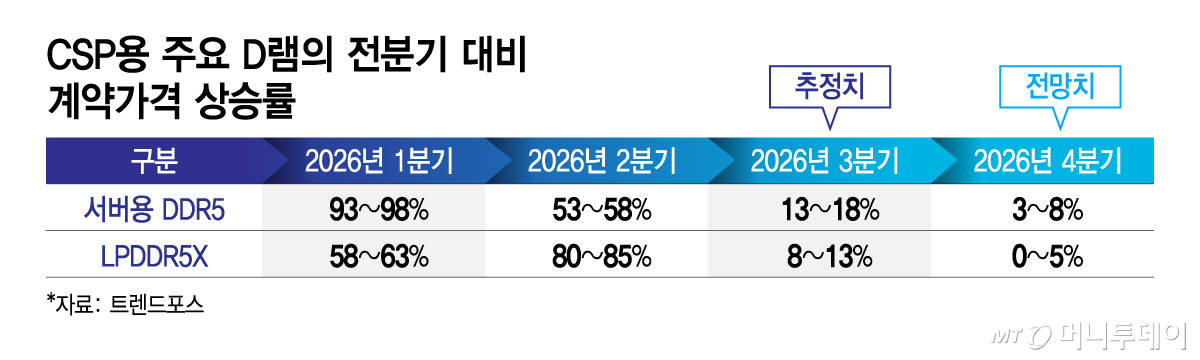
Nvidia expects its gross profit margin, which was about 74% this quarter, to decline to the 71st–72% range in Q4 due to cost pressures from rising memory prices. According to market research firm TrendForce, server DDR5 prices for CSP (cloud service provider) use rose 13–18% compared to the previous quarter in Q3 and are expected to rise an additional 3–8% in Q4. LPDDR5X prices also rose 8–13% in Q3 and are projected to increase by up to 5% more in Q4.
Investment in AI data centers is also expanding. According to Nvidia, infrastructure investment by the top five global hyperscalers (large-scale data centers) is expected to rise from $800 billion (approximately 1,105 trillion won) this year to 1.3 trillion won (approximately 1,795 trillion won) next year. Leveraging this trend, Samsung Electronics and SK Hynix each recorded record-breaking operating profits of 89.5 trillion won and 60.5426 trillion won, respectively, in the second quarter. The combined operating profit consensus estimate for both companies this year reaches 658.4335 trillion won.
Both companies have launched capacity expansion efforts. Samsung Electronics plans to fully operate its P4 (Factory No. 4) in Pyeongtaek, Gyeonggi Province six months ahead of schedule by the end of this year. Construction on P5, which had been halted, resumed last April. The company is also reviewing memory production utilization at the Yongin semiconductor cluster. SK Hynix plans to invest 600 trillion won and 100 trillion won long-term, respectively, for new fab construction at the Yongin semiconductor cluster and Cheongju, North Chungcheong Province. On the 27th (local time), it will hold a groundbreaking ceremony for advanced packaging in West Lafayette, Indiana, USA.
An industry source stated, "As long as global big tech continues AI investments, memory demand will remain at high levels," adding, "Although Samsung Electronics and SK Hynix are expanding production capacity, it is expected to take considerable time for supply to catch up with demand."

 in INDUSTRY

