

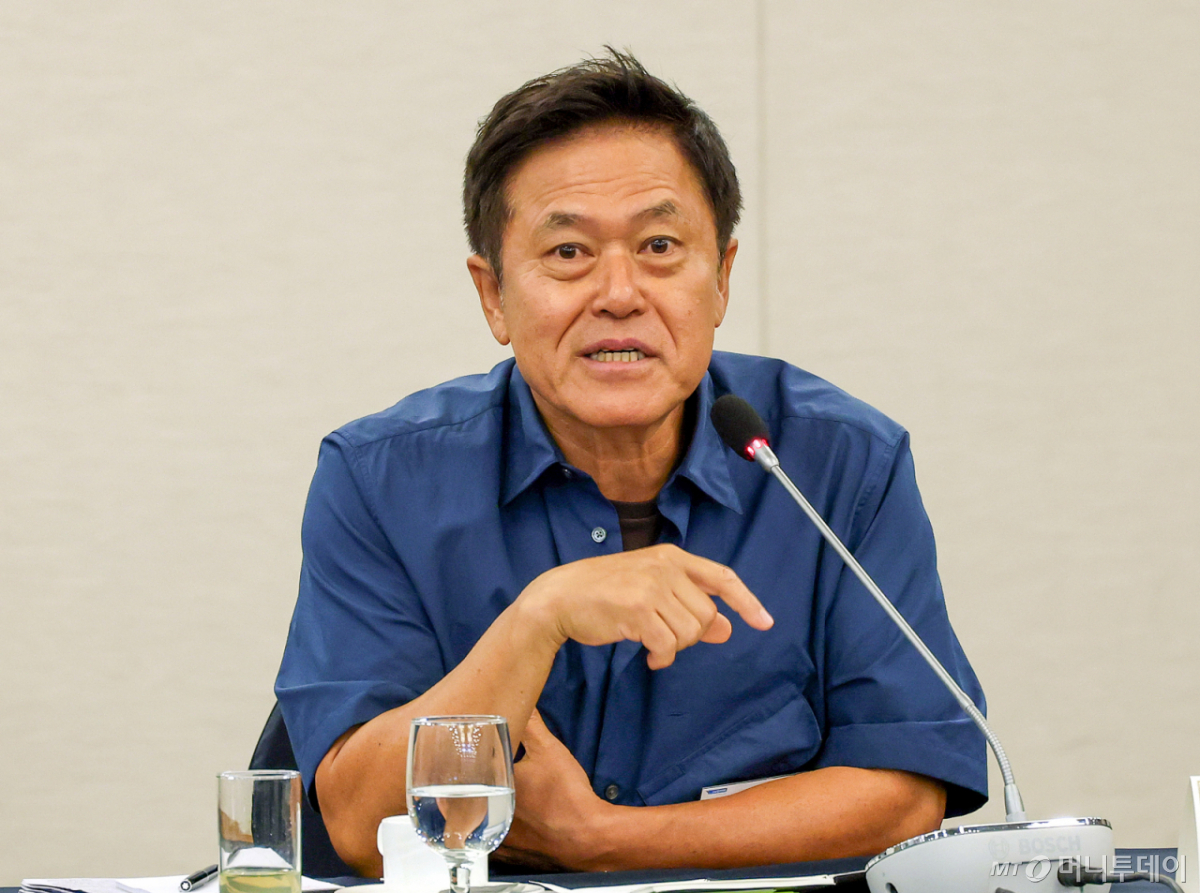
"I hope that the experiences I have gained and felt along the way can be of even a little help to you as you make judgments and choices moving forward."
Park Jung-ho, advisor at Global Korea Insights (GK Insights), sat down with young entrepreneurs who will lead the future and carefully shared his own experiences.
He did not speak of a formula for success or claim that his experience was the correct answer. Rather, he expressed his hope that the concerns and trial-and-error he had personally experienced would serve as a small reference for younger generations living in a rapidly changing era as they seek their own answers.
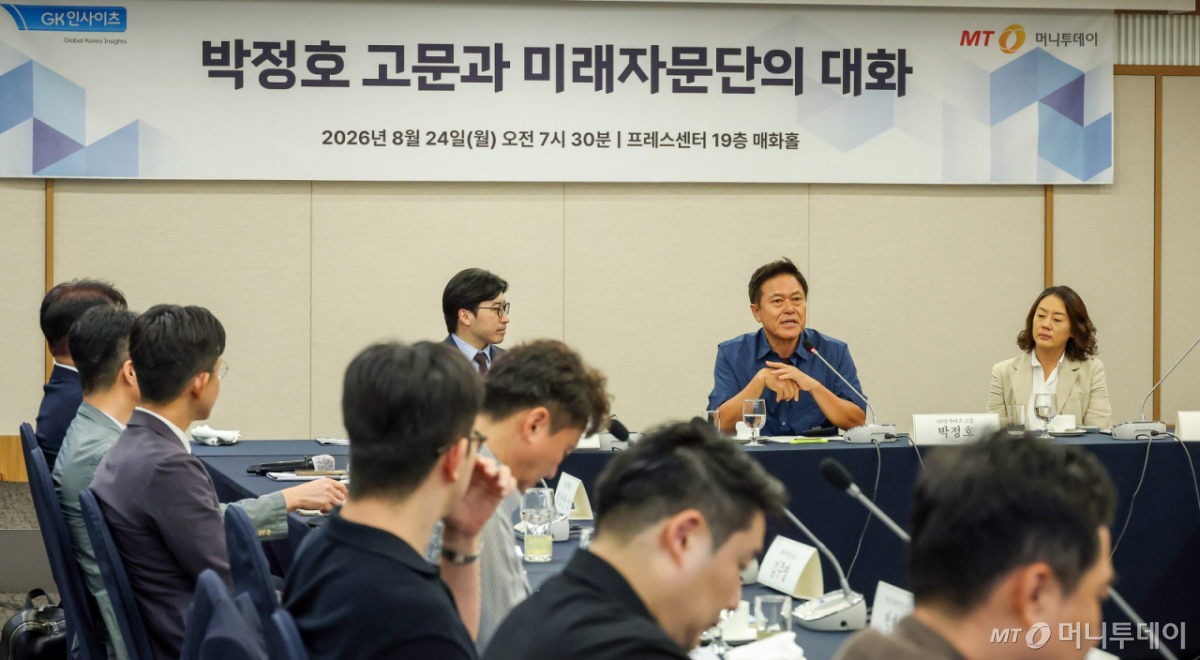
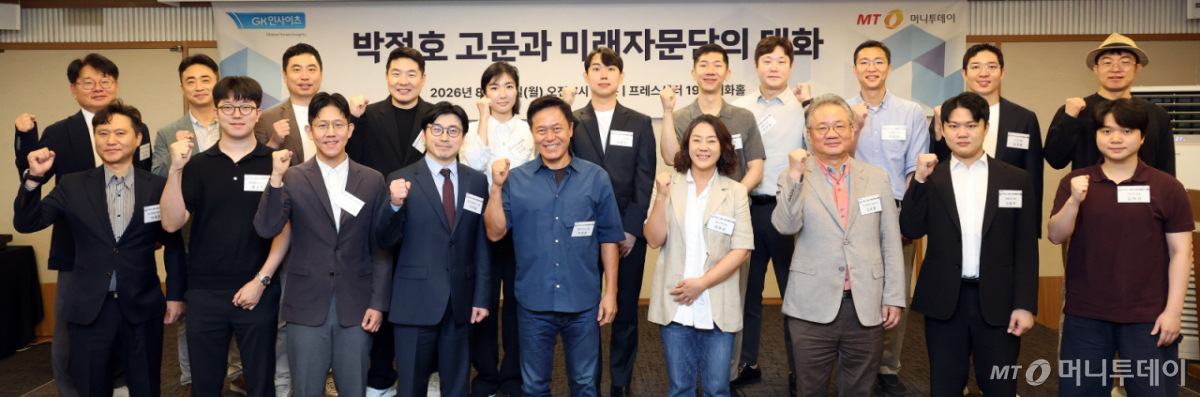
The GK Insights (Lee (President) Baek Yong-ho, honorary chairman of MoneyToday) Future Advisory Board invited Park to lead a 'Dialogue between Advisor and the Future Advisory Board' on the 24th at the Korea Press Center in Jung-gu, Seoul. This was the third such gathering, following former LG Vice Chairman Kwon Young-soo and former Mirae Asset Securities Chairman Choi Hyun-man.
The Future Advisory Board is composed of young entrepreneurs challenging new markets with innovative ideas and technological prowess. Today's session, like others, was less a one-sided lecture and more a dialogue where seniors who have led companies exchanged concerns with juniors who are now building their own enterprises.
Park said, "Those starting ventures nowadays possess far greater courage than those joining large corporations," offering encouragement first to young entrepreneurs who chose new paths despite difficult circumstances.
He then shared several thoughts he felt were important after making countless choices in the corporate world over the past 30-plus years: vision and insight, decision-making amidst uncertainty, and the importance of people.
While explaining his experiences, Park brought up the story of a boat floating on the sea.
"Macro is the wind, and micro is my boat's performance. I have felt many times in life how important that wind is."
It is not enough to simply build a good boat; one must also look at which direction the wind is blowing.
During his 30-plus years in the corporate world, the major trends of the world shifted from the internet to mobile, and then to cloud and AI. There was even a time when he pondered as a university assignment whether cars could be sold via the internet, but now industries that were once unimaginable have become reality.
Park conveyed his belief that while focusing on one's own business and technology is important, it is equally necessary to occasionally step back and observe which direction the world is moving.
However, this did not mean one must follow past success formulas exactly. Rather, he warned against becoming overly dependent on past experiences.
What Park said was necessary to gain insight was 'contemplation.'
In the past, he would tell juniors to read many books, but now the situation has changed. It is not due to a lack of information, but because we live in an era where too much information pours forth.
He explained that knowledge known from the past can unconsciously become the standard for judging the present and may sometimes act as prejudice. Therefore, while continuously accepting new information, it is necessary to take time away from information to think and organize things alone. His long experience is not so much an 'answer' that future generations must accept as-is, but rather a reference material for making new judgments.
Park also shared his experiences regarding the decision-making that young entrepreneurs running companies face most frequently.
Park explained that he categorized the uncertainties he examined before making major decisions into three main areas.
How well do you understand the 'business' you intend to pursue? Can you handle the variables that arise as the scale of business and investment grows? And ultimately, how much can you trust the 'people' who will execute the work? While it would be best to decide only after everything is certain, his experience was that such moments are difficult to encounter in actual management.
Even when deciding on large-scale investments and mergers and acquisitions (M&A) in the past, he said he did not have absolute confidence in all conditions. Although there was uncertainty regarding the future of the industry and the scale of investment, he shared that believing in the capabilities of people who had accumulated technology became an important basis for investment judgments.
Park conveyed his wish that this would serve as a reference for each person to establish their own criteria for what to verify and what to believe in during uncertain moments, rather than presenting it as his own success story.
Reflecting on his long management experience, Park mentioned 'people' many times. He said that while finding good talent is difficult, creating an environment where they can fully display their capabilities was also not easy.
He stated, "Promotion is indeed a reward, but it is not enough." Promotion means taking on greater responsibility and more difficult tasks. Therefore, he explained, one should not think that simply raising job titles provides sufficient motivation. He also reflected that in the process of companies meeting each other, ultimately understanding people's hearts was important.
Speaking of his experiences with M&A and negotiations with global companies, Park said it is necessary to make an effort to understand the other party's history, situation, and what they value most.
"You must move people."
Though a short phrase, this touched upon the thoughts Park wanted to convey to his juniors that day. Regardless of how large a company grows or how fast technology advances, it is ultimately people who make choices, execute actions, and work together.
The dialogue that day was less a lecture passing on one generation's success to the next and more a gathering where seniors and juniors living in different eras shared experiences and concerns. Park also did not present his experience as an absolute answer.
△Look at the major trends but do not lose your own thoughts. △Do not be trapped by past experiences; be able to change your thinking before new facts. △Even when everything is uncertain, find what you can believe in and make a decision. △And throughout all these processes, do not forget people.
The words Park offered to the future generation that day were less an answer of 'this is how you must do it' and more a few experiences shared by a senior who has walked a long path ahead of the juniors following behind.
After the lecture, entrepreneurs belonging to the GK Insights Future Advisory Board actively discussed difficulties they encountered while running their companies with Park.
Kim Ha-gyeong (CEO) of ZDVC (ZD Ventures), an early-stage startup-focused investment firm, asked, "You mentioned there are three types of uncertainty when making decisions (business, scale, talent). Is there a priority order?"
Park replied, "There is no set priority. For example, if someone has a lot of money, they can eliminate uncertainty regarding the scale of investment." He explained that it would likely vary depending on the circumstances of individual investors.
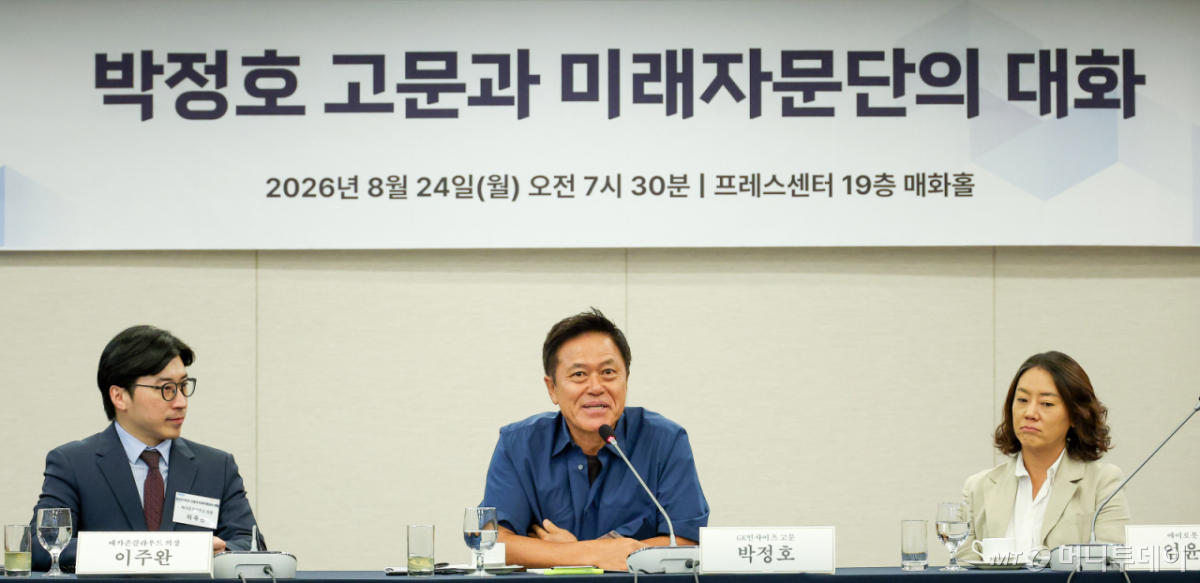
A question also arose regarding how to reward employees to motivate them. Park Geun-u (CEO) of Doctor Noa, an eco-friendly oral health management company, asked, "You said promotion is not the only reward for a general who wins a war; specifically, what should be done?"
Park said, "Regarding rewards, it is not just about giving someone a lot of something; one must look at what can actually motivate that person." He further explained that in cases like venture companies where immediate salary or benefits alone make it difficult to provide sufficient motivation to members, there is a need to consider various reward methods that allow sharing the company's growth and future value with its members.
Park also said, "It was a case of a security company in Czechoslovakia; their cafeteria was so good. (Local) Google's cafeteria was so good that it was to attract talent from there." He added, "Even such seemingly trivial things are very important."
He also advised against trying to forcibly bind an organization expanded through M&A into a single culture. Kim Jun-yeong (CEO) of Apartmentmentary, an apartment interior solution company using IOT (Internet of Things), said, "We were a service company but became involved in manufacturing. There are many combinations between different industries; it is not easy to unite and run in one direction as a group."
Park said, "Why must we force everything into one? While there may be times when effort is needed to unify an organization, the side effects, 'demotivation,' can also be great. If you make an organization into one, it might be slightly positive, but there could be more negative things. Find other ways to achieve harmony between organizations, separate them well, and motivate each individually."
◇ Advisor Park Jung-ho
He graduated from the Department of Business Administration at Korea University and earned a master's degree in business administration from George Washington University in the United States. After joining Seonkyung, the predecessor of SK, in 1989, he served as CEO of SK Telecom, CEO of SK C&C, and Vice Chairman of SK Square and SK Hynix. In particular, he is evaluated as a key figure who led the group's entry into the semiconductor business by spearheading the acquisition of Hynix in 2012. Since then, he has led growth strategies for SK Telecom and SK Hynix, global investments, and portfolio restructuring, becoming a representative strategic and M&A (mergers and acquisitions) expert who contributed to the growth of the SK Group with broad management experience spanning telecommunications, semiconductors, platforms, and investment.
[Profile]
△1963 △Masan High School △Korea University Department of Business Administration △George Washington University Graduate School of Business Administration △SK Telecom New York Office Ji (President) △CEO of SK C&C △CEO of SK Telecom △CEO of SK Broadband △

 in INDUSTRY


