

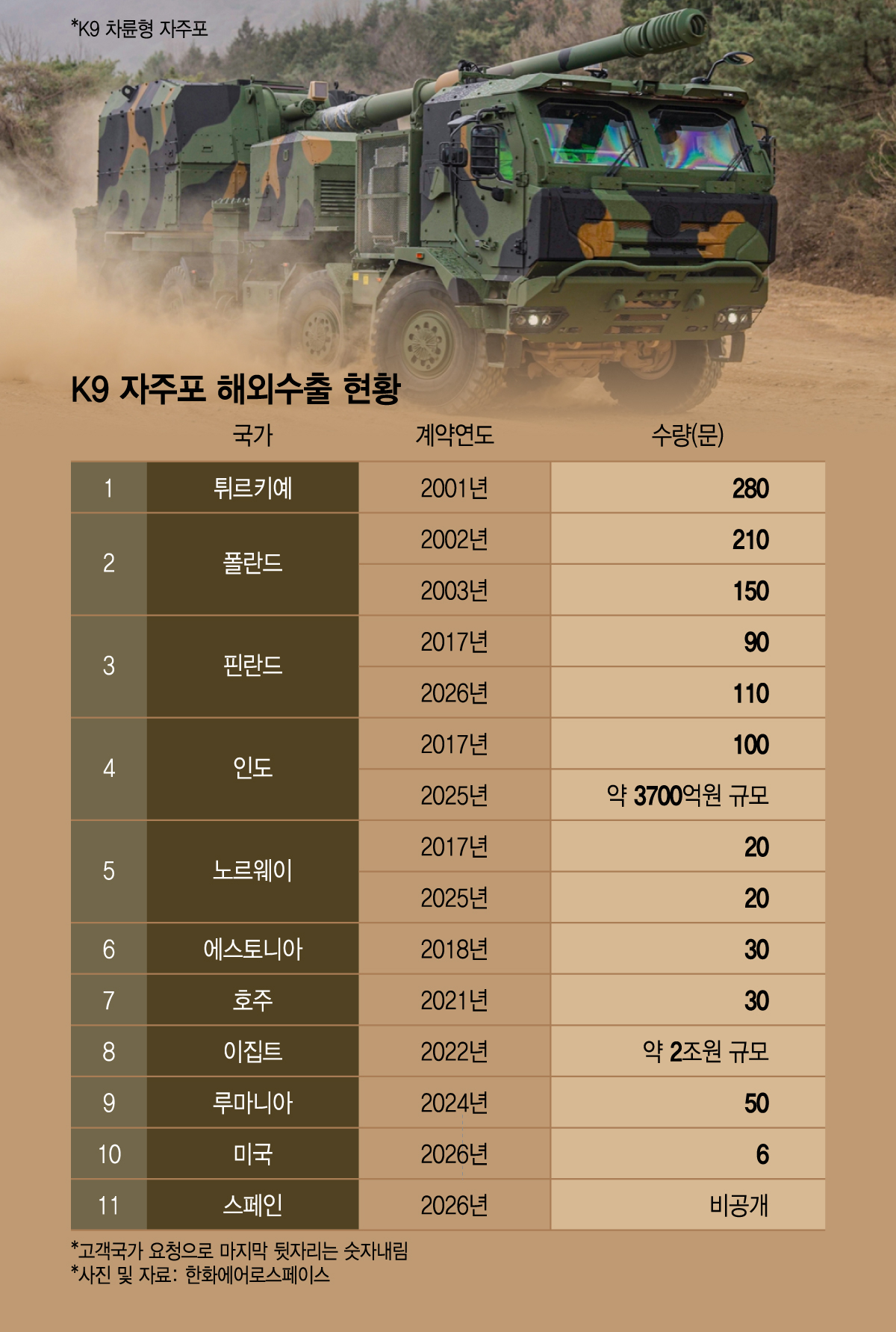
The reason Hanwha Aerospace's K9 self-propelled howitzer has entered the Spanish market for the first time among Western European countries lies in its "localization" strategy. Analysts note that it was not merely about exporting finished products manufactured in Korea, but rather responding to conditions required by various European countries based on cooperation with a local company (Indra). This approach gained traction as nations, following the Russia-Ukraine war, prioritized securing defense supply chains capable of producing and maintaining weapons independently during emergencies. The recent order focused on a model where Indra designs and produces the chassis in Spain based on Hanwha Aerospace's platform, while integrating mission and communication systems.
An industry official explained, "The structure involves not just supplying finished products manufactured in Korea but also having local companies participate in production and system integration." They added, "This is significant as it responds to localization requirements from European countries, including Spain, by strengthening cooperation with local firms."
In fact, cooperation between Hanwha Aerospace and Indra officially began when a binding memorandum of understanding (MOU) was signed in March this year for Spain's self-propelled howitzer modernization project. Although Hanwha Aerospace publicly disclosed in late July that it had signed a basic supply contract worth more than 2.5% of its revenue, the contracting party and project details were not revealed at the time.
This contract is part of a large-scale self-propelled howitzer modernization initiative led by the Spanish Army. Spain plans to invest a total of €4.554 billion (approximately ₩725 billion) to modernize its tracked self-propelled howitzer forces. The project includes the procurement of 128 tracked self-propelled howitzers based on the K9, 120 ammunition resupply vehicles, 11 command and control vehicles, and 21 recovery vehicles. Given that the overall project scale significantly exceeds the execution contract between Hanwha Aerospace and Indra, additional orders are expected as the project progresses.
The expansion of the K9's export market to Western Europe, where countries with their own defense industries and technological capabilities are concentrated, is also significant. Western Europe hosts global defense companies such as LINE Metal, KNDS, BAE Systems, Thales, and Leonardo.
Notably, Spain has recognized the comprehensive competitiveness of the K9 platform—including firepower, mobility, survivability, operational and maintenance efficiency—based on operational experience accumulated in Eastern and Northern Europe. The "K9 User Club," which facilitates sharing of experiences and information among K9 operator nations, is also expected to expand its reach into Western Europe. The K9 User Club is a cooperative framework established by Hanwha Aerospace to build long-term collaborative networks among operator countries beyond mere sales of the K9.
Hanwha Aerospace has already increased localization levels in response to country-specific requirements during the K9 export process. A prime example is the Polish variant K9PL, which is being developed to reflect local requirements and Polish-made subsystems, with plans for future local production. The Krab self-propelled howitzer, utilizing K9 chassis technology, is also a representative case of industrial cooperation combining the K9 platform with local defense technologies. A Hanwha Aerospace official stated, "Regarding this contract, we plan to disclose the contract amount, duration, and other details in accordance with regulations once non-disclosure reasons are lifted."

 in INDUSTRY
