

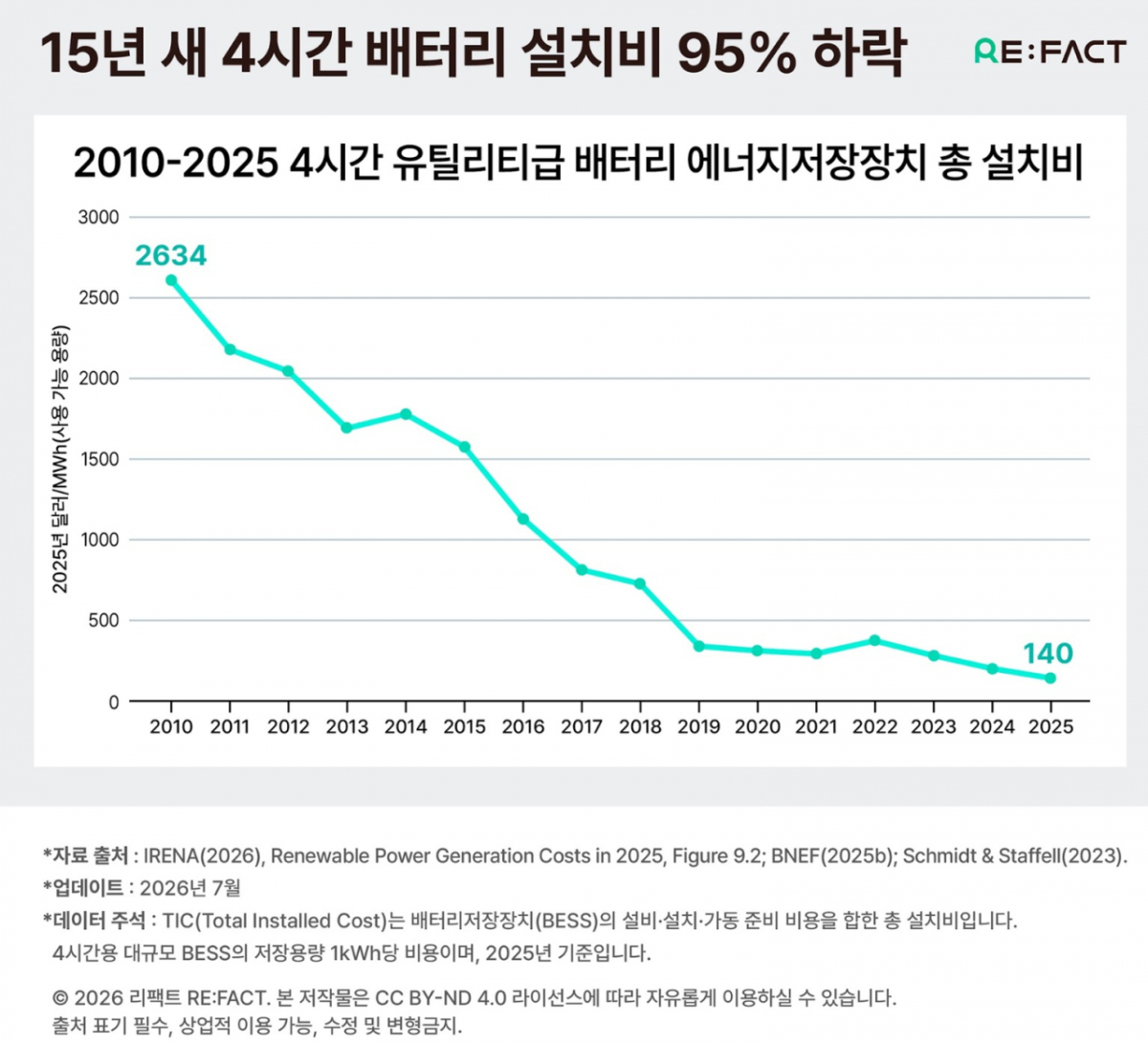
An analysis has concluded that the claim "adding battery energy storage systems (ESS) to renewable energy causes costs to skyrocket" is mostly untrue. This is because both renewable energy generation costs and battery energy storage system (BESS) costs have declined simultaneously, significantly enhancing the price competitiveness of 'solar and wind power combined with BESS' compared to other power sources over the past decade.
On the 7th, RE:FACT, a renewable energy fact-checking platform, derived these findings by cross-verifying studies from the International Renewable Energy Agency (IRENA), the International Energy Agency (IEA), U.S. investment bank Lazard, and Lawrence Berkeley National Laboratory (LBNL) in its report titled 'If you attach batteries to renewable energy, it ends up being expensive? Mostly not true.'
According to IRENA, the price of a '4-hour BESS,' the representative model for utility-scale markets—meaning a battery storage system capable of supplying power at rated output for four hours when fully charged—dropped by 95%, from $2,634/kWh in 2010 to approximately $140/kWh in 2025. In China, which has accelerated policy support for renewable energy and BESS deployment, the price of a 4-hour BESS has already fallen below $70/kWh.
Renewable energy generation costs have also plummeted compared to a decade ago. According to IRENA, over 90% of large-scale renewable energy projects commissioned in 2025 generated electricity at lower costs than the cheapest new fossil fuel power plants in the same region. Over the past 15 years (2010–2025), global average generation costs fell to one-tenth for solar power, from $408/MWh to $44/MWh; onshore wind also declined (from $114 to $33/MWh), as did offshore wind (from $208 to $78/MWh).
The IEA's World Energy Outlook 2025 report similarly estimated that in 2024, solar and wind power generation costs in the United States, European Union (EU), China, and India were generally lower than those of other power sources. The IEA compiled utility-scale solar generation costs at $30–55/MWh and onshore wind at $40–60/MWh across these four markets—levels lower than new nuclear power ($70–165/MWh) or gas combined-cycle plants (excluding the U.S., which stands at $50/MWh), with EU costs at $200/MWh, China at $100/MWh, and India at $90/MWh.
South Korea, while lagging behind the global average, has seen a clear downward trend in solar power generation costs. The generation cost for utility-scale solar projects completed in South Korea in 2025 was $54/MWh—higher than the global average of $44/MWh—but South Korea's solar LCOE in 2025 fell by 36% compared to the previous year, marking the largest decline among the world's top 15 solar markets according to IRENA. A study by Lawrence Berkeley National Laboratory (LBNL) suggested that as large-scale solar (100 MW) LCOE in South Korea drops to $47–48/MWh by 2030, it could become the cheapest power source domestically between 2030 and 2035.
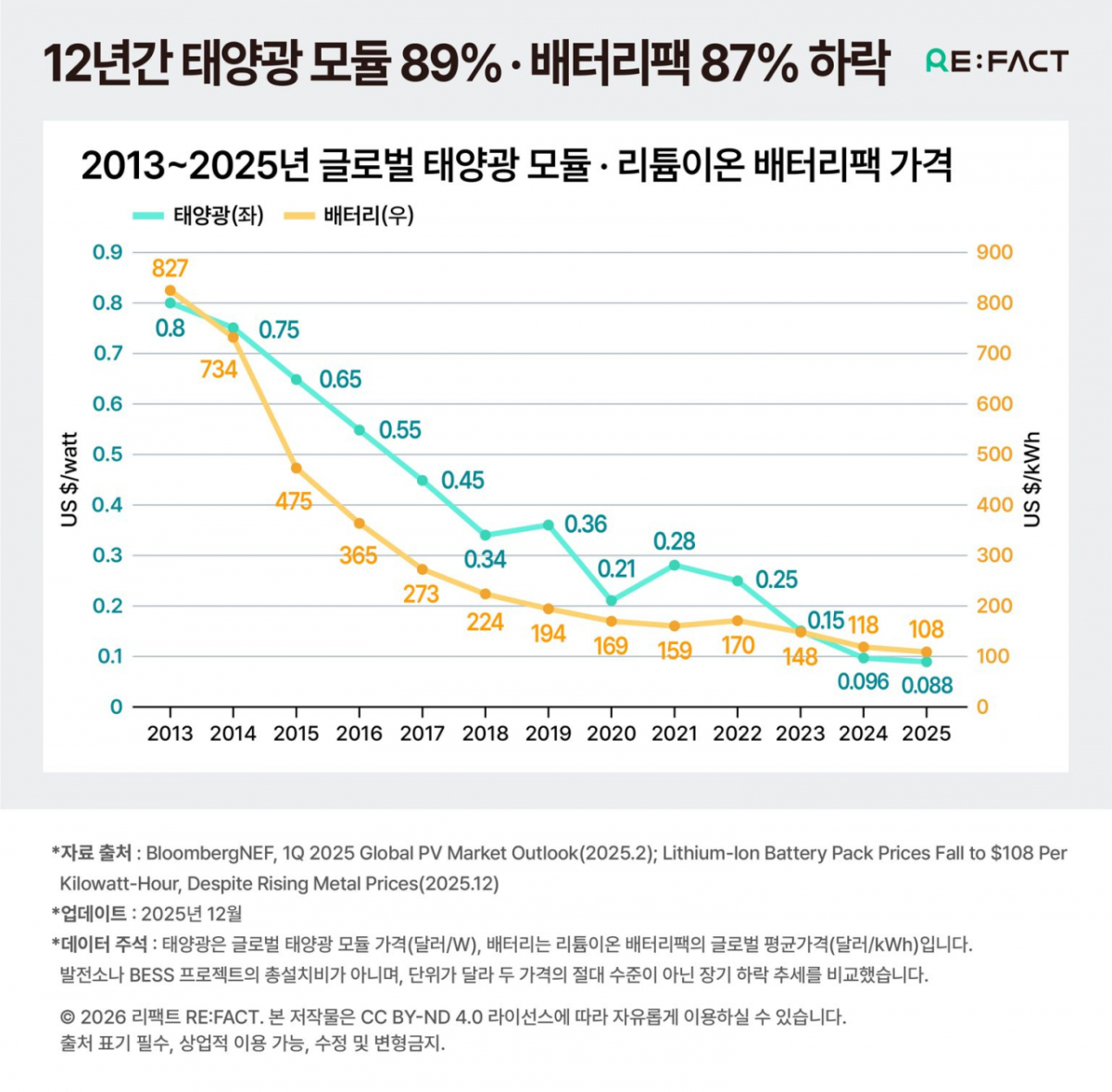
The key factor behind this improvement in BESS and renewable energy economic viability is the significant decline in supply chain costs over the past decade. According to BloombergNEF, solar module prices fell from $0.8/W to $0.088/W between 2013 and 2025, while average lithium-ion battery pack prices dropped from $827/kWh to $108/kWh.
As renewable energy generation costs and ESS costs declined, the economic viability of facilities combining solar power with BESS naturally improved. According to IRENA, in regions with excellent solar irradiance, the cost to meet 95% of annual demand by combining additional solar capacity with a 4-hour BESS fell from over $100/MWh in 2020 to approximately $54–82/MWh in 2025.
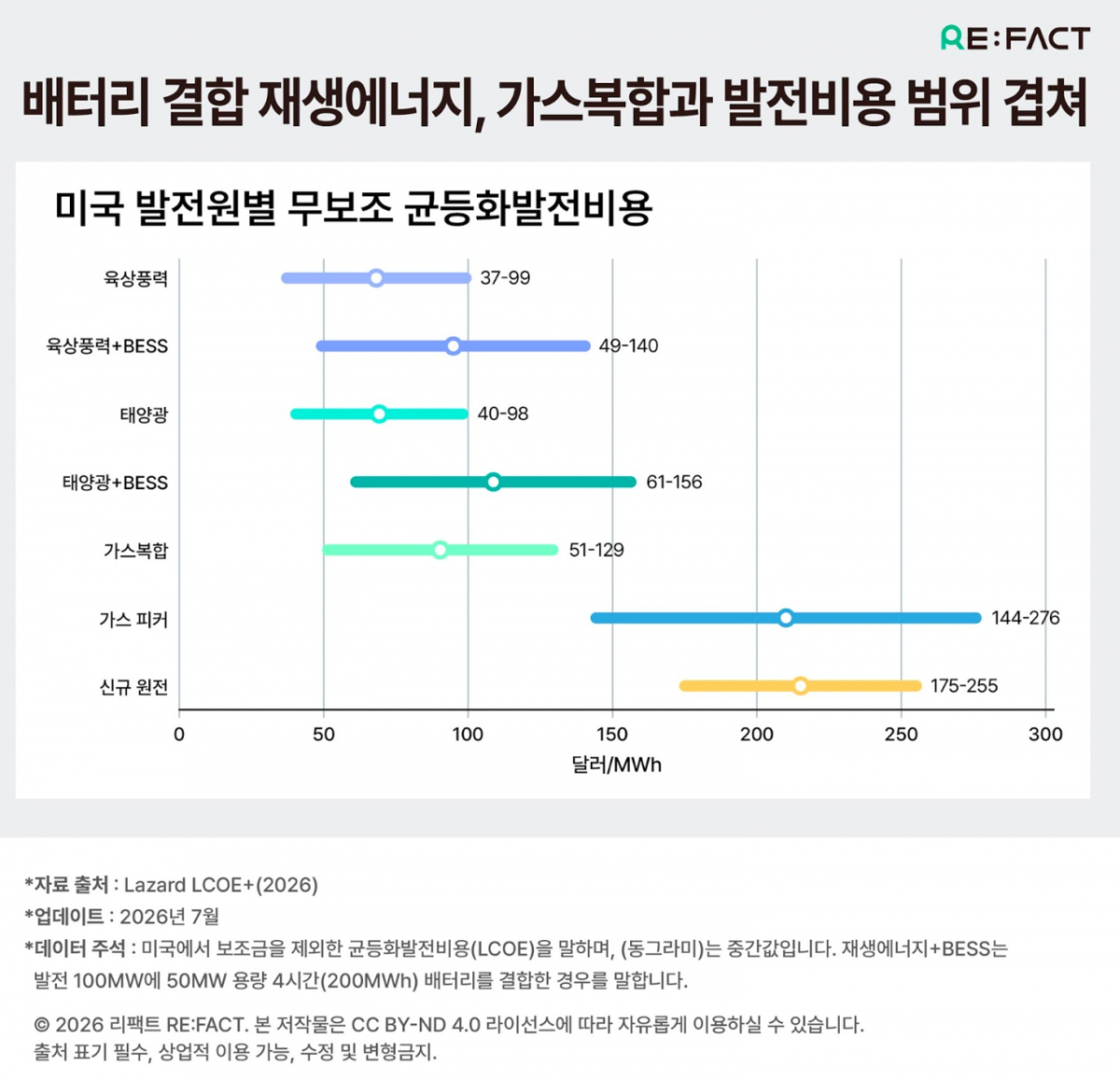
Consequently, the economic viability of power infrastructure combining renewable energy and ESS has improved significantly compared to gas power plants. According to a 2026 analysis of new U.S. power plant costs released by global investment bank Lazard, generation costs for solar + 4-hour BESS (excluding government subsidies) ranged from $61–156/MWh, and onshore wind + BESS from $49–140/MWh—comparable to gas combined-cycle plants ($51–129/MWh). These were also substantially cheaper than gas peaker plants, which operate for short periods during surges in electricity demand ($144–276/MWh).
RE:FACT stated, "It is difficult to assume that combining renewable energy with storage systems inevitably incurs massive costs based on past battery prices." It further clarified, "Based on a comprehensive review of international data and research analysis, the claim that 'combining batteries with renewable energy ultimately eliminates price competitiveness' is mostly untrue."

 in INDUSTRY


