

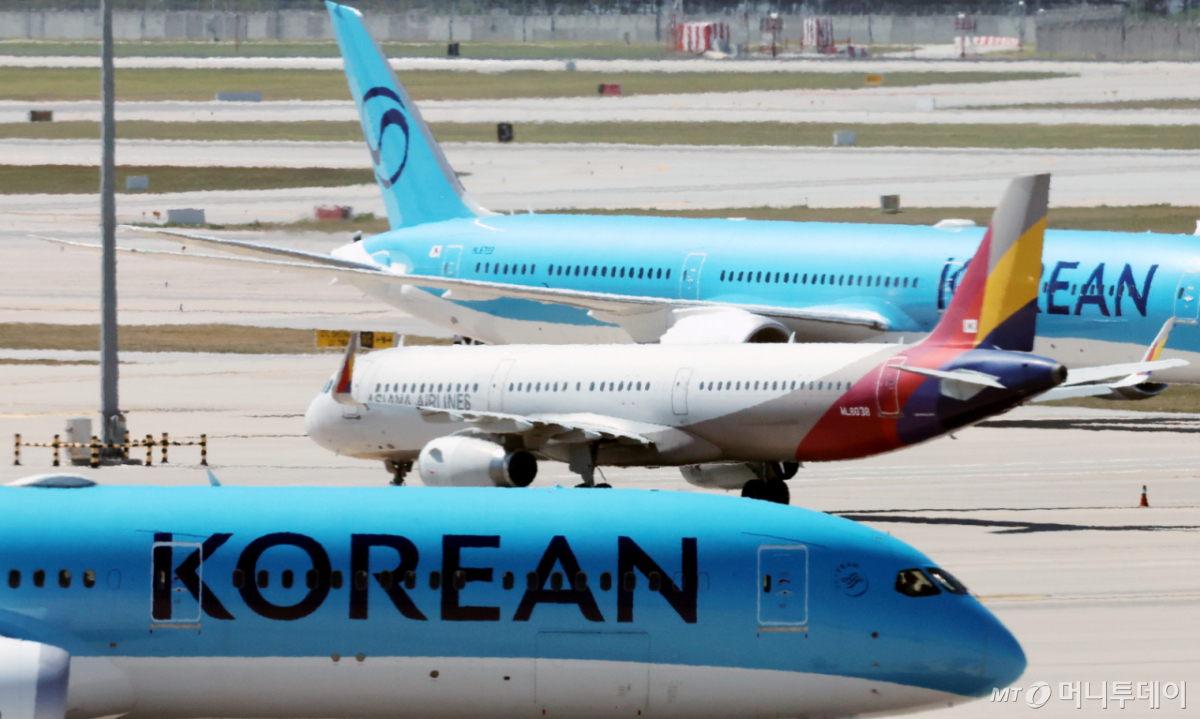
With the launch of Integrated Korean Air just 100 days away, Korean Air is accelerating integration efforts by dispersing overlapping flight schedules with Asiana Airlines and adding new routes. However, concerns are rising that confusion over customer conversion and usage may persist for some time, as approval from the Fair Trade Commission (Korea Fair Trade Commission) for mileage integration has not yet been granted.
According to the aviation industry on the 7th, Korean Air and Asiana Airlines are scheduled to officially launch as 'Integrated Korean Air' on December 17. Both companies approved the merger at their respective board meetings and extraordinary shareholders' meetings last month. They are currently proceeding with follow-up procedures, including creditor protection processes and necessary permits for integrated operations.
Korean Air is reviewing plans to reorganize routes and flight schedules after integration. The approach involves dispersing flights from both companies that previously departed at similar times to the same destinations into morning and afternoon slots. By adjusting time slots that were redundantly scheduled as the two airlines competed for passengers, the intention is to broaden travelers' schedule options.
Another option under review is reallocating aircraft on routes currently operated two to three times a week to enable daily service. Surplus aircraft are planned to be deployed on new destinations or high-demand routes. A Korean Air official explained, "With a wider range of route and schedule choices, travelers will be able to plan their trips more diversely and conveniently."
However, the major issue of mileage integration has remained unresolved for over seven months since the submission of a revised proposal. Last December, Korean Air was required by the Korea Fair Trade Commission to supplement plans such as bonus tickets and seat upgrades, and it submitted a revised plan on January 22 this year, but final approval has still not been granted.
According to the integration plan disclosed by Korean Air, Asiana Airlines miles earned from actual flights will be converted to SkyPass miles at a 1:1 ratio. Miles accumulated through credit cards and hotel partnerships will be converted at a rate of 1:0.82. This means that 10,000 partnership miles will become 8,200 SkyPass miles.
Existing Asiana Airlines miles will continue to operate separately for 10 years after the merger, allowing customers to choose whether to convert them. Even without conversion, they can be used for bonus tickets and seat upgrades on all Korean Air routes according to existing deduction standards. The validity period of individual miles will remain unchanged, while newly accumulated miles after integration will be unified under SkyPass.
It is understood that the Korea Fair Trade Commission is examining whether actual usage opportunities are sufficiently guaranteed alongside the mileage conversion ratio. Even if the number of routes and flight frequencies increases, benefits for mileage users could be limited if bonus seats remain insufficient.
However, if approval is not granted by the merger deadline, the two companies' mileage systems may continue to operate separately. Korean Air also specified in its securities filing the possibility of maintaining and operating each existing system until the time of approval. In this case, customers wishing to combine miles accumulated across both airlines to purchase tickets will have to wait until conversion becomes possible. The company will inevitably bear the cost burden of separately operating computer systems and personnel.
An aviation industry official stated, "The later the integration plan is finalized, the more difficult it will be for travelers to make plans regarding mileage conversion and usage." They added, "While thoroughly reviewing consumer protection measures, the conversion criteria and implementation schedule should be finalized before the merger so that customers can understand and utilize the new system."

 in INDUSTRY
