

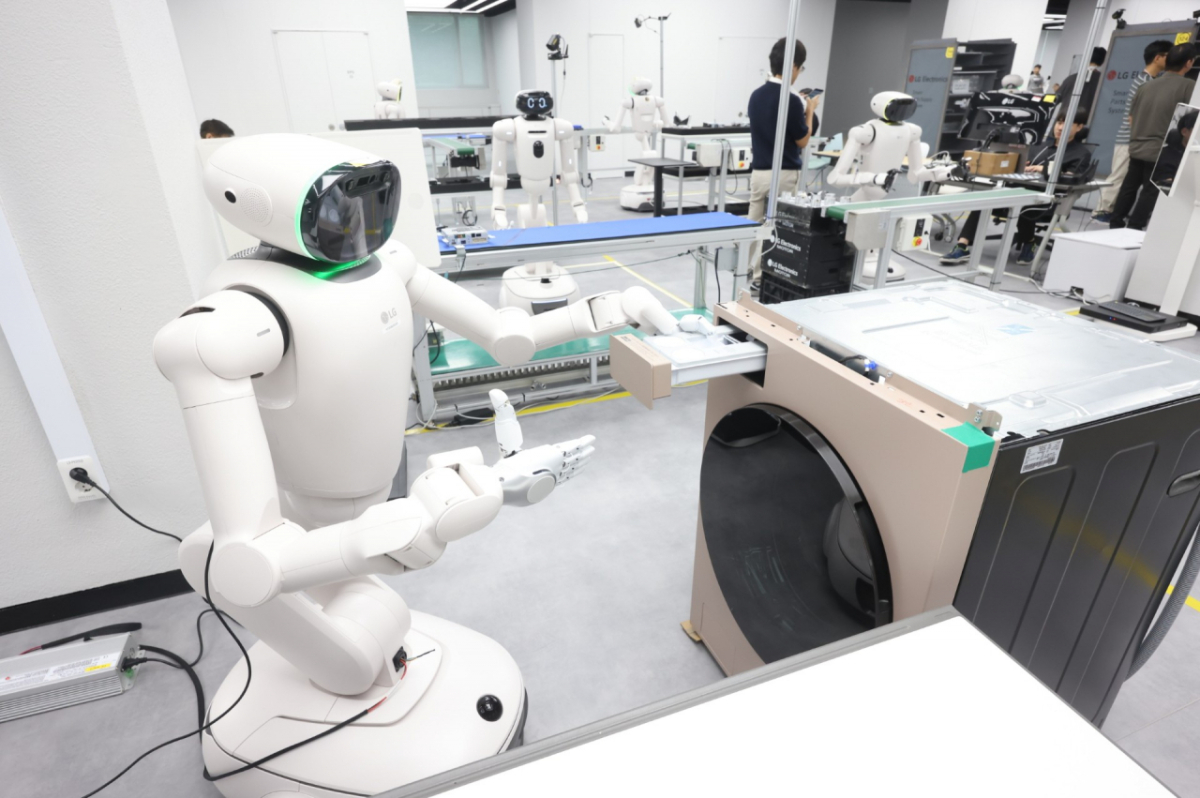
LG Electronics is strengthening its sensor strategy focused on 'spatial understanding' beyond individual sensor performance to enhance the competitiveness of home robots in the era of physical AI (artificial intelligence). The core lies in combining sensor information scattered across appliances and robots to grasp the state of spaces and people, then connecting this to actions and result verification.
Kim Sung-hyuk, Executive Vice President at LG Electronics, stated on the 15th during a keynote speech at the '11th Advanced Sensor Forum' held at the Chosun Palace Hotel in Gangnam-gu, Seoul, that "it is most important to evolve into sensors that not only are good but can also drive actual actions and create customer value." He further emphasized that physical AI should not be limited to individual robots but must be expanded to entire spaces such as homes and factories. If information obtained through sensors is processed and translated into action, the space itself can be viewed as a robot. When an entire home operates as a single recognition system, home robots can utilize information already accumulated within that space.
The foundation for securing spatial information lies in appliances installed inside homes. LG Electronics has applied radar sensors to air conditioners to determine whether people are present, their actions, and the structure of the space. The 2026 model LG Whisen air conditioner analyzes user location, usage patterns, and space using radar sensors to adjust airflow according to the situation. When it detects that no one is present, it automatically switches to 'away mode,' reducing unnecessary energy consumption. This means the sensor does not merely collect information but judges the surrounding situation and even changes the product's control method. LG Electronics aims to expand this approach so that spatial information grasped by each appliance is not used only within individual products but is shared with other appliances or robots.
When spatial information is shared, the recognition method of home robots also changes. Currently, robots directly recognize their surroundings using high-performance sensors, but if they utilize information held by other devices, there is less need to rely solely on their own sensors to grasp all situations. Executive Vice President Kim cited examples where appliances inform robots of locations to move to, presenting a mutually complementary information-sharing model.
However, simply collecting sensor information from multiple devices is insufficient. It is necessary to understand what each piece of information signifies within the home. For instance, beyond the fact that a sensor detected an odor, it must also grasp the situation that a pet has defecated. LG Electronics' proposed sensor strategy is that only by understanding the 'state' of the space can AI predict future events and decide on necessary actions.
After understanding the space, action and verification are required. Once AI decides on a necessary action, the robot performs it, and then verifies whether the actual result occurred as intended. Executive Vice President Kim explained that even if sensors are highly accurate, they are meaningless if the situation is not properly understood or if the action does not lead to the desired outcome. He stated, "We must expand the observation range from a sensor perspective and reuse sensors so that various devices and spaces can share each other's states." He added, "Creating a loop where all of this is verified, leads to action, and can be improved again will determine the success or failure of robots and physical AI, including home robots."
Meanwhile, about 150 industry, academic, and government officials, including Korea Siemens, attended the forum to discuss trends in industrial and physical AI and AI-sensor convergence technologies.

 in INDUSTRY
