

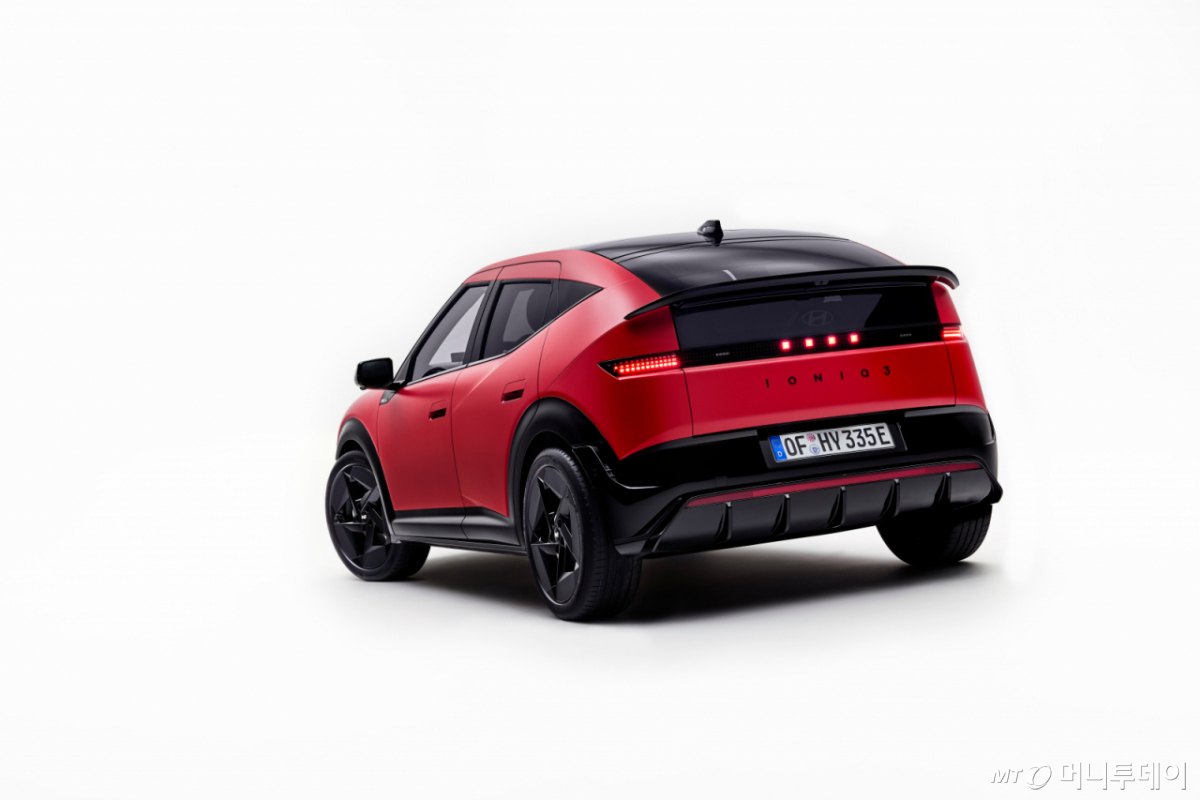
Hyundai Motor is expanding sales of small electric vehicles in Europe. With demand confirmed by compact models such as Inster (domestically known as Casper Electric) and Kona Electric leading European EV sales, the company plans to target the B-segment (compact) market, Europe's most competitive battleground, with the upcoming Ioniq 3 launching this month.
According to industry sources on the 17th, Hyundai Motor's retail sales in Europe from January to August totaled 251,420 units, a 10.8% decrease compared to 281,860 units during the same period last year. In contrast, EV sales rose by 4.7% to 53,210 units. The share of eco-friendly vehicles, including HYBE Lead and electric cars, reached 55.6%, up 8.3 percentage points (p) from 47.3% in the same period last year. Starting at 51.6% in January, the figure remained above 50% for all eight months this year. Europe is the market among Hyundai's key regions where electrification transition is progressing most rapidly.
EV demand is concentrated in compact segments. Of the 53,210 EVs sold from January to August, Inster and Kona Electric accounted for 39,479 units, representing 74.2% of the total—a 4.1 percentage point increase from 70.1% a year ago. Inster sales surged 24.1% year-on-year to 21,523 units, making it Hyundai Motor's top-selling EV model in Europe. Meanwhile, mid-size and larger models like Ioniq 5 and Ioniq 6 recorded only 7,979 and 1,711 units sold, respectively.
Hyundai Motor plans to boost sales by introducing the compact electric SUV Ioniq 3 in the future. The B-segment market targeted by Ioniq 3 accounts for approximately 15% of total European demand, making it the largest and most competitive battleground. Alongside mid-size vehicles, this segment is considered one of the two pillars of the market and is experiencing the fastest electrification transition. This is why Hyundai Motor has launched its first compact model under the dedicated EV brand Ioniq in this category.
The target was set aggressively. Hyundai Motor plans to launch the Ioniq 3 starting this month, aiming for sales of 20,000 units by year-end and over 40,000 units annually from next year. Previously, the company had announced a goal to increase European EV sales from approximately 116,000 units last year to more than 420,000 units by 2030; Ioniq 3 is expected to be the first step in achieving this expansion.
Expectations for the European market are also reflected in production investments. Hyundai Motor invested 250 million euros (approximately 40 billion won) at its Izmit plant in Turkey to establish a dedicated EV body line and an integrated high-voltage battery system, with construction beginning in mid-September. Hyundai Motor Group Chairman Chung Eui-sun personally visited the factory at the end of July to inspect production readiness.
Competition is fierce. According to the European Automobile Manufacturers Association (ACEA), the new car market across the European Union (EU), European Free Trade Association (EFTA), and the United Kingdom grew by 6.1% in the first half of the year, reaching 7.23 million units. However, Hyundai Motor's registered vehicles decreased by 8.7% to 243,828 units. Its market share fell to 3.4%, down 0.5 percentage points. During the same period, Chinese EV makers BYD and Chery Automobile increased sales by 145.5% and 305.8%, respectively.
An industry executive stated, "Although Hyundai Motor's overall sales in Europe have declined, the company is responding swiftly during the electrification transition." He added, "Compared to Chinese EVs, both pricing and product competitiveness remain strong, so we expect the targets will be achieved."

 in INDUSTRY
