

Chinese home appliance companies are expanding local production overseas and upgrading product quality, prompting Samsung Electronics and LG Electronics to highlight AI (artificial intelligence) and home appliance connectivity as key differentiators. Both companies aim to maintain a gap with Chinese firms by shifting from simple hardware specifications to software-centric home appliance ecosystems.
According to the home appliance industry on the 18th, Chinese firm TCL recently completed construction of an annual production capacity of 1.4 million units for high-end air-cooled refrigerators in Thailand and has begun trial production. The freezer line with an annual capacity of 300,000 units, which started operations earlier this year, is also running at full capacity. This reflects a significant expansion of overseas local production capabilities to meet rising global demand.
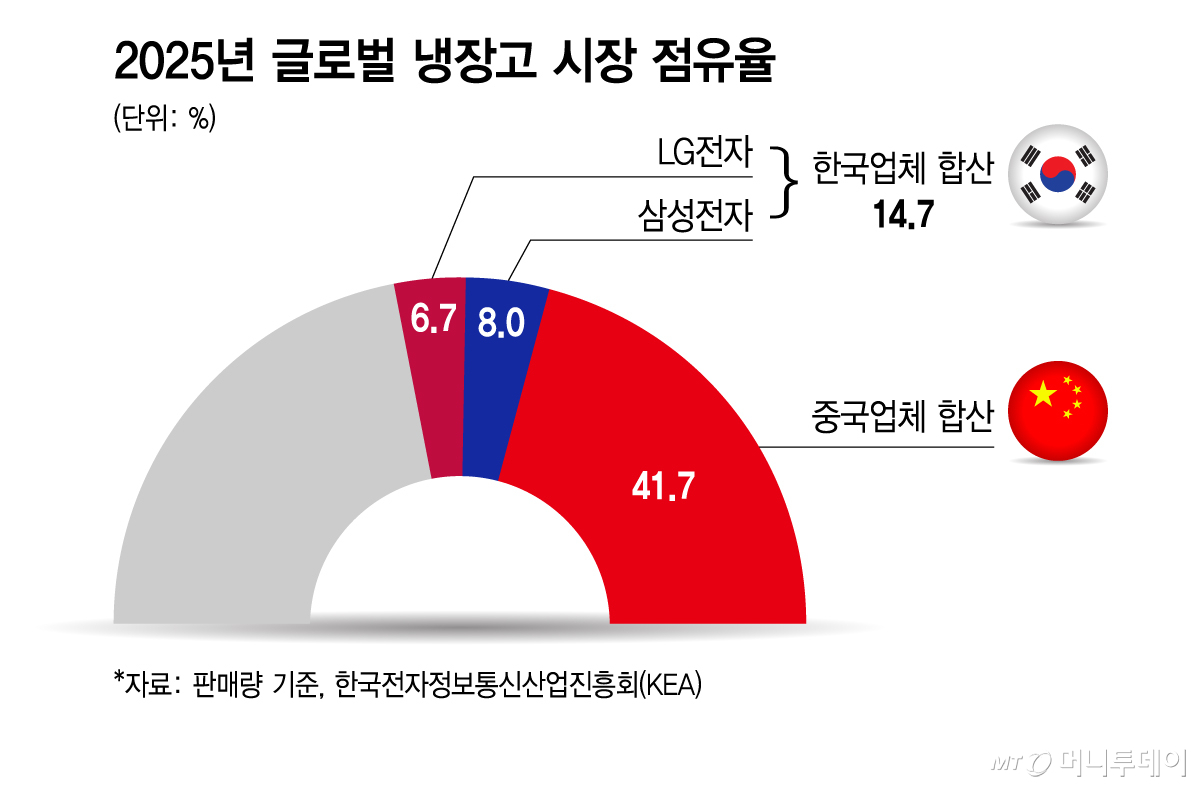
Chinese companies are already overwhelming Korean firms in terms of volume in the global market. According to the Korea Electronics and Information Technology Industry Association (KEA), the combined market share of Chinese companies in the global refrigerator market last year reached 41.7% based on sales volume. This figure is three times the combined share of Samsung Electronics (8.0%) and LG Electronics (6.7%), totaling 14.7%.
Alongside expanding production capacity, Chinese companies are also changing their competitive strategies. Moving away from previous approaches that relied on price and volume, they are raising product quality and expanding into the mid-to-high-end market segment. China's leading home appliance company Haier showcased wine refrigerators with automatic temperature adjustment based on wine type and AI refrigerators that recognize ingredients and suggest recipes at the Milan Design Week in April.
As Chinese companies' pursuit has expanded to include mid-to-high-end products, Samsung and LG are also moving beyond product performance to differentiate user experience. Samsung Electronics positioned its "Bespoke AI" refrigerator combined with SmartThings as a central hub for the AI home. The 2026 model features "AI Vision" based on Google Gemini, enhancing capabilities to autonomously recognize and manage internal ingredients. It also offers smart functions that recommend recipes based on stored ingredients and transmit them to connected cooking appliances.
LG Electronics has also strengthened AI functions that learn user patterns to maximize product performance and efficiency. "AI Fresh Care" analyzes refrigerator door opening frequency and usage time to perform concentrated cooling before meal preparation and optimizes compressor operation during low-usage periods via "AI Saving Mode." Additionally, LG is expanding connectivity with other appliances through the AI home hub "ThinQ ON," while applying LLM (large language model)-based AI voice recognition to its ultra-premium brand "LG Signature."
The reason both companies are betting everything on AI and connectivity is clear. As Chinese companies improve performance in mid-to-high-end products and increase overseas production, maintaining a gap through simple premium hardware specifications or design alone has become difficult. Ultimately, instead of hardware elements like refrigeration performance that China can quickly catch up on, software with continuous post-purchase updates and ecosystem connectivity between home appliances have emerged as the new battleground.
An industry executive stated, "Chinese companies are not only competing on price but also improving quality and expanding local production overseas, rapidly widening the competitive arena against Korean firms." He added, "For domestic companies, the key challenge is to create differentiated value centered on AI and home appliance connectivity that consumers can directly experience in daily life, going beyond simply launching high-priced products."

 in INDUSTRY
