

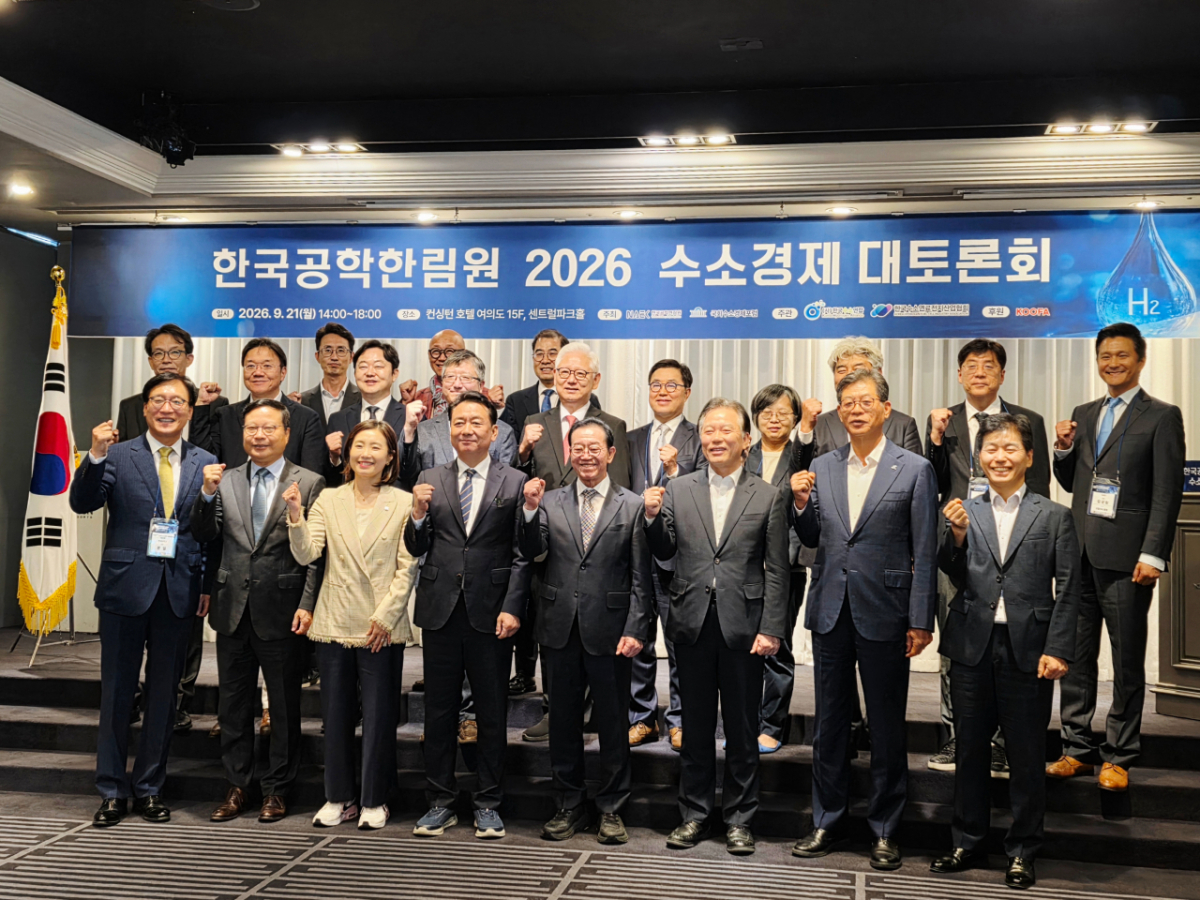
Domestic hydrogen materials, components and equipment companies voiced the need for government infrastructure support to foster the hydrogen industry, along with a "gradual expansion" of green hydrogen (hydrogen produced using renewable energy) production.
Lim Man-gyu of Iljin HLee Sol-ru-seu (CEO)urged at the 'Hydrogen Economy Grand Debate' organized by the Korean Academy of Engineering and the National Assembly Hydrogen Economy Forum on the 21st at the Kensington Hotel in Seoul Yeouido that "to foster the hydrogen industry and create demand, large-scale hydrogen supply infrastructure with high accessibility for users must be proactively installed and continuously expanded under government leadership."
Iljin Haisolus is a company that manufactures hydrogen storage tanks and systems required for hydrogen vehicles. As the domestic hydrogen market remains in its early stages and requires large-scale, long-term investment, it has primarily called for strengthened policies such as government infrastructure support centered on major corporations. This time, however, mid-sized materials, components and equipment companies joined the call with a unified voice, marking a significant development.
Lim (CEO)further argued that "initially, production should be flexible by including gray and blue hydrogen, and the share of green hydrogen production should be gradually expanded by utilizing various methods such as leveraging idle solar power."
Hydrogen is categorized into gray, green, pink, and blue based on production methods and environmental friendliness. Among these, green hydrogen produced using renewable energy such as solar and wind power is the most environmentally friendly but suffers from high production costs. The industry points out that to create an initial hydrogen market, it is necessary to encourage the production of gray and blue hydrogen before green hydrogen.
Other debate participants at the event also reached a consensus on the need to expand hydrogen into a "core pillar" constituting the national energy system alongside consistent government promotion of hydrogen policies.
Lee Gwang-jae, Chairman of the National Assembly Budget and Accounts Special Committee (Democratic Party of Korea member), delivered a keynote speech titled "The Era of Energy Daejeon Transformation: How to Prepare for National Strategy," stating that "energy policy has been drifting with each change in administration" and emphasizing that "consistent policy without wavering is crucial." Lee Gwan-young, Director of the Clean Hydrogen Storage and Utilization Strategy Research Team at the Korea Institute of Science and Technology (KIST), presented on "Completing the Energy System: Hydrogen," noting that "the greater the expansion of renewable energy, the larger hydrogen's role will be" and predicting that the government's promoted 'Three Mega Projects' would become hydrogen's first major customers.
Meanwhile, during the panel discussion following the main presentations, high clean hydrogen production costs and uncertain demand were identified as obstacles to market expansion. Additionally, key challenges were raised regarding how to balance domestic hydrogen production capacity with overseas imports and roles, and how to address initial market price gaps. In the mobility (transportation) sector, opinions emerged that both the stagnation in passenger hydrogen vehicle adoption and the low profitability of charging stations must be addressed simultaneously.

 in INDUSTRY
