

RoboTiZ, which has launched production expansion targeting an annual output of 10,000 humanoid units, has partnered with NVIDIA to unveil practical work technologies for 'AI Sapiens.' The company is accelerating preparations for Yangsan by securing artificial intelligence (AI) learning technologies that enable robots not only to walk and run but also to perform diverse tasks such as recognizing and grasping objects in actual industrial settings.
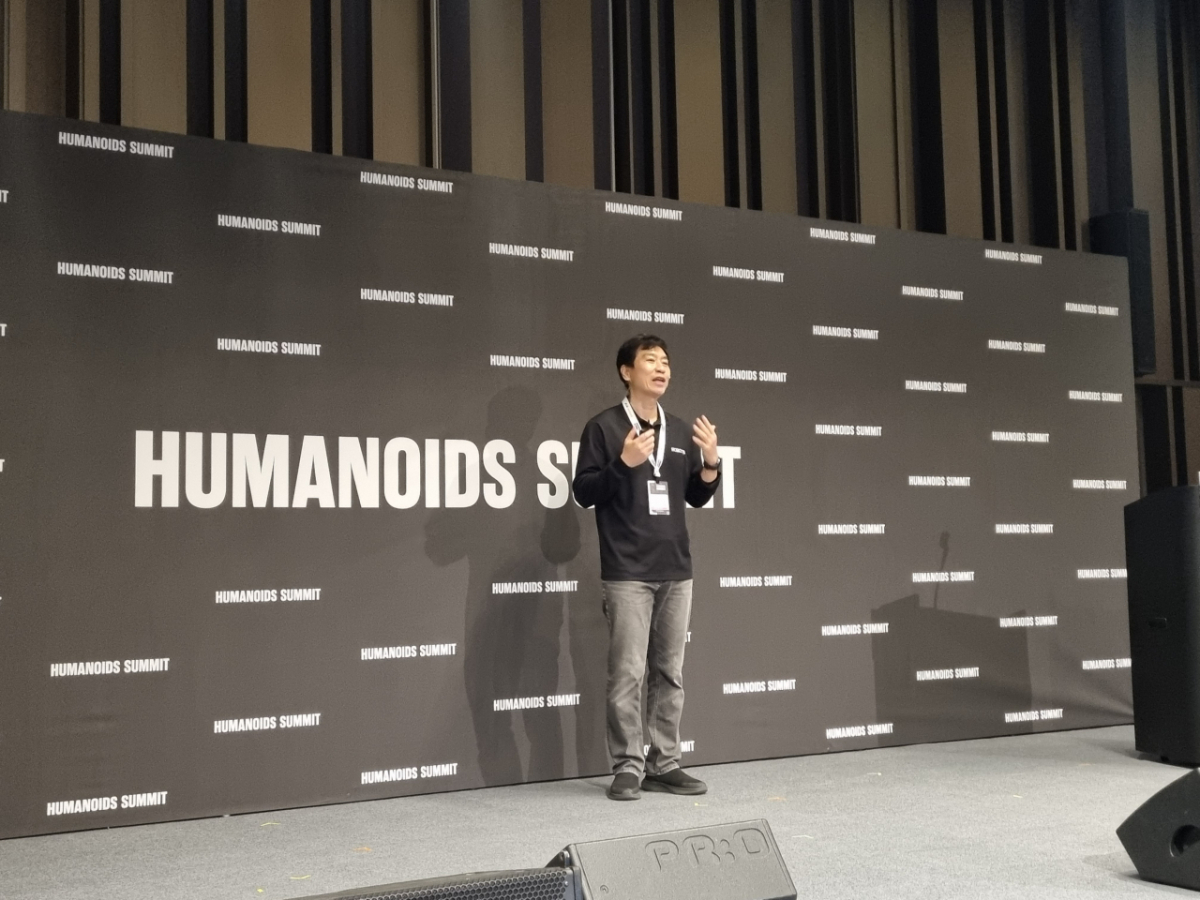
On the 22nd, at 'Humanoid Summit Seoul 2026' held at COEX in Seoul, RoboTiZ announced its open humanoid platform strategy and showcased AI Sapiens and AI Worker learning technologies utilizing NVIDIA's software stack. AI Sapiens is an open-type humanoid platform developed by RoboTiZ based on its proprietary actuators, designed to allow external developers to utilize and expand both hardware and software. NVIDIA also unveiled the latest robot foundation model 'Isaac GR00T 1.7' and development directions for the next-generation 'GR00T 2.'
Kim Byung-soo, CEO of RoboTiZ, presented a vision to grow humanoid robots into platforms similar to smartphones. He explained that while automating 100 tasks previously required 100 different types of robots tailored to each task, the advancement of AI now enables a single robot to perform multiple tasks.
To achieve this, RoboTiZ is pursuing an 'open humanoid' strategy that opens not only humanoid hardware but also environments for simulation, data, AI model utilization, and operating software. In an experiment where university students were provided with only robots and open-source code without separate training, the system implemented various movements such as dancing, handstands, and crawling within one month.

The company also unveiled AI learning technologies required for actual work. RoboTiZ secured 268 data samples of remote-controlled robots grasping objects to train its AI model but explained that in real-world environments, the robot mistakenly identified its own hand shadow as an object.
Instead of moving the robot hundreds of times again to collect new data, the company added 300 synthetic data samples by using NVIDIA's 'Cosmos Transfer' to alter lighting and backgrounds in existing videos. After retraining with both real and synthetic data, the robot's ability to respond to shadows improved, and it began exhibiting behaviors such as dropping an object and then attempting to pick it up again.
As the number of Humanoid Yangsan units increases, this learning efficiency is expected to become increasingly important. Acquiring actual work data for each robot individually requires equipment, operators, time, and space. RoboTiZ is also utilizing methods that extract movements from human videos or text, train simultaneously in thousands of virtual environments, and then apply the results to actual robots.
NVIDIA also proposed a 'data pyramid' strategy that combines real robot data, simulation and synthetic data, and human work data. The latest GR00T 1.7 focuses on enhancing versatility by learning tasks performed by humans in various locations, avoiding specialization in specific environments or tasks alone.
The goal is to create a 'generalist-specialist' robot that broadly understands multiple tasks while maintaining high precision in individual tasks. NVIDIA is developing technology to apply AI intelligence not only to humanoid robots with bipedal locomotion but also to various forms such as wheeled robots, without tying the AI to a specific robot body.
The next step involves enabling robots to predict the outcomes of their actions in advance. NVIDIA plans to release an early access version of the next-generation robot foundation model 'GR00T 2' within several months. Based on the concept of 'learning through imagination,' this approach allows robots to decide their next actions by predicting not only situations they experience before their eyes but also how the surrounding environment will change after their actions.
RoboTiZ aims to begin full-scale production of AI Sapiens from next year and expand the Humanoid Yangsan scale to an annual level of 10,000 units. The company's Humanoid Yangsan strategy involves building a software ecosystem where a single robot can quickly learn multiple tasks alongside mass production of hardware.

 in INDUSTRY

