

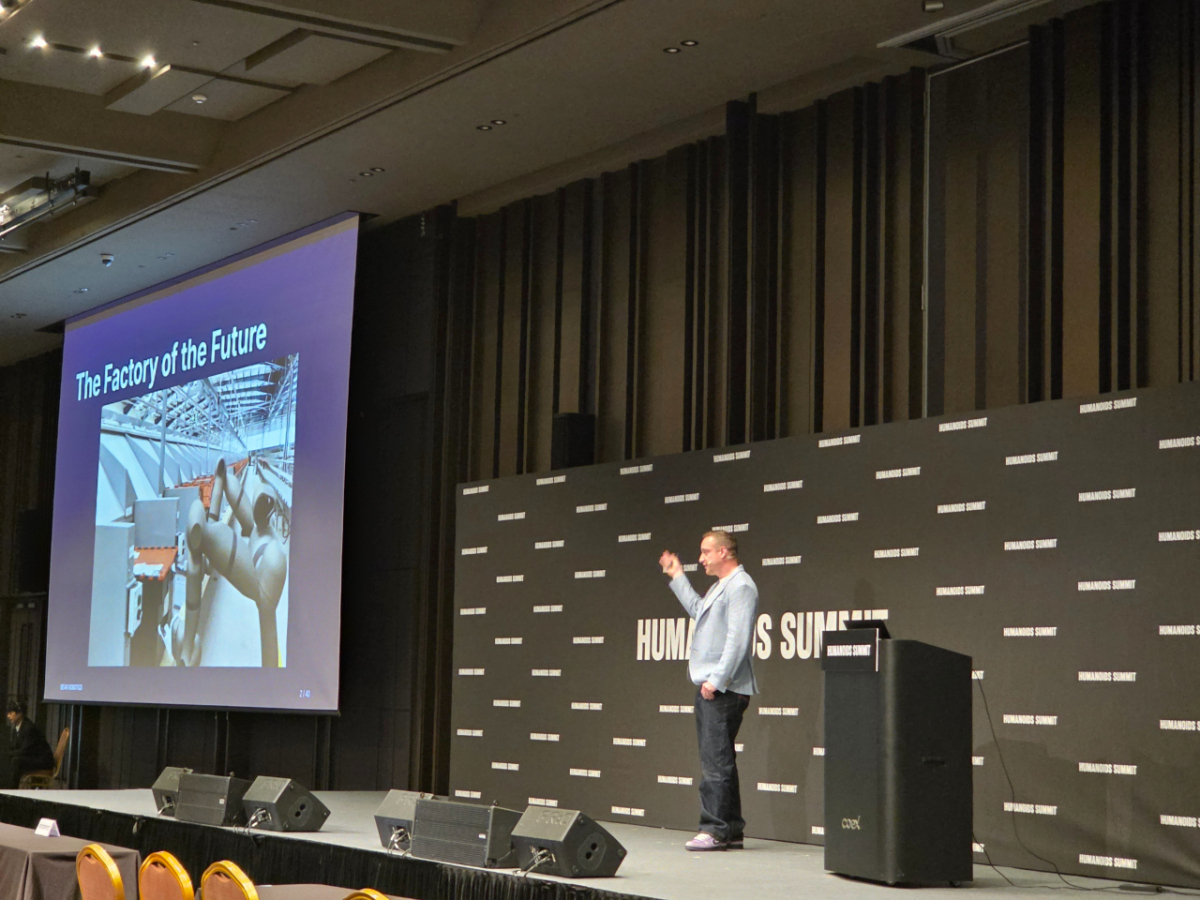
LG Electronics' robot subsidiary, Bare Robotics, cited 'operational experience on-site' as a condition for deploying humanoids on an industrial scale. The plan is to leverage its deployment and operational capabilities built through serving robots and AMRs (autonomous mobile robots) to target factories and logistics sites with humanoids.
Brennan Pierce, CRO of Bare Robotics, stated at the keynote speech of "Humanoid Summit Seoul 2026" held at COEX in Gangnam-gu, Seoul on the 23rd, that "what many humanoid companies lack is on-site experience." He added, "Bare Robotics has supplied 16,000 robots worldwide over nine years, with a cumulative delivery count reaching 93 million deliveries." On this day, CRO Pierce presented under the theme "The Factory of the Future: Introducing Humanoids at an Industrial Scale." This event, hosted by U.S. venture capital (VC) firm ALM Ventures, was held in Korea for the first time this year.
CRO Pierce divided the growth stages of robot companies into three categories: a stage performing single tasks, a stage carrying out production work during 8-hour shifts, and a stage deploying multiple robots simultaneously. He said, "It took Bare Robotics one year to reach the single-task stage, three years to perform shift work, and five years to achieve large-scale deployment." He noted, "Humanoids are still in the pilot phase; while they can operate for eight hours, they cannot be left unattended."
CRO Pierce explained that 80% to 90% of humanoid software is identical to existing AMRs. This means the cloud infrastructure built over nine years, including remote updates and customer-specific settings, will be almost entirely applied to humanoids as well. The lower body of the humanoid was also designed with wheels utilizing an AMR platform. CRO Pierce stated, "Wheeled models are much safer around people than leg-based walking methods."
Actual on-site application cases were also revealed. At a recycling facility in Germany, a pilot operation was conducted to pack sorted beer bottles into boxes. The success rate for picking up bottles is 99%, and the success rate for placing them down is at the level of 94%. CRO Pierce remarked, "With 24 bottles per box, errors occur roughly once every three or four boxes, which is not a level acceptable to customers." He added, "Since foundation models have not yet reached Yangsan quality, error recovery actions were coded directly." He then predicted, "We expect to reach 100% within a few months."
Bare Robotics plans to showcase humanoids, AMRs, and humans working together on loading and unloading tasks at customer sites within one to two months. For the next year, the focus will be primarily on picking up boxes, moving them, and loading and unloading them onto AMRs. CRO Pierce said, "Existing AMRs had limitations in utilization because humans had to place items on them," adding, "When humanoids load and unload items, it also increases opportunities for AMR sales."
Bare Robotics is a serving robot company established in Silicon Valley, U.S., in 2017. Last year, LG Electronics acquired a 51% stake in Bare Robotics, making it a subsidiary, and integrated all commercial robot businesses centered around the 'Chloe Robot' with Bare Robotics. Recently, Bare Robotics has been pursuing external fundraising of up to 400 billion won, and the possibility of listing on the U.S. NASDAQ is also being discussed.

 in INDUSTRY
