

While the global smartphone SoC (System on Chip) market is contracting, competition in the premium AP (Application Processor) market is intensifying. In addition to incumbent leader Qualcomm, MediaTek is accelerating its push into the flagship (top-tier product) market, increasing the burden on Samsung Electronics, which is leveraging its 2-nanometer (nm; nm = one-billionth of a meter) Exynos chips.
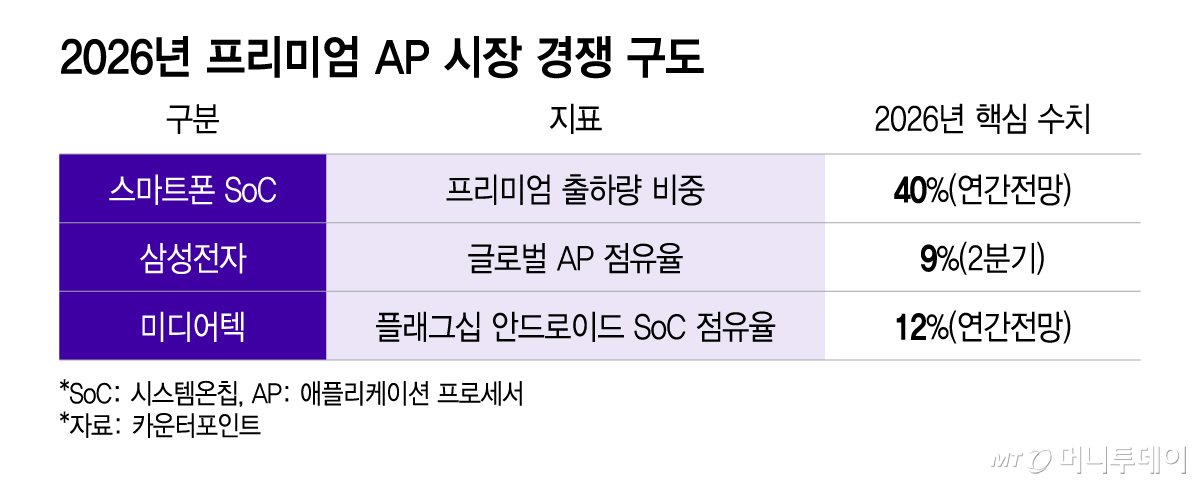
According to Counterpoint Research on the 7th, global smartphone SoC shipments this year are projected to decline by double digits compared to the previous year. Conversely, the share of premium products in total smartphone SoC shipments is expected to expand from 30% in 2024 to 40% this year. Despite the overall decrease in shipments, the growing proportion of high-value products is elevating the importance of the premium market for AP manufacturers.
Samsung Electronics is also moving to increase the share of Exynos. In the global smartphone AP market, Samsung Electronics' market share rose by 3 percentage points (p) from 6% in the second quarter of last year to 9% in the second quarter of this year. The company's strategy is to expand its in-house AP share by equipping flagship models such as the Galaxy S27 Ultra with 2-nanometer-based Exynos chips.
Although Samsung is recovering Exynos' market share, the competitive environment remains challenging. This is because Qualcomm maintains a strong position in the premium Android AP market, while MediaTek is rapidly expanding its scale. MediaTek's market share in flagship Android SoC shipments is projected to rise from approximately 5% in 2022 to 12% this year. Revenue from its flagship Dimensity product line has also increased by roughly fivefold since 2022. As MediaTek expands its presence in high-end products beyond the mid-to-low-price market centered on shipment volume, the competitive arena with Samsung is expanding into the premium market.
The next-generation product set to continue this trend is the Dimensity 9600 Pro. The price of the Dimensity 9600 Pro, which utilizes TSMC's 2-nanometer process—the world's leading foundry (semiconductor contract manufacturing) firm—is reportedly up to $220. This is the highest price among MediaTek's flagship SoCs to date. The product supports LPDDR6 (Low Power DRAM) memory and UFS 5.0, and features a dual NPU (Neural Processing Unit) architecture. Devices equipped with this chip include the Vivo X500 Pro series and the Oppo Find X10 Pro Max.
As MediaTek's premium offensive intensifies, the importance of not only Exynos' own competitiveness but also the 2nd-nanometer foundry process used to produce it grows for Samsung Electronics. Increased Exynos adoption in flagships could simultaneously help expand System LSI sales and secure 2-nanometer production volumes at Samsung Foundry's Yangsan site. Meanwhile, MediaTek is expanding its premium market based on TSMC's 2-nanometer leading-edge process. For Samsung, it has become urgent to stabilize Exynos' performance and yield and increase its adoption in Galaxy devices to create a virtuous cycle linking "design" and "foundry."
In the industry, there is a prevailing view that securing leadership in premium APs will be a watershed moment determining the overall recovery of Samsung Electronics' System LSI and foundry business performance. An industry official stated, "In a situation where growth in the smartphone market is slowing, securing competitiveness in premium APs is crucial," adding, "For Samsung, stably improving the performance and yield of next-generation Exynos to increase its flagship adoption rate will be an important test for enhancing not only System LSI but also foundry order competitiveness."

 in INDUSTRY
