

A historic wave of orders is sweeping the global shipbuilding industry. While order performance in South Korea remains strong, concerns are mounting as China's pursuit intensifies and labor-management conflicts pile up.
According to the shipbuilding industry on the 8th, new vessel orders worldwide from January to September this year totaled 145 million GT (a unit of vessel volume). Based on the nine-month cumulative figure alone, the number of order contracts signed ranks third in shipbuilding history on an annual basis. Factoring in new orders for the fourth quarter, industry observers expect this year to record the second-highest level of new orders since 2007.
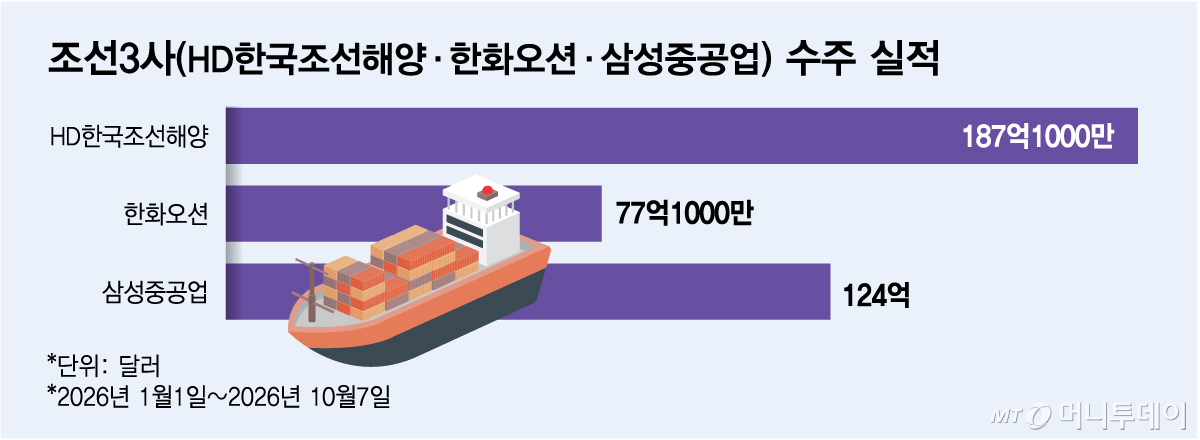
Order indicators for South Korea's shipbuilding sector are also showing strong performance. As of the 8th, the cumulative order value for HD Hyundai Heavy Industries, Samsung Heavy Industries, and Hanwha Ocean this year reached a total of $38.82 billion (approximately 52 trillion won). By company, HD Hyundai Heavy Industries, the industry leader, achieved $18.71 billion, fulfilling 80.3% of its annual order target. Samsung Heavy Industries met 89% ($12.4 billion) of its target of $13.9 billion. Hanwha Ocean has not disclosed its annual target, but it secured contracts worth $7.71 billion, a 22% increase in order value compared to the same period last year.
While the numbers suggest a boom, underlying risks exist. First, the gap in orders with China is widening. Based on cumulative orders from January to September, South Korea's market share fell to 14%, down from 20% last year. In contrast, China's share rose to 80%, up from 67% the previous year. The pursuit by China is also intensifying in LNG (liquefied natural gas) carriers, a key vessel type for South Korea's Big Three shipbuilders. China recorded a market share of nearly 40% in LNG carrier orders this year, narrowing the gap with South Korea (60%).
Labor risks are also holding the industry back. Among the Big Three shipbuilders, HD Hyundai Heavy Industries and Hanwha Ocean, excluding Samsung Heavy Industries, have yet to conclude their wage negotiations. The labor and management sides at HD Hyundai Heavy Industries reached a tentative agreement after overnight talks, but the proposal failed to clear the hurdle of a union member vote on the 2nd. Initially aiming to settle wage negotiations before the Chuseok (Korean Thanksgiving) holiday, they ultimately failed to reach an agreement. With the rejection of the tentative agreement, further negotiations between labor and management have become unavoidable, yet no negotiation schedule has been set as of now.
Hanwha Ocean is facing not only wage negotiations with its direct-employment union but also conflicts with subcontractor unions. Hanwha Ocean's labor and management sides have agreed to continue daily negotiations after the Chuseok holiday to accelerate talks, but they have yet to reach even a first tentative agreement with the direct-employment union. In addition, six individuals, including Kang In-seok Ji (Chairman), head of the Metal Workers' Union Geoje-Tongyeong-Goseong Shipbuilding Subcontractor Branch, are conducting a high-altitude protest by occupying cranes and factory roofs near the Geoje facility. They demand that the Wellive branch, composed of workers from subcontractors responsible for shipyard catering and facility management, be included as a party to collective bargaining. Recently, the court also ruled in favor of these subcontractor branches, making negotiations between Hanwha Ocean and the subcontractor unions unavoidable.
The issue is that the shipbuilding industry is one where orders and production are closely linked. For shipbuilders, it is crucial not only to secure order contracts but also to build and deliver vessels according to set deadlines. An industry official said, "In a situation where the backlog of orders is growing rapidly, any production disruptions could lead to increased burdens regarding process delays and deadline management."

 in INDUSTRY
